Sign In to Your Account
Subscribers have complete access to the archive.
Sign In Not a Subscriber?Join NowHARLEM HOMECOMING
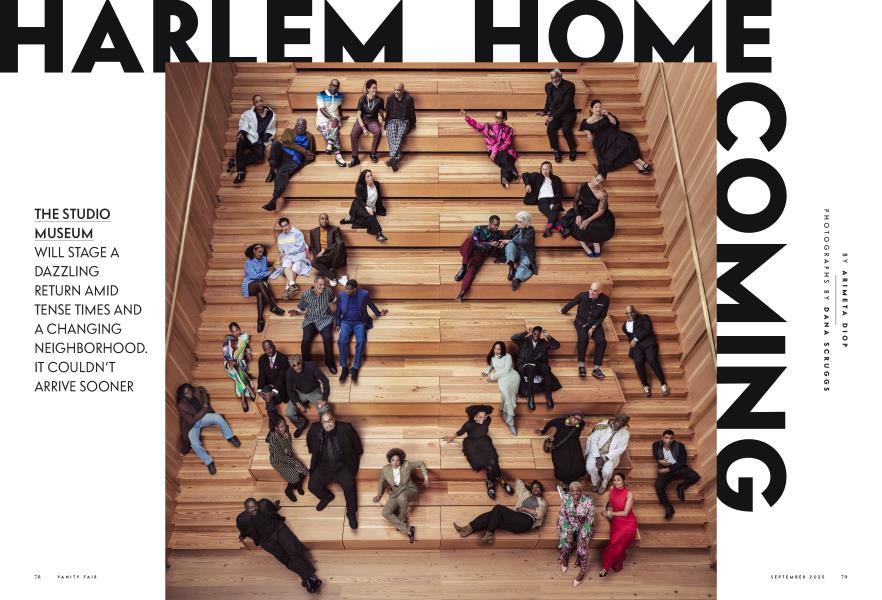
THE STUDIO MUSEUM WILL STAGE A DAZZLING RETURN AMID TENSE TIMES AND A CHANGING NEIGHBORHOOD. IT COULDN'T ARRIVE SOONER
ARIMETA DIOP
ON A WEEKNIGHT in April, the Studio Museum in Harlem hosted a sort of alumni gathering. The institution, which opened in a loft in 1968 and has grown to become the preeminent space for Black art in New York City, has been physically shuttered since 2018 as a new building, its first purpose-built space, was constructed. It was still a few months before doors would open to the public, but a select group of artists with ties to the museum were gathered for an artist party. There was Julie Mehretu, Manuel Acevedo, Mickalene Thomas, Jordan Casteel, Candida Alvarez, and Xenobia Bailey—each one a former Studio artist in residence.
The museum's ability to assemble such a potent group of talent helped make clear what's been missing from the New York cultural landscape in the seven years its doors have been closed. Though the Studio's curatorial team has maintained satellite programming during construction over a years-long partnership with MoMA PSi in Queens and historic parks in the area, including Morningside and Jackie Robinson Park, the lack of a physical Studio Museum has been palpable for artists, the art world, and Harlem residents, many ofwhom have tapped longtime director Thelma Golden on the shoulder during her walks to Pilates or at the dry cleaners to tell her how much the museum has meant as a place for the community to congregate.
"I miss the Studio Museum even though Tm the director," Golden, who has held the title for 20 years, tells me this spring when we speak a few weeks after the party, the sounds of 125th Street audible on the line.
At the project's onset in 2014, Golden began design talks with the architectural teams at Adjaye Associates and Cooper Robertson with key tenets mined from the neighborhood. It came down to three experiences of Harlem she saw as ideals to manifest in the structure. The experience of the street was first. "How we understand life in Harlem happens so much by understanding the culture of Harlem through what exists on the streets, past and present," Golden says. Then, the stage: "That is because of the place the performing arts have in Black culture. And that idea of the stage—their version of museum—how we present, felt important as well to bring in."
"And the third was the experience of the sanctuary," Golden continues. "Harlem being a community of houses of worship of all kinds, of all scales." She views museums as spaces for "the experience of our inspired reverence."
The street, the stage, the sanctuary. Project architect Sir David Adjaye brought in a fourth experience to the mix: the stoop. The space's centerpiece is a massive "inverted" set of steps; a facility for gathering intended to serve as the core of the building that, says Golden, "allowed people to sit, be with each other, wait, experience our café." (The museum and Adjaye parted ways in 2023 after three women accused him of misconduct, including sexual harassment and assault. Adjaye denied their allegations but apologized for engaging in relationships that "blurred the boundaries between my professional and personal lives.")
" But also a space that is easily converted for public programs," Golden adds. "Where we would have talks, where we would present programs, and so the stoop would live in the building just as stoops live in this neighborhood: that space between the public and the private, a gathering space, a space that gives you a view to what's happening out on the street. But also lives on its own as a place to connect, to converge, to engage." The community seems eager to gather again.
"People, I think, interact with the museum similarly with all other public spaces in the neighborhood," says Tschabalala Self, the figurative artist whose works have been collected by the Studio as well as the Hammer Museum and the Art Institute of Chicago. Harlem born and raised, Self is another alum of the Studio's artist-in-residence program. An exhibition in the new space will feature work by past participants in the program.
The Studio's rented loft opened in a moment of political, cultural, and artistic reckoning in America. The parallels today are almost to the point of cliche. A reshaping of national arts institutions by the Trump administration is underway. There's talk of "Black fatigue" in the art world after a perceived excess of successes for Black artists in recent years. On the latter point, particularly, the Studio's return this fall could not arrive soon enough. "When the museum comes back and it takes its place within the arts universe, that voice of authority that can speak to these issues and put on exhibitions and have programming—it's feeling now the need for something like that," Self says.
"it can be discouraging for young Black creatives to hear Black art spoken about in such harsh ways, ways that don't reflect what Black art should be: a means for Black individuals to express their worldview, their existential concern, their desires for themselves, their own personal narratives; to share these things without shame and guilt and fear," Self says. It was her own "confidence rearing" at the Studio in her earliest years that led to her pursuing art in full: "It went from being intellectual belief to a really deep-seated understanding that it was possible for me."
"THIS MUSEUM IS NEEDED AND NECESSARY IN THIS MOMENT AND IN THE ONES THAT WILL COME IN THE FUTURE."
THE SPACE S CENTERPIECE IS A MASSIVE "INVERTED" SET OF STEPS; A FACILITY FOR GATHERING INTENDED TO SERVE AS THE CORE OF THE BUILDING.
Karon Davis, the artist and cofounder of Los Angeles's Underground Museum, calls Golden a "lighthouse." "We see her in California, we see her in openings," Davis says. "I call it 'spreading the gospel.' " Davis, a recently returned New Yorker, often passes the Studio Museum site between errands or visits to the National Black Theatre, whose chief executive officer, Sade Lythcott, she's spotted in conversation with Golden on the street. "These are some powerful-ass women right outside on my stoop sharing wine, talking, supporting each other," says Davis. Growing up in the city, for Davis the Studio itself was just as ever present. "Black people in New York City, it was our only space," she says.
THE STUDIO'S REOPENING comes as other institutions of the neighborhood celebrate milestone anniversaries—Golden rattles off her neighbors: the Schomburg Center for Research in Black Culture, which celebrates its centennial; the Apollo Theater, now in its 91st year; Harlem School for the Arts, founded just before the Studio in the early 1960s; Harlem Stage; National Jazz Museum. "I can keep going," Golden says. "This is a rich, rich, rich constellation of cultural institutions devoted to Black arts, culture, and letters. So our responsibility is born of what it is to be in the privilege of that richness."
" I'm calling it the jewel box of Harlem," Davis says of the new building. Even details of the handrails and the elevator inspire a bit of awe in her. "The gold, the little gold lines going up the handrails, it's so royal," she says, "it's just so regal. We're kings and queens, right? Just the way the light comes in through the skylights. It is such a gorgeous gift to the village of Harlem."
The reopening will present a full-circle moment of sorts with another inaugural exhibition, a comprehensive presentation on the work of artist, activist, and educator Tom Lloyd. His "Electronic Refractions II" show christened the Studio in 1968, presenting abstract light sculptures that flashed in programmed kaleidoscopic patterns. There has not been another solo museum presentation of his work since.
"Being able to open with Lloyd is both a way to honor the institution's history, to honor our founders' prescience, but also to honor an artist whose work reverberates through these moments," says Davis. "This museum is needed and necessary in this moment and in the ones that will come in the future. And I know that's what our founders thought. We were built for this moment, and I mean that literally."
Subscribers have complete access to the archive.
Sign In Not a Subscriber?Join Now


