




Sign In to Your Account
Subscribers have complete access to the archive.
Sign In Not a Subscriber?Join NowKISS KISS BANG BANG
When Gaston Glock died in 2023, he left behind an empire built on a killing machine—wealth that put his new wife, an animal rights activist and enthusiastic arms executive, at odds with his family. SIMON AKAM goes inside the wild succession saga of the makers of the world's favorite gun
SIMON AKAM
On a bright Monday afternoon in March 2024, inside the Glock factory in the Austrian village of Ferlach, around 1,000 visitors gathered to mourn. On the exterior of a white-walled building with a curving roof—a production facility where steel parts for the company's eponymous pistol are manufactured—hung an enormous billboard. The display showed, on the left, the face of a gray-haired man with a resolute expression, his neck vanishing into a white collar and dark suit. On the right was the company's logo: a giant minimalist G wrapped around "LOCK," rendered here in white across a sky blue field. Underneath it, in English: HONORING THE BOSS.
The occasion was a memorial for the pistol company's founder, Gaston Glock, who had died a few months before, age 94. The gathering had been organized by Gaston's second wife, a blond, sharp-featured woman named Kathrin, then 43. The event was private, but the German tabloid Bild had staked it out, dispatching from Munich a long-lens photographer named Robert Gongoil. His images show Kathrin standing in a dark blazer, flanked by security guards, next to a sign indicating that photography is forbidden.
Notably absent from the memorial were Gaston's three children— Brigitte, Gaston Jr., and Robert, all in their late 50s and 60s, aswell as his ex-wife, Helga, then 88. Indeed, the children did not evenknow that the memorial was taking place. That day, 61-year-old Brigitte (whom, according to a source close to the children, Gaston had for years promised would succeed him as head of the company) was 14 miles away, in her villa in Velden, at the other end of the Wdrthersee, a 10-mile-long lake surrounded by thick coniferous forests and the 7,000-foot peaks on the Slovenian frontier.
A few months after the March memorial—in parallel to a posthumous 95th birthday party for Gaston, again leaving out his offspring—Kathrin posted on Instagram. Under the same portrait that had appeared in Ferlach, she wrote in English: "You'll forever be my rock, my soulmate, my husband and my best friend. Happy birthday my darling!
I will always love you.
Kathrin often dresses in black: close-fitting Gucci jackets, an Alexander McQueen knuckle duster box clutch, Fiorentini+Baker leather biker boots. On social media, where she posts regularly, Kathrin once responded to the suggestion that she resembles the bad guy in a James Bond film with "I'm not a villain...
Kathrin married Gaston in 2 011, when she was in her early 30s and he was over 80, just after he had divorced his wife of decades, Helga, with whom he had built the company. At Kathrin and Gaston's wedding, the maid of honor was a woman named Inge Unzeitig, then 76, who is the proprietor of the Hotel Palais Porcia, at the eastern end of the nearby Wdrthersee.
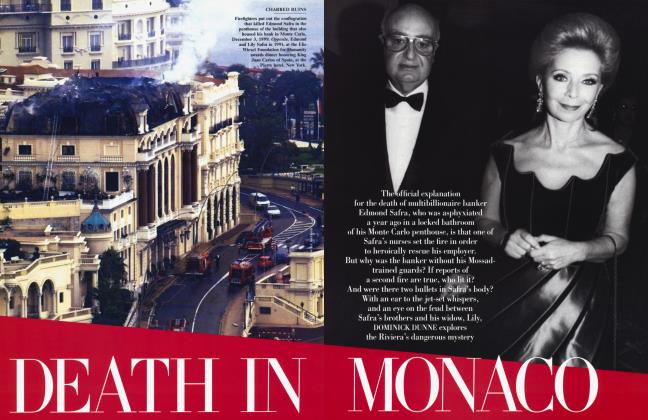
Today, Kathrin—not Brigitte, not Robert, not Gaston Jr.—is the public face of the world's leading pistol firm. At the time of Gaston's death, almost all of his fortune was tied up in the system of foundations and trusts that owns Glock. The company is down from its best year, around 2019, when estimated sales exceeded 1 million units—60 to 70 percent in the United States.
Kathrin declined to speak to Vanity Fair for this story. "My husband Gaston was, is, and always will be my soulmate," she says in a written statement, adding that "Gaston is my great love, and we will remain connected forever.
"Anyone who knew Gaston knows that he left nothing to chance. He always made clear decisions about who he would delegate which responsibilities to, and he always made all the important decisions himself, both private and professional," the statement went on, in response to numerous reporting questions. "This continued throughout his life—and, through his clear directives, even beyond his lifetime. Gaston never allowed himself to be manipulated or used by anyone."
Who, then, is Kathrin Glock? After she dropped out of high school, she failed to complete Austrian gendarmerie training, and never finished college. "She is a person, I would say, who basically wants to make something of her life, and who doesn't have a particularly good starting point in life but still has the drive to the goal," says Jan Krainer, an Austrian parliamentarian.
In 2021, Krainer was part of an Austrian parliamentary committee who questioned Kathrin in a corruption inquiry triggered by the Ibiza affair, a political scandal in which a leaked video emerged showing Heinz-Christian Strache, then Austria's vice chancellor and leader of the far right Freedom Party, or FPO, along with another FPO apparatchik, in conversation in a villa in Ibiza with a woman posing as the niece of a Russian oligarch. In the tape, from 2017, Strache suggested ways to donate to his party to avoid campaign finance disclosures and alleged that Gaston Glock, along with the department store heiress Heidi Goess-Horten and the investor René Benko, had made large donations to the FPO via nonprofit associations. In a scene from the video that became local lore, Johann Gudenus, the former vice mayor of Vienna, mimed a pistol with his fingers while discussing untraceable donations to the FPO. "Glock, boom, boom," he said. (The Glocks, Goess-Horten, and Benko have denied making donations to FPO. None of them were the focus of the investigation, and no charges were filed against them. Strache resigned, and the inquiry led to his conviction on a separate corruption charge that was later overturned.)
The hearings took place mid-pandemic, and Kathrin arrived in Vienna in her trademark black, wearing two face masks, one of them Glock branded, aswell as plastic gloves. "I've been going through the Gaston Glock school for 16 years," Kathrin responded after an MP asked her what her qualifications were. "It's a tough school at my husband's practice. He taught me from the ground up."
Her statement to Vanity Fhzrused similar language: "I had the privilege of learning from and with my husband—which was also Gaston's wish. This was demanding and challenging—a tough school. In retrospect, this was the best possible foundation to fulfil Gaston's mission: to continue and protect his life's work in my roles, in accordance with his wishes. Gaston's values are my law, the companies my life, and the employees my family."
"Kathrin Glock is the second wife, that's always difficult," says Elisabeth Giirtler, a figure in Austrian society whose family owns the Sacher, Vienna's celebrated hotel. Giirtler is also a former chair of the Vienna Opera Ball and served as the first female director of Vienna's storied Spanish Riding School. "If wealthy entrepreneurs divorce their first wife and marry their second wife, and there are children from the first marriage, then they have a problem."
WHEN GASTON GLOCK MOVED INTO MAKING PISTOLS, EVERYTHING CHANGED THE AUSTRIAN WENT GLOBAL, AN UNLIKELY DEVELOPMENT THAT SOME WOULD SAY LITERALLY BROKE AMERICA.
TOP GUN
The Kathrin reign matters; the company does not produce Tupperware or luxury cars, but America's most beloved gun. Since arriving in the United States in the mid-1980s, Glock pistols have become both one of the most common police weapons in the US and the most popular firearm for doing bad things. In 2018 the company claimed that Glocks were the preferred pistol of 65 percent of American law enforcement agents. Between 2017 and 2021 nearly 20 percent of all traced pistol-type guns used in crimes in the US—more than 250,000 individual weapons—were Glocks, according to the Bureau of Alcohol, Tobacco, Firearms, and Explosives. That's more than any other manufacturer; the next most common was Smith & Wesson, with 14 percent ofthe total and 183,000 individual recovered weapons. By 2024, Glocks also accounted for 24 percent of all recovered crime guns in the US, up from 18 percent in 2019. There are no reliable estimates for how many Americans routinely carry Glocks, but the weapons regularly surface in the news. A preliminary government report shown to some members of Congress indicates that bullets fired at Alex Pretti in Minneapolis this year by two Customs and Border Protection agents came from a Glock 19 and a Glock 47.
The European weapon permeated swiftly into American pop culture. In Die Hard 2 (1990), Bruce Willis's character quips, "That punk pulled a Glock 7 on me. You know what that is? It's a porcelain gun made in Germany. It doesn't show up on your airport X-ray machines here, and it costs more than you make in a month." This was wrong—there never was a Glock 7 model; the gun contains metal parts as well as polymer, and it does show up on X-rays. But the weapon had hit the Zeitgeist, and Glocks have subsequently surfaced in other films, from U.S. Marshals to Ronin. They also found favor with rappers, not least because of Glock's versatile rhyming potential: cock, lock, pop. But almost from the start, Glocks were involved in mass killings. In October 1991 a disturbed Army doctor's son murdered 23 people and then killed himself in a Luby's Cafeteria in Killeen, Texas, armed with a 9-mm Glock 17 and a Ruger. And Glocks have been the killing machine of choice in some of America's most horrifying massacres, including Virginia Tech in 2007, which left 33 dead, including the gunman, and the shooting at Borderline Bar and Grill in California in November 2018, where a gunman killed 13 people, then himself.
"Kathrin Glock's fortune has come at the expense of America's children and teens, who are now more likely to die by gun violence than car accidents or cancer," says John Feinblatt, president of the campaign group Everytown for Gun Safety. "Just like the Sackler family has been held to account for profiting off the opioid epidemic, Glock must answer for being the top manufacturer of crime guns in the United States." (Ruger is the top American gun manufacturer overall.)
The Glock is also easily modifiable with an aftermarket third-party device colloquially known as a Glock switch. These gadgets, imported from China or Russia or homemade in the US with 3D printers, transform a semiautomatic weapon—which fires a single round with each trigger pull—into a fully automatic one, able to discharge at a rate of 1,200 rounds per minute, limited only by the capacity of the magazine. Glock switches are illegal for civilians, but due to their small size and ease of manufacture, they are profoundly hard to prohibit and therefore provide a handy way around American restrictions on machine guns that date back to the 1930s, when legislation was introduced in response to Al Capone-era gangsters wielding tommy guns.
"There are counties all across New York, not just New York City, but the entire state, where these are being recovered at crime scenes, where people are being killed, where the proliferation is becoming existential," says Zellnor Myrie, a New York state senator who has introduced a bill aiming to ban the sale of easily modifiable semiautomatic pistols in the state. Between 2017 and 2021 the ATE recovered 5,454 "machine-gun conversion parts," a 570 percent increase over the preceding Eve years. Finally, after years of pressure and litigation—with Gaston dead and Kathrin at the helm—Glock has also responded. In late 2025 the company discontinued much of its product range and brought out a new stable of V series pistols, supposedly designed to resist modification with third-party switches.
The switch story begins 40 years ago. Around March 1986 a 21-year-old Venezuelan named Jorge Leon got his hands on an early Glock pistol and took it apart to see how it worked. Leon was impressed by the weapon's simplicity. "That gun was so stable in the firing," he said in a 2024 interviewwith a Minneapolis TV station. (When reached for this story, Leon referred Vanity Fair to his previous media comments.) Within 18 months, Leon had developed a small aftermarket part that could be inserted into the rear of the Glock to depress the pistol's cruciform-shaped trigger bar and cause the gun to continue firing automatically each time the slide returns forward, converting a semiautomatic weapon into a machine gun. Modified in this way, the gun will continue firing as long as the shooter depresses the trigger and the gun has ammunition. Leon envisaged selling the product to police and military customers. He filed for a US patent on his "fire selector system" in July 1996 and the patent was awarded in January 1998.
CONTINUED ON PAGE 110
CONTINUED FROM PAGE 81
Leon's invention secured interest from Gaston himself, who came to see him in Venezuela in 1987. "He looked at me in a serious way," Leon told the Minneapolis TV station. "He told me, 'Hey, Jorge, I suggest you keep this as a curiosity and not work on this anymore.' " The young Venezuelan ignored the Austrian. Rather than prohibiting unlicensed copies, the patent became, combined with the rise of the internet, a blueprint for pirates.
As switches proliferated, the gun safety campaign group Everytown lobbied individual American cities to bring litigation against Glock. In March 2024, Chicago filed a lawsuit alleging that Glock had unreasonably endangered its residents. Nine months later the attorneys general of New Jersey and Minnesota sued. Baltimore and Maryland followed in February 2025. Finally, last October, California governor Gavin Newsom signed a law that made his state the first in the country to prohibit gun dealers from selling pistols that can be easily converted into fully automatic weapons via aftermarket switches.
Firearms experts debated the extent to which Glock could design the vulnerability to modification out of their pistols. Some suggested that, even if the company did make structural changes, switch makerswould simply modify their designs. The ultimate option of sealing up the rear of the weapon, which would prevent the ingress of any kind of aftermarket device, would lead to a pistol that could not be easily cleaned. But then, in the autumn of last year, word started to seep out on gun websites and YouTube channels that Glock was indeed planning a massive redesign of its product range. In October, Glock confirmed it would discontinue almost all its existing pistols in favor of the new V series. The main change was a steel ramp machined into the weapon's slide and the reinforcement of a preexisting lug intended to prevent the fitting of a switch. The cruciform trigger bar remained in place.
"Well, that didn't take long," the gun YouTuber Brandon Herrera announced on November 19, shortly after the new guns got into public hands. "Today is a good day for everybody except gun grabbers and Glock's PR team." Herrera was referring to a Reddit post where a user under the handle 5N7X had uploaded two photos of a new design of a switch that he claimed could fit the new guns. It was not even a fully redesigned switch, just a standard one with the tripping arm cut away to clear the new ramp. The poster noted in the comments that he even could have cut away less of the arm than he had.
It's still unclear how this new arms race will play out.
SNAKES AND JEWELS
The second Frau Glock was born Kathrin Tschikof in 1980 and grew up in the Austrian village of Goritschach, part of the municipality of Wernberg, between Villach and the Wdrthersee Lake. According to a local official who asked for anonymity, the Tschikof family ran, though did not own, the café at the Wernberg Tennis Club. "The parents led and she helped," says Georg Partoloth, a groundskeeper who also coaches soccer at the adjacent sports club. "People came to play tennis, then they would have something to drink or eat." Partoloth added that Kathrin had recently attended a party at the club.
Goritschach is a quiet place, where doorbells produce tinny renditions of Beethoven's "Fur Elise" and houses break quickly into fields. According to locals, the Tschikof family home was a large, yellow farmhouse, with a barn out back and, beyond that, a meadow dotted with mature trees. Today a wooden plaque gives the name of the former Tschikof residence in Gothic script as Urch, a word that has no particular meaning in German, under a carving of a bird that resembles a dove.
"As far as I know, they grew up there," a local woman walking her dog nearby tells me. "The mother of one of my son's classmates grew up with her, and she says she's a really nice girl." A server at the Landgasthaus Faile, a pub with yellow walls a couple miles east in Lind ob Velden, said that Kathrin used to work there too.
Animal rights are central to Kathrin's personal brand. Helga Happ, who runs a reptile zoo in Klagenfurt that Kathrin has supported, tells me that Kathrin first visited the zoo as a child. Happ says Kathrin told her about holding a giant snake around her neck when she was a little girl and even showed her a photo.
"Thatwas either a bull python or a Madagascar ground boa," Happ adds, "and she was totally relaxed and happy."
After a Dutch lorry carrying exotic animals to Italy crashed in Carinthia in 2013, spilling the creatures across the road, Kathrin provided funds to the Happ Reptile Zoo to provide a home for two abandoned armadillos. The zoo christened the beasts Gaston and Kathrin in the Glocks' honor. In German, an animal would usually be addressed using the familiar second person, du, but Happ explains to me they use the polite form, Sie, for the armadillos. ("There's a certainrespect for these personalities," she tells me.)
Since 1929 the Tschikof family has also run a jeweler in Spittai an der Drau, a river town some 25 miles northwest of Goritschach. Juwelier Tschikof is a narrow shopfront crammed next to a boutique selling stationery, opposite a tobacconist. The staff there refused to discuss Kathrin, but the window displays showed rings and necklaces from the German brand Wilhelm Muller and the Italian house Ti Sento, with prices ranging from less than 100 euros to a few thousand.
On April 30, 1981, when his future second wife was five months old, Gaston filed a patent in Austria for a new kind of pistol. "The gun was designed in response to the demand from the Austrian military for a new military sidearm," journalist Paul M. Barrett, the author of the 2012 book Glock: The Rise of America's Gun, tells Vanity Fair. "The very unlikely designer of this new gun was this guy who had never designed a firearm before, was not really even in a position to design a firearm himself, so instead he collected a brain trust of other European gun designers and gave them the mandate to design this pistol for the future with a variety of specifications that he thought would distinguish it from rival firearms."
Kathrin tried to tell the children and their lawyers to take their shoes off before they entered the house, but one of the lawyers refused, saying, "There's a hearing today," and barged in, stilettos a-clack.
Born in Vienna in 1929, Gaston grew up believing his father to be a railroad worker and only later discovered that that man was in fact his stepfather. Gaston married a German woman, Helga, from higher social standing; her father ran the police homicide squad in Munich. Gaston also had no real firearms background. During the war Gaston spent a short stint in the Nazi armed forces. In a court deposition in a product liability case in 1993 he stated it was only for a few days of training—but the war clearly marked him. When his own children were young, he forbade them from even playing with water pistols.
Gaston ran a car radiator factory outside Vienna, and in his garage in DeutschWagram, he and Helga had a side operation that at first produced brass window and door fittings. He founded his eponymous firm in 1963 and later expanded to produce field knives and bayonets for the Austrian army, as well as components for training grenades and links for machine gun belts.
Gaston was a strict parent for an aspiring magnate. When his daughter, Brigitte, asked for a scooter, Gaston put her to work, explaining that there were 10,000 field knives downstairs that needed to be sharpened for the Austrian army. After six weeks whetting blades in the factory on a grinding belt, Brigitte received a silver motorbike.
But when Gaston moved into making pistols, everything changed. The Austrianwent global, an unlikely development that—some would say literally—broke America.
COCK. LOCK. POP.
Firearms always reflect the engineering techniques of their age. In the 1830s the American inventor Samuel Colt filed patents for a new kind of handgun, one in which multiple firing chambers rotated around a single barrel. His was not the first revolver, but Colt's design (after early teething problems and bankruptcy) proved practical, and the way he rolled it out—using interchangeable parts and mechanization—became standard in other industries. A century later Gaston's expertise with injection molding and polymers, garnered from earlier manufacturing ventures, allowed him to put a revolutionary handgun forward for an Austrian army tender.
From the start, the Glock pistol, its frame manufactured from polymer rather than steel, was lighter, cheaper to manufacture, and just as robust as existing alternatives. The real innovation, however, came with the pistol's firing mechanism. Most earlier semiautomatic handguns featured a hammer, a spring-loaded part to the rear of the barrel. The hammer caused a filing pin to strike the base of a cartridge, igniting the primer and firing the bullet. After the first shot, recoil would drive the slide back and automatically recock the hammer. But before the first shot, the hammer had to be pulled back—cocked—either by hand or by retracting the slide (which also loaded the first round from the magazine). With the hammer cocked, only light, brief pressure on the trigger was needed to fire, making the weapon accurate but easy to discharge inadvertently. As a result, pistols were carried either with a dedicated external safety catch engaged to stop the hammer from falling or with the hammer deliberately lowered to a safe position.
In contrast, Glock used a "striker-fired" mechanism that took the pressure off that critical first shot. Gaston's pistol still needed to be retracted to chamber a round from the magazine, but there was no exposed hammer. Instead, pressure on the trigger pulled a firing pin (now called a "striker") back under spring tension, moving in line with the barrel rather than pivoting around it, and then smoothly released it. Every round required the same limited pull. Glock also dispensed with external "active" safeties, which shooters had to disengage manually and which therefore could slow them down, instead designing "passive" features—including a safety lever on the trigger face that has to be depressed for the trigger itself to move back. This was intended to ensure that the weapon would only fire if a user pulled the trigger deliberately and that the Glockwould not discharge if itwas dropped or knocked. These technologies were not individually new. The German firm Heckler & Koch had brought out a striker-fired pistol in 1970 called the VP70, which also had a polymer frame, and the lineage of striker firing itself can be traced back to the Borchardt C93, the world's first successful semiautomatic pistol, dating from 1893. But earlier versions required long and forceful trigger pulls and had never caught on. As with Colt 150 years earlier, Glock took existing designs and refined them into a usable product.
"The original Glock pistol was not only a combination of several good ideas that came together to create a reliable gun, but it was also created at the right moment in history," says Ashley Hlebinsky, executive director of the University of Wyoming's Firearms Research Center. "The assurance of support, ifthey received the government contract, allowed Glock to explore and test new materials and designs that hadn't yet seen complete success when attempted by previous manufacturers."
Gaston first sold his pistol to the Austrian army; then he sold it to the world. Glock's initial Austrian army contract involved 20,000 pistols. While military contracts can be lucrative, the big prize for all handgun manufacturers is the American private market. An estimated 16.1 million firearms were sold in the US in 2024. Back in Austria, the family suddenly became seriously wealthy. "Itwas actually unbelievable, to witness how quickly it all happened," says a source close to Gaston's children. Gaston discouraged the kids from going to college, instead expecting them to work for the family business.
Kathrin has claimed to have met Gaston in the waiting room of a doctor's office in 2004. According to one source close to the children, itwas the practice of an ear, nose, and throat physician in Villach named Erich-Hans Kollmitzer, where Gaston went to have the regular check-ups required for his pilot's license.
THE QUEEN & I
Gaston had a history of girlfriends, often much younger, though up to this point he had remained married to his first wife and the mother of his children. He "had affairs with other women, and yes, Helga suffered greatly because of it. But he always came back, and I know that he loved her very much," Marika Lichter, an Austrian singer and actor who is a friend of the family, tells me. "It was actually relatively late that he came into money. And then he just wanted to catch up on a few things."
" 'My girlfriends are younger than my sons' girlfriends,' he said that," adds Charles Ewert, Gaston's Luxembourger former financial adviser.
Ewert is not a fully dispassionate witness. In July 1999 he lured Gaston to an underground parking garage in Luxembourg, claiming that he wanted to show off his new sports car. In the garage, a masked man—a 67-yearold former French Foreign Legionnaire and professional wrestler named Jacques "Spartacus" Pecheur— emerged from the shadows and attacked Gaston with a rubber mallet while Ewert ran off. Although Gaston was already 70, he put up a vigorous defense, knocking out several of his assailant's teeth. Gaston suffered seven hammer blows to the head and lost a liter of blood but survived. In March 2003 a court in Luxembourg convicted Ewert and Pecheur of attempted murder, though Ewert, who is now out of prison, denies he was responsible. Pecheur was released in 2007.
Gaston's relationship with Kathrin was different from the ones Ewert described. Early in the relationship, Gaston contacted Inge Unzeitig, the Klagenfurt hotelier, whom he had known for years. "He said, 'I'm meeting a beautiful woman today, are you coming?' " Unzeitig tells me over cake in the mirror-lined saloon of the Hotel Palais Porcia, which is decorated with red striped wallpaper and features statues of Black boys supporting chandeliers with their heads.
Unzeitig, Gaston, and Kathrin headed out for dinner at the restaurant at the casino in Velden. Unzeitig's verdict was positive. "I see she's not after money; she has heart and that's good," Unzeitig tells me, recounting her assessment. "You know, I've got a good nose. I notice immediately what a person is like. I realized that she appreciated and admired him, that he had created so much. It wasn't that he had this and that."
Even into old age, Gaston had remained fit, swimming regularly in the Wbrthersee Lake. That tough physical condition had allowed him to fend off the 1999 assassination attempt. However, nine years later age started to catchup with him. In 2008, Gaston suffered a stroke, and Kathrin began her ascent of the Glock enterprise. "Let me put it this way: Gaston was married to Helga, I think, for over 30 years," says Hubert Wallner, an Austrian chef whose Wdrthersee eatery sports a Michelin star, who knows the family and who had collaborated with Gaston's son Robert on a restaurant venture. "And certainly, this stroke was the deciding factor in the split in the family."
"Kathrin was with him in the hospital very often, or most of the time," Wallner added. "And after that, he became a bit isolated." Gaston's daughter, Brigitte, came to the hospital to find Kathrin on site, with her parents. At one stage Kathrin told Brigitte she would have preferred it if Gaston didn't have any money. And while the children were allowed to visit, Helga, back in Vienna, was not, per Gaston's wishes.
After his stint in the hospital, Gaston moved to a rehabilitation facility. Kathrin moved out of the flat in the basement of the Velden villa to larger rooms upstairs. Then the gunmaker began to freeze his wife and children out of the company.
Brigitte had served as Glock's managing director after her father's stroke, but in 2010 she was summoned to a meeting in Deutsch-Wagram, the company's headquarters outside Vienna, and, according to a source close to Brigitte, unceremoniously fired from the firm. Her brother Gaston experienced similar treatment. (Robert had already left the firm.) The following year, Gaston married Kathrin in a small ceremony. "I was there to support them and was happy that two people who understood each other had found something beautiful for both of them," Unzeitig told me.
His divorce from Helga and the ejection of the children from the company prompted rounds of litigation in Austria and the US. The German-language media called it a "Rosenkrieg," a war of the roses. In 2014, Helga sued in US federal court in Georgia, alleging that Gaston had carried out a racketeering scheme to conceal Glock proceeds from her and her children. "Glock Sr.'s actions towards Ms. Glock, especially in their later and particularly spiteful stages, resemble the senseless and self-destructive rage of Shakespeare's King Lear, when he foolishly mistreats a loyal but candid daughter, Cordelia, in favor of cunning and ruthless flatterers," the complaint alleged.
The litigation ran on for around five years, with the campaign on the family's side quarterbacked by Beate Arnold, a consultant who had formerly run IT operations for Glock. Brigitte last saw her father in 2 016, at a legal hearing at his villa in Velden. (The court came to Gaston's house due to his medical condition.) Kathrin tried to tell the children and their lawyers to take their shoes off before they entered, but one of the lawyers refused, saying, "There's a hearing here today," and barged in, stilettos a-clack.
Kathrin prevailed. Helga received an Austrian settlement, which she shared with the children, while Kathrin took control. (The Georgia case was dismissed.)
"I had the privilege of learning from and with my husband " says Kathrin Glock. "Gaston's values are my law, the companies my life, and the employees my family."
Over time, some Austrian publications shied away from covering the firm for fear of legal action. "It was indeed the case in recent decades that critical media reports were then attacked by Glock, mostly through lawsuits," explained Florian Skrabal, the publisher and managing director of Dossier, an investigative nonprofit in Vienna that is one of the few Austrian outlets to have deeply covered the firm. "And of course, word of such things gets around in the media industry."
But Glock's targets were not just journalists. In 2006 the Austrian chapter of Amnesty International announced that a Glock pistol had been identified in Darfur, in weapons-embargoed Sudan. "They sued Amnesty Austria," says Heinz Patzelt, the former secretary general of Amnesty Austria, and "me personally as an individual." Glock lost that case. In 2018 the company sued Irene Hochstetter-Lackner, then the Austrian parliamentarian for Klagenfurt, a town on the Wbrthersee. Hochstetter-Lackner had posted a newspaper article about Glock on her Facebook page. The lawsuit reportedly alleged that she had not moved quickly enough to delete third-party comments under the post that were insulting and defamatory to Glock. (As a result of the settlement, Hochstetter-Lackner agreed to post a statement on her Facebook page that condemned the language used by the third-party commenter.)
The result of these cases was still, in Austria, pervasive fear of the company and its potential reach. When I met one former Glock executive, in a modern hotel in a European capital on the fringes of an arms fair, he insisted on anonymity. That evening, after an extended discussion, I received an email from him apologizing that we had not been able to meet. Other Glock insiders tell me they thought I was acting as a spy for Kathrin; after I messaged another Glock insider, he called me back and attempted, somewhat unconvincingly, to pretend that he was not himself but rather a friend calling on his behalf.
Kathrin has found a friendlier narrative in philanthropy. According to analysis from Dossier, in the seven years leading up to 2018, Glock disbursed about 6 million euros to Austrian organizations. Some went to medical and animal rights groups—250,000 euros to the association Rescue Vienna General Hospital; 100,000 euros each to Vier Pfoten (Four Paws, an outfit to support animals "under direct human influence"), a children's cancer charity, and the child protection organization Die Mdwe. Other disbursements went directly to Austrian media-backed causes—around 640,000 euros between 2011 and 2014 for a local emergency appeal run by the regional newspaper Kleine Zeitung, 500,000 euros between 2013 and 2018 on the Christmas Heart fundraising campaign and Leading Ladies award put together by the Mediengruppe Osterreich, and 600,000 euros between 2011 and 2018 to the Verein Freunde der Tierecke animal rights body, which was led by the editor in chief and a columnist at the Kronen Zeitung, the tabloid that is Austria's largest newspaper.
The Austrian media blitz paid off. "The name Gaston Glock stands for the wealthy industrialist, inventor, and producer of the unique Glock pistol. But the name Glock also stands for a husband and wife with big hearts," noted Madonna magazine, a Mediengruppe Osterreich property, in December 2017. "Glock's donations help to make the world a little better." Elsewhere, Maggie Entenfellner, the columnist at Krone who is also one of the chiefs of Freunde der Tierecke, described Kathrin presenting another donation of 50,000 euros to a children's organization. "I'm not usually one to get emotional, but a few days ago I couldn't hold back my tears," Entenfellner wrote in June 2015, adding that Kathrin was "sympathetic and warmhearted"—one of the children present had described her as a blond angel.
THEY LOVE HORSES, DON'T THEY?
Horses were another element of the Glock business. Cross-branding firearms with equestrianism goes back to "Buffalo Bill" Cody's Wild West show. Gaston's interest in horses predated his relationship with Kathrin; her predecessor as his girlfriend was a keen rider.
On the one hand, Glock sponsored a pair of Dutch dressage riders, Edward Gal and Hans Peter Minderhoud, and invested money into the Glock Horse Performance Center in Holland. Meanwhile, closer to home, at the Glock Horse Performance Center in Austria, Kathrin put together a series of lavish Horses & Stars pageants. Many of the A-listers (and B-, C-, and D-listers) hailed from the English-speaking world. Over the years, David Hasselhoff, Naomi Campbell, Joan Collins, John Travolta, Mariah Carey, and Robbie Williams all made appearances in Austria. "Robbie Williams brought one of my children, one of my sons, onstage and sang with him," recalls Manfred Wrussnig, a veteran Austrian journalist who attended Glock bashes. "He was completely down-toearth." (Williams, Carey, and Travolta did not respond. A spokesperson for Campbell declined to comment.)
As Gaston liked Kathrin to be at home in Austria, Horses & Stars was away to bring the jet set to her doorstep. But the events were also laced with irony. Some of the famous international guests had previously spoken out about gun violence. In 1999, in the months following the Columbine High School mass shooting, British actor Hugh Grant said: "What horrifies me, these shootings happen and then the newscaster is saying, 'America has to look into its soul and askwhy is this happening?' And as a European, you want to say, 'Because you've all got guns, you f****** moron.' " Two decades later, Grant attended Gaston Glock's 90th birthday party. ("All I can tell you is that I had good and in my opinion rather worthy reasons to be atthatparty," Grant tells Vanity Fair. "Frustratingly I can't share them with you. Sorry.") Also at that event was Leona Lewis; the year before she had attended March for Our Lives in Los Angeles and also spoken out against firearms. (Lewis did not respond to a request for comment.)
When Gaston died on December 27,2023, his children heard the news from the media. That day Brigitte was on a call with a friend, according to a source close to the family. After the conversation ended, the friend called back and asked how she could possibly not have mentioned what had just happened. Only then did Gaston's eldest see that the patriarch was dead. In a way, says the source, Brigitte felt an element of freedom.
Ill the garage, a masked man emerged from the shadows and attacked Gaston with a rubber mallet. He suffered seven hammer blows to the head and lost a liter of blood, but survived.
The children are still not certain where and how Gaston was buried. Today, a visual depiction of Glock's corporate structure drawn from Austrian corporate filings resembles a solar system, balls of different sizes representing the various foundations and subsidiaries set amid a constellation of individuals. The main firm, Glock GmbH, is primarily owned by the Glock Privatstiftung istiftung means foundation in German). Kathrin is not on the board of the Glock Privatstiftung. However, she is a board member of another entity, the IGG Privatstiftung, and this foundation in turn owns another subsidiary (Gaston Glock GmbH), which in turn holds "founding rights" in the main Glock Privatstiftung.
Glock sales are down. In 2024 the company reported significantly lower revenue and profit compared to the year before and cut 130 jobs. Revenue shrank by 89 million euros to 380.3 million euros, and profit nearly halved, falling from 72 million euros to 39 million euros, according to the annual report. Under the second Trump administration, there is little prospect of the gun control legislation that always supercharges American pistol sales; it's his whipsaw tariffs that could really bite, with predictions of price increases of $50 to $200 per gun. A number of senior and long-serving executives have left the firm, and there is ongoing litigation with former directors of one of the company's foundations who, according to the Austrian newspaper Der Standard, were dismissed after they allegedly gave themselves a 19 million euro payout in 2018. Meanwhile, online workplace reviews indicate employee disgruntlement.
In Holland, the horse center has closed and the contract with dressage riders Edward Gal and Hans Peter Minderhoud ended. In her statement to Vanity Fair, Kathrin denies the company was in difficulties. "We are experiencing high demand for our innovative products," she says. "Our production capacities have been adjusted accordingly. Additional employees have been hired in the production area, extra shifts have been scheduled, and further investments have been initiated in this area. At the same time, Glock is continuously working on the development of new products and technologies. This development work has always been an integral part of our ongoing business."
Kathrin also says the closure of horse operations was part of a considered plan. "Glock's withdrawal from international equestrian sport and breeding was publicly announced in November 2024. The underlying decision was made by Gaston Glock in 2022. Its implementation was carried out gradually and consistently under my leadership in the following years. All Glock horses were retired from competition and are now enjoying their retirement in a true equestrian paradise—GHPC Austria. This decision also affected the internationally oriented 'Horses & Stars' tournaments, which were extensively covered. These world-renowned tournaments were also part of Glock's marketing and communication strategy."
In March 2024, three months after Gaston's death, the company appointed a new managing director: Urs Breitmaier is the former CEO of the Swiss national weapons producer RUAG. It made sense to have a weapons veteran take over operative control. But RUAG is a mixture of private and public sector business.
"It was run like a private company. But in the end, it belonged to the Confederation, the Swiss state," explained Sven Millischer, an op en-source intelligence exp ert in Zurich. "This has led to repeated attempts to enter areas that actually had nothing to do with the state's core responsibilities. They converted private jets. They manufactured civilian aircraft, etc. This constantly caused tension." And Breitmaier's tenure at RUAG's helm, from 2013 to 2019, coincided with scandal. A June 2019 report by the Swiss Federal Audit Office alleged that RUAG charged excessive fees to Armasuisse, the Swiss Federal Office of Defence Procurement. (At the time, RUAG stated that it was surprised by the findings, but that it would "consider any future adjustments.") Then, later in 2019, a whistleblower sent an anonymous letter to the Swiss Ministry of Defence and the president of the RUAG board of directors alleging that an unnamed RUAG executive had defrauded the company of an amount in the "high double-digit millions." The senior employee had reportedly redirected disused Leopard tank parts to a scrapping company in Germany for below-value price. Instead of scrapping the parts, the executive had allegedly organized the sale of them through a company in which his wife was involved, reportedly making a significant profit. (This case is still under investigation; Breitmaier did not respond to VF) An RUAG spokeswoman tells Vanity Fair: "In 2020, the former RUAG Group was split up following a decision by the Swiss government. Since then, there have been two completely independent companies, namely RUAG International Holding AG and RUAG MRO Holding AG. Mr Urs Breitmeier left the company at the beginning of 2020 and has no connection with our current company, RUAG MRO Holding AG. "
Back in Austria, alongside Breitmaier, last July Glock appointed Guntram Haas, a former executive at the German automotive parts manufacturer Mahle, as a second managing director (and chief technical officer).
Transitioning from a founder CEO to the next generation of leadership is a complicated undertaking in any business, much more so when family succession is in play. Predictions for Glock vary. "I think they'll be bought up," one source close to Gaston's children tells me. "And the lower the value gets now, the more interesting it becomes for the market, of course."
"Without envy and without being malicious, I believe that Glock will be a mediocre company in five years," added a former member of Gaston's inner circle.
Much of this story will play out on the other side of an ocean, in an America reluctant to regulate firearms.
Subscribers have complete access to the archive.
Sign In Not a Subscriber?Join Now


