

Sign In to Your Account
Subscribers have complete access to the archive.
Sign In Not a Subscriber?Join NowTHE CRYPTO KEEPERS
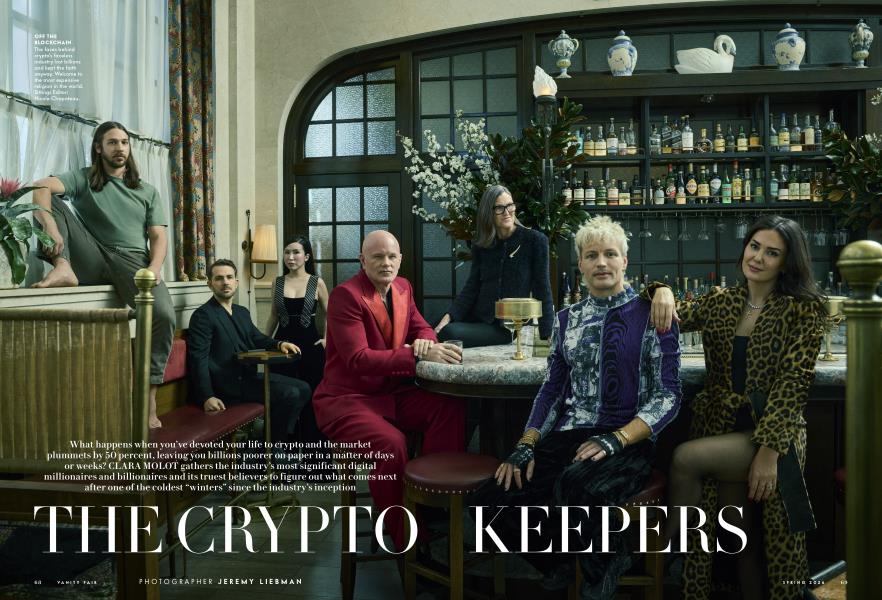
What happens when you've devoted your life to crypto and the market plummets by 50 percent, leaving you billions poorer on paper in a matter of days or weeks? CLARA MOLOT gathers the industry's most significant digital millionaires and billionaires and its truest believers to figure out what comes next after one of the coldest "winters" since the industry's inception
CLARA MOLOT
FOR DETAILS, GO TO VF.COM/CREDITS.
When Carlson-Wee's not running one of crypto's largest hedge funds, he can be found jetting to the United Arab Emirates, where he was recently spotted bleach-blond on a mega-yacht celebrating TOKEN2049—a far cry for a preacher's kid.
"I don't think I can do this anymore," read one of the dozens of Signal messages that a major crypto market maker, who asked to go simply by Bison, received in the first few days of February. The crypto market had just shed another 15 percentsome $400 billion gone in a matter of days.
In the previous four months, the total value of cryptocurrencies had plunged nearly 50 percent, dragged down by Bitcoin, with both Ethereum and Solana dropping nearly 60 percent. The crash erased roughly $2 trillion in value and tipped the industry into a bear market known, in crypto slang, as a "winter"—a nerdy subterranean nod to Game of Thrones' foreboding refrain: "Winter is coming." Bison recounts stories of top founders scrambling to take companies private, close emergency equity rounds, or abandon ship altogether.
Veterans of the space have endured worse, with the market dropping 80 or even 90 percent, but this season felt different. Not to make it about me, but the timing, from my perspective, was comically bad. In October, as euphoria under a deregulated, crypto-friendly Trump administration pushed the market toward its peak, I had begun working on a feature about the faces behind an often faceless industry. As the market stalled, so did several of my conversations with prospective participants, some of whom had viewed this kind of press as a victory lap.
Executives at Coinbase fell conspicuously silent as its CEO, Brian Armstrong, watched an estimated $10 billion evaporate from his net worthwhile battling regulators in Washington. Tensions simmered within Ethereum's ranks, where its quasi-mythic cofounder, Vitalik Buterin, fired off tweets about his concerns for the way his platform is scaling and, as an early Polymarket backer, his distaste for the ultra-addictive direction of blockchain-based prediction markets. Rank-and-file traders—dismissed by OGs as tourists—either panic-sold, drifted toward shinier obsessions like AI and prediction markets, or quietly shed the identity of crypto bro altogether.
"They're all pussies," says Meltem Demirors, an early crypto investor who now runs her own firm, Crucible Capital, of her panicked peers. She is layered in diamond crosses and wearing a
black sweatsuitwith her firm's slogan—"Believe in Something"— bedazzled across the ass. For the first time in years, she is buying Bitcoin again.
And so, on a biting February afternoon, as the market continued its slide, a small circle of true believers gathered inside a Beaux Ails landmark on the Lower East Side—a former bank once nicknamed the "temple of capitalism," now reborn, a reported $300 million later, as the Nine Orchard hotel. Michael Novogratz, CEO of Galaxy Digital, is its newly minted co-owner.
Collectively billions poorer on paper, Novogratz, Demirors, and other crypto players Olaf Carlson-Wee, Cathie Wood, and Danny Ryan compared notes—not about what they had sold, but about what they were buying. Wood, armed with reams of proprietary research, and Carlson-Wee, who insists he never follows the news, are accumulating Bitcoin. Ryan shrugs off the daily noise altogether. "I'm a Luddite," he proclaims. "People will tell me when I need to know something. "
"Technology without belief," Demirors reiterates, "technology without spirituality, is nothing." Unlike Jesus's followers who doubted his resurrection, crypto's true disciples aren't losing faith. "Really," Demirors says, "what we were building was a religious movement."
Asset classes—whether gold, commodities, real estate, bonds, or stocks—are an answer to the same question: Where does value come from? They are social constructs that mean something because we collectively agree they do. Gold says: from nature and scarcity. Bonds say: from institutional trust. Real estate says: from place and permanence. Commodities say: from matter itself. Stocks say: from human ingenuity.
Each one needs a creation myth, from scarcity to capitalism itself, but for those who believe crypto is the sixth asset class, it works precisely because they insist that its value is more than financial. "I have been waiting for this since we closed the gold window in 1971," Wood, whose actively managed ETFs bet highly on disruptive technology, recalls being told by Arthur Laffer, the Reagan-era economics titan who developed the Laffer curve. "How big could this idea be?" Wood asked him. His answer revealed the fantasies of crypto's earliest adherents: " 'Well, how big is the US monetary base?' "
On Halloween in 2008, just six weeks after Lehman Brothers, the fourth-largest investment bank in the country, imploded, taking with it the myth of institutional security, a mysterious figure under the pseudonym Satoshi Nakamoto quietly emailed a short list of cryptographers a nine-page PDF titled "Bitcoin: A Peer-to-Peer Electronic Cash System."
Before he became a multibillionaire, Novogratz felt the distance between his world and his college roommate's (a son of Gloria Vanderbilt). He remembers emailing his mom: "Rich people's sheets kick the shit out of our sheets."
Now known simply as "the White Paper," Nakamoto outlined a novel financial system that completely bypassed central authorities—like banks, governments, the Federal Reserve—and as a result would insulate everyday people from inflation, seizure, and the caprices of monetary policy. Bitcoin secures itself through "mining"—specialized computers competing to solve cryptographic puzzles—and access depends on the ability to memorize a specific series of words. Lose the phrase and the funds are gone forever. Remember it, and you could reclaim your wealth from anywhere in the world without asking anyone's permission.
By 2009, Nakamoto took Bitcoin from theory to reality, mining the Genesis Block, and then, once the rules were set, protections against counterfeits were secured, and Bitcoin began to circulate—still worth next to nothing—Nakamoto vanished. His disappearance not only deepened the myth but granted Bitcoin true decentralization: No longer was there an omnipotent figure at the reins. Now the experiment belonged to everyone and no one.
"I fell in love with it," says Erik Voorhees, founder of ShapeShift currency exchange and Venice AI, who discovered Bitcoin in 2011 while working for the libertarian Free State Project in New Hampshire. "I thought [Bitcoin] might take over the world," he says, enamored that it "couldn't be debased, that no single person or company controlled it, and that nobody could stop it."
The movement took hold in the fringes of society among a ragtag group of misfits disillusioned with a postrecession world and in search of both social and political change. Its early believers were mostly young, mostly male, and hyper-online. They were cypherpunks on message boards, creating their own echo chamber and convinced that cryptography could do what regulators never would: redistribute power. "Itwas like the rebels in Star Wars, " says Novogratz, who was wearing his new red Valentino suit at the photo shoot, and describing a movement that saw itself as small, scrappy, but morally certain.
"Once you really understand [Bitcoin]," says Carlson-Wee, the founder and CEO of the crypto hedge fund Polychain Capital, "you can't unsee it." He first encountered Bitcoin on an online forum during his senior year at Vassar College in 2011 and was quickly overtaken with the conviction that crypto currency was the future of global finance, even persuading his thesis advisers to let him write about it.
After graduating, while working as a lumberjack in Washington, he cold-emailed his résumé and thesis to Coinbase, then a tiny startup operating out ofa San Francisco apartment. He was hired within days as Coinbase's first employee. "In those early days, it felt like everybody knew a secret the rest of the world didn't know about yet. "
By the time Occupy Wall Street began sounding the alarm bells about growing wealth inequality in the US, the crypto ideals of self-sovereignty and the global democratization of financial access also resonated with a generation that had watched trillions in household wealth evaporate while the government bailed out the banks. "My first day on the trading floor was the day after Lehman Brothers went bankrupt," says Arthur Hayes, who is snowed in on a remote Japanese island, unshaven and clad in a red thermal T-shirt. "An interesting way to start your financial services career."
Hayes had aimed squarely at traditional finance—Wharton, Deutsche Bank, Citigroup—but watching colleagues get fired while markets collapsed pushed him toward assets he could control, first gold and then, in 2013, Bitcoin. By 2014, between jobs and living on a friend's couch, 28-year-old Hayes cofounded BitMEX, which brought Wall Street-grade leverage and derivatives to crypto traders and would eventually create "the perpetual swap." Instead of buying Bitcoin and holding it, now traders could place leveraged bets of 10,50, even 100 times their initial stake on whether its value will rise or fall. "Some died, some went bankrupt, some did really well," Hayes says flatly of the early converts whose fortunes were sometimes made—or obliterated— in a matter of minutes.
The product exploded, generating trillions and minting a new class of crypto degenerates who were willing to take massive risks that, occasionally, resulted in millions. It turned crypto into a casino.
When no one is in charge, who gets to decide the future? That was the point and also the problem. Disagreements bubbled up about everything from ethical-use cases to whether Bitcoin's ecosystem should expand to include new tokens.
Still, itwas precisely this unruly coalition—libertarians, venture capitalists, builders, traders, scammers—that went on to push crypto into the mainstream. The same year that Hayes made Bitcoin feel closer to gambling than to gold, Buterin—a spindly 20-year-old Thiel Fellow who looked like he should be walking a Demna-era Balenciaga show—blew the industrywide open. Novogratz recalls the afternoon in 2014 when his Princeton roommate Joseph Lubin brought him to Brooklyn to meet members of the Ethereum Foundation, who would launch their platform the following year.
Through "smart contracts"—self-executing code living on the blockchain—Ethereum meant that developers could suddenly build entire financial universes: lending platforms, digital art markets, self-governing organizations. No banks, no corporate overlords. Just code. Lubin "had almost a religious conversion," says Novogratz, recalling being told Ethereum "is going to change and save the world. " Lubin had visions of entire economies migrating onto the chain—stablecoins supporting fragile Third World currencies, open-source finance replacing the opacity of legacy banking. "I didn't need the world to be saved because I was already rich," says Novogratz, "but Iwas like, 'This is kind of cool.' "
Bitcoin secures itself through cryptographic puzzles. Access depends on the ability to Remember it, and you could reclaim your wealth from
The Crucible Capital founder judges potential investments on a sliding scale of "rizz" (charisma) and "tiz" (autism). "Here's the secret to lasting a really long time," she says. "You never become the main character.... Everybody knows who I am, but nobody really knows why."
"I didn't have the aha moment" with Bitcoin, says Etherealize cofounder and president Danny Ryan, his long hair braided, wearing a thin black T-shirt and jean jacket on a single-digit-degree New York day and a plastic yellow nose ring he claims helps him breathe. Instead, his revelation came in2016,whenhe discovered Ethereum. By January 2017 his sole focus was making himself useful at Buterin's foundation, where he would soon be hired, just as crypto burst into the mainstream.
"It was a fucking moment in time," says Demirors, recalling the day she knew she'd made it: a conference that November, where she watched the Ethereum "nerds," clad in unicorn T-shirts and Hawaiian button-downs, instruct the newly arrived Goldman and Andreessen Horowitz types on how to set up MetaMask wallets and participate in ICOs. Bitcoin had hit $10,000, and crypto's total market capitalization surged from $ 16 billion to a peak of $535 billion that year—an annual growth rate exceeding 3,200 percent. Demirors says, "I went on Net-a-Porter and bought myself a pair of red Giuseppe Zanotti heels and had them same-day delivered to the conference."
Ethereum meant there was no longer one coin, one origin myth, or one philosophy. Anyone could build anything. It shattered singularity—but it also fractured unity.
The US government never quite knew what to do with an industry whose founding premise was to evade centralized authority. To regulators, crypto appeared as one impenetrable blur of internet scam. The market would spend the next decade swinging between euphoria and collapse, wiping out the life savings of many while producing generational wealth for the savvy few who correctlyrode the wave. Yet inside of crypto's ecosystem, the divisions appeared enormous: old guard versus tourist, ideologue versus grifter, builder versus trader.
"There are two kinds of crypto bros," says Voorhees. The first is the legitimate crypto bro—"someone philosophically aligned with Bitcoin's original ethos, who cares about decentralization, privacy, and individual sovereignty, " he says. "They are vilified because they stand on principles that many modern institutions—specifically the government and its bedfellow, fiat banks—abhor."
Then there are the tourists and scammers. "These are the guys driving around in Lambos slinging meme coins," he says. "They have no principle; they generally showed up after 2017. They range from outright scammers to the slightly grifty to honest fools who don't know any better. They're vilified because they rightly suck."
Meanwhile, one crypto holder, let's call him Moose, pulls out an ID card from Palau, a sovereign island off the coast of Micronesia, that he ordered online for $200 and shows it to me like it's a joke—which it partly is—except it's also how he accesses offshore derivatives platforms unavailable to Americans. "Everyone does this," he says.
He's 27, and like many men his age, he first encountered crypto while trying to buy drugs and fake IDs on Silk Road in the mid20108. His heroes aren't athletes or movie stars but anonymous Twitter accounts—anime avatars and pseudonyms with cryptic bios—whose followers track their trades with devotional intensity.
Jordan Fish occupies a different register of the same world. Known online as Cobie—his Telegram profile photo is a fluffy white puppy mid-jump—he made early money in Lido, the staking protocol that democratized Ethereum validation, and later founded Echo, a members-only crypto investment platform worth north of $300 million. "Being a cryptobro was almost cool in 2019," he tells me over encrypted chat. "Now it's very much not cool." As crypto moved from fringe to mainstream to cultural punch line, its promise of revolution faded. The men who once styled themselves renegades increasingly resembled every other hyper-online young guy—gaming, memeing, trading.
The aesthetic didn't help. There were the infamous conference after-parties: Hayes's 2023 rave in Singapore during TOKEN2049 that drew thousands and ran out of alcohol after only an hour, ending in security fending off a mob of wasted and determined crypto bros who were all but scaling walls to get in. At the same conference two years later in Dubai, Carlson-Wee—who jets between California and the United Arab Emirates, where he has reportedly worked on projects with the government—partied on a Lotus mega-yacht alongside Jordan Jefferson, CEO of DogeOS, reportedly sporting a T-shirt ofwhat he calls "Habibi Doge"—a Shiba Inu in a customary Emirati headdress called a Kandura. (A UAE-linked firm, notably, had purchased a $ 5 00 million stake in a Trump family crypto venture shortly before his inauguration.) There was even that party where Rick Ross had to fend off an army of crypto nerds who were trying to scale the stage.
memorize a specific series of words. Lose the phrase and the funds are gone forever, anywhere in the world without asking anyone's permission.
Running Etherealize—a company attempting to bring Wall Street onto the blockchain—has Ryan spending his days talking to men in suits, which is an adjustment from his old gig designing apps for a duty-free theme park on the Mexican border.
"I went to La Guérite for like three days straight," says Demirors of last year's Ethereum conference in Cannes. "Iwas drunk and army-crawling on the table." She adds, "It will never be in June again. Ethereum people hate nice things and having fun. They want you to eat tofu and wear organic cotton only and suffer."
"Everyone assumes if you've made money in crypto, you're in a yacht in Miami with a hundred prostitutes," says Demirors, whose interests include alien and rocket research, collecting "esoteric objects of divine provenance," and "learning how to survive in a wide range of conditions with no equipment or tools."
And then there are the whales— Bitcoin's own leviathans. In crypto slang, the term refers to individuals who have more than 1,000 BTC, but they often possess upwards of $ 10 billion worth of digital assets, sums large enough to move markets with a single transaction. The whales are completely anonymous. They don't attend conferences, host parties, or fire off controversial tweets, underscoring a point raised by almost everyone I spoke to for this story: The loudest voices in crypto are rarely the richest.
Anonymity, once an ideological rejection of centralized power, is also practical. Visibility in crypto is a liability. The industry sees dozens of violent attacks a year— kidnappings, home invasions, armed robberies. Massive data leaks expose holdings, turning digital wealth into physical targets. Last year a crypto holder in Nolita escaped his allegedattackers after what he says was two weeks of being tortured for his password. "I stopped being a public figure," Fish says, because it's "likely a personal risk."
Devin Finzer and his wife, Yu-Chi Lyra Kuo, meanwhile travel with an enormous, looming man who looks more Viking than Secret Service. "That's our bodyguard," Kuo says casually.
Demirors has her own theory about longevity. "So here's the secret to lasting a really long time," she says. "You never become the main character. I'm a side character. Everybody knows who I am, but nobody really knows why."
On the morning of the photo shoot, Wood doesn't recognize Demirors, whom she hasn't seen in over a decade. "You somehow look younger," Wood says, pulling her into a hug. "It's because I'm rich now," Demirors responds with a smirk. Carlson-Wee introduces himself to Wood with the sweet docility of a young boy meeting his hero. They immediately dive into conversation about the years when everyone thought they were crazy, affirming their shared conviction that when the market's down, you buy—lightly skirting the reality that crypto is down nearly 50 percent from three months ago. Novogratz swaggers in wearing a full-length silver puffer jacket, greeting everyone warmly before announcing that he really wishes he weren't on day two of a gnarly hangover—he then proceeds to describe a Saturday night that climaxed with a 4 a.m. trip to the Burning Man-inspired New York nightclub Gospel, which he hopes his 30-year-old daughter and her new husband, who live nearby, did not witness.
Ryan keeps to the room's edges, watching with a mix of amusement and horror. Demirors and her assistant flip through the options they've brought—Khaite, Schiaparelli, and Jill Sander. Novogratz deliberates between a bedazzled black suit and that Valentino. Ryan, meanwhile, brought his only two pairs of pants. His favorite has a hole in the crotch. He wears them anyway. "Em so hot," he complains, barefoot, as the hairstylist blow-dries his thick locks, which graze his shoulders. "Where's Devin?" Demirors asks. Finzer and Kuo are four floors above in their own private suite, with a personal team of assistants, security, and celebrity hair and makeup artists, surrounded by racks of couture. "I have Armani Priv6 flying in," Kuo tells me. "An elegant black jacket from Mr. Armani's last collection before he passed away." Then, to the fashion director: "Someone from Jean Paul Gaultier haute couture flew in with options." In the end, after millions of dollars of couture have been considered, she chooses an Armani gown that isn't even couture and forgoes wearing her JAR jewelry.
"You look like a fucking clown," Demirors texts Kuo when she learns the pair are upstairs with an entire team.
Finzer cofounded the NFT marketplace OpenSea in 2017— which means that in the eyes of crypto's pioneers and even his wife, he missed the critical cutoff to be considered an OG. His origin story reads like a Silicon Valley mother's dream: He grew up outside San Francisco, went to Brown, majored in computer science and math, took a job as a software engineer at Pinterest, and then, as crypto exploded into the mainstream, he and a friend, Alex Atallah, decided to build essentially the eBay of digital assets. Inspired by the tokenization happening on Ethereum and particularly the explosion of the digital cat trading platform Crypto Kitties, they launched OpenSea.
Wood's exchange-traded fund, ARKK, is named after the Ark of the Covenant—the gold-covered chest described in the Book of Exodus that carried the Ten Commandments. She has been crowned the best stock picker in the market—in 2020—and the worst, in 2022.
Shortly after, COVID hit. Bored at home, a generation of young men flooded into the online universe of crypto, and NFTs took off. By 2021, Beepie NFT artwork sold at Christie's for $69 million, and avatars like Bored Ape Yacht Club and CryptoPunks had become status symbols in the way a Rolex or a Porsche once was. Someone apparently even spent more than a million dollars for clip art of a rock. By January 2022, OpenSea's valuation skyrocketed to more than $ 13 billion.
That same year, as a young Finzer scrambled to keep pace with a rapidly growing company and found himself suddenly admitted to the top echelons of Silicon Valley society, he met Kuo. "She was like a Ferrari engine inside a hot girl," he says.
He calls me the day before the shoot to say he will only participate if Kuo, whom he describes as his cofounder of OpenSea 2.0, stands next to him in the photograph. The request triggers eye rolls from their fellow participants, who laugh and chat between frames, barely acknowledging the couple—moments Finzer and Kuo use instead to get touch-ups from their own hair and makeup team. The tension is palpable.
A few days later, back in their everyday athleisure, Kuo and Finzer reflect on OpenSea's past. Kuo tells me that she had expressed her doubts to Finzer about OpenSea even before the moment in 2022 when the crypto market crashed and the NFT bubble burst—but that it fell on "deaf ears."
OpenSea was too trendy, and Finzer too immature and shortsighted, she says, to pivot quickly enough toward something more enduring. "My family measures things in generations," she tells me, "but people in crypto measure things in years."
"Everybody was blowing smoke up his ass. Forbes, Devin's face, 29 years old, good-looking. Everybody wants to fly him private to the Super Bowl, take him to every gala. " She pauses. "I'm not impressed by this stuff."
"It was just a humbling process," adds Finzer quietly. "Even though all these people have gassed you up, you have so much to learn."
The market had been building toward collapse for months. Bitcoin fell from its 2021 peak of $69,000 to $ 16,000, kicking off the worst winter the industry had seen. OpenSea's valuation tumbled about 90 percent. Terra/Luna imploded in May 2022—erasing more than $40 billion from the Terra ecosystem in 72 hours, wiping out retail investors worldwide. Three Arrows Capital, one of crypto's largest hedge funds, collapsed shortly after. Then in November came the infamous fall of Sam Bankman-Fried's exchange FTX, the industry's golden child, undone in aweek. He would ultimately be arrested and convicted of seven counts of fraud and conspiracy, stealing as much as $ 10 billion from customers. "Devin isn't my first time advising one ofthe wonder kids," Kuo says without elaborating.
As the company cratered and the NFT bubble burst, Kuo became what she calls Finzer's "product mommy" and considers Finzer her "Build-A-Bear."
Now they're relaunching OpenSea as something that they claim is even more ambitious. "We tell normal people it's an expansion," she says, "but it's the world"— explaining that the "normies," those outside the crypto space, can't yet fathom what technology will do to their lives in the next 5 to 10 years. "As the OGs are tired and quitting," she says, "we feel more animated than ever. "
Not everyone shares the conviction. The more blockchain infrastructure matures, the harder it becomes to explain what OpenSea's platform offers that trading venues like Coinbase or Gemini don't. The projects that are succeeding have raised the bar— Hyp er liquid and Uniswap, for example, now share revenue with token holders. Most tokens can't compete with that model. The majority are issued primarily for governance purposes, giving holders a vote on protocol decisions but no direct stake in the company's economics.
The demise of FTX not only sent the whole industry into free fall but ignited what the crypto world would come to call a witch hunt: a coordinated regulatory assault designed to strangle a technology its overseers didn't understand and couldn't control. Regulators saw it differently: The crypto world was the Wild West, and even if the rules weren't perfect, at least it was a good start to protect American investors.
President Joe Biden had installed Gary Gensler—a former Goldman Sachs partner, MIT blockchain professor, and thus a man who understood crypto better than almost any other regulator—to chair the SEC with the ambition to bring the industry to heel. The central question was whether crypto currencies were securities or commodities. The answer determined everything: Securities fall under SEC jurisdiction, meaning exchanges and token issuers would need to register, disclose, and comply with investor protection rules designed for stocks, rules built for centralized institutions, not assets that could be sent and received anywhere on earth without a bank, a broker, or a border. Applying traditional financial forms of regulation to a technology that was at its core about self-sovereignty, privacy, anonymity, and breaking down global borders was destined to fail.
Finzer met Kuo just as his NFT marketplace OpenSea was approaching a $13 billion valuation. "I crashed a New York Fashion Week party that she was hosting at her penthouse," says Finzer. "It was like all these crypto OGs. And she was just brilliantly immersed." Five years later the two are relaunching OpenSea—which cratered in 2022—together.
Described in the crypto world as "regulation by enforcement," Gensler charged companies with violating securities laws and enforced a regulatory crackdown that squeezed crypto-friendly banks out of the system. "The SEC at the time was trying to sue crypto out of existence," says Ryan, who recalls getting served with papers on Easter Sunday 2024 while setting the table for dinner. "I was the highest person at the Ethereum Foundation in the US," he says plainly when I ask why he thought he was targeted.
Hayes was sentenced to six months of home confinement in May 2022 after pleading guilty to willfully failing to implement anti-money laundering controls at BitMEX—specifically, for allowing American customers to access the platform via VPNs while publicly claiming otherwise. He had, at a conference, bragged that it was cheaper to bribe Seychelles officials than comply with US regulations.
Binance CEO Changpeng Zhao, commonly known as CZ, fared worse. In April 2024 he was sentenced to four months in federal prison for enabling money laundering. Binance paid $4.3 billion in fines—one of the largest corporate penalties in US history.
Then Donald Trump had his second coming.
Trump called Bitcoin a scam in 2021. Three years later he was keynoting the Bitcoin Conference and promising to make America "the crypto capital of the planet." Even though Trump embodied so many values that were antithetical to the globalist utopian vision of the crypto evangelists, his positive stance on the industry was enough to secure their votes. "I don't think there is a political party in the United States that is inherently proor anti-crypto," says Hayes. And if crypto investors act as single-issue voters, the question before politicians is really: "Do I want them or do I not want them?"
"I think I'm the only person in crypto who didn't vote for Trump," says Novogratz, a major progressive donor who spent years unsuccessfully trying to get Elizabeth Warren to sit down with him about the industry. "It's still a politically charged industry, and it shouldn't be. It should be bipartisan," he says. "We need rules. One reason there's been no innovation is because there are no rules."
Meanwhile, in the final months before Trump's reelection, Ryan got a letter. Case closed. His lawyers, former SEC attorneys, told him they had never seen the agency do this before. "The best you get is they just stop talking to you," he says. Instead, his charge of securities fraud just evaporated. "What happened? It was politics." Let Ryan tell it, the Biden administration realized their margins in the presidential race were too close for comfort, and they could no longer afford to alienate all of tech. The industry would ultimately pour $ 135 million into the 2024 election, with most reportedly going to Republican candidates, and win more than 90 percent of the races it backed.
In 2025 Trump launched $TRUMP, his own meme coin, which shot to a market cap of around $ 10 billion before cratering some 80 percent within weeks, and once he was inaugurated, he issued federal pardons to Hayes and Zhao. (Bankman-Fried remains in prison.) The supposed "tourists" followed swiftly with theirown meme coins.
Back at Nine Orchard, the photo shoot is underway and almost everyone has descended downstairs. I try to get Carlson-Wee to finally talk politics as he puts the final touches on his outfit. He holds firm that he stays out of Washington. I say that growing up in DC, I was raised with the belief that not following politics was immoral.
"It is," says Novogratz from the makeup chair across the room, not lookingup. Carlson-Wee drifts over to him.
It was a striking posture for the first employee of Coinbase—even as his former boss Armstrong had just stalled the Digital Asset Market Clarity Act, the sweeping legislation the crypto industry had spent years and millions of dollars lighting for, and rumor has it, pulling his support on the eve of the Senate vote once the final draft threatened a revenue stream worth hundreds of millions of dollars annually. At Davos, JPMorgan's Jamie Dimon told Armstrong he was "full of shit." Much of the crypto community agreed.
Depending on one's vantage point, crypto's permeation of the establishment is either a betrayal of everything it was supposed to be, or proof that the experiment worked. Some of the most committed believers in decentralization are now in closed-door Oval Office meetings. Crypto is held not only by everyday people but by sovereign wealth funds, family offices, and corporations with private wealth managers. The movement born to make Wall Street irrelevant has become one of its most powerful lobbying forces—and its most reliable clients.
"We won," Moose had told me. "But does winning just turn us into every other asset class?" Is the industry becoming everything it hated—or changing the world from the inside out?
Subscribers have complete access to the archive.
Sign In Not a Subscriber?Join Now


