Sign In to Your Account
Subscribers have complete access to the archive.
Sign In Not a Subscriber?Join NowOPERA IN PROSPECT AND RETROSPECT
A Glance at the Metropolitan's Programme and a Review of the Century's Achievements
SIGMUND SPAETH
WITH the opening of the Metropolitan Opera House, the New York musical season annually reaches the limit of congestion. From this time on, the multitudes of music-mad citizens may be seen rushing desperately from one performance to another, from concert to opera and from opera to concert, from the friendly recital of a popular virtuoso to the overpowering complexities of an orchestral performance, from the intimate pleasures of chamber music to the heavy burdens of opera and oratorio. In the wake of the scurrying public follow the professional critics, advising, expostulating, ridiculing and eulogizing by turns, and adding their babel of opinions to the general hubbub. In the background are the artists, the managers and the press-agents, speculative and anxious, now inflated with sudden success and again cast down by complete failure.
From the midst of all the confusion the Metropolitan Opera House looms up, serene and calm in its mantle of prestige, the acknowledged classic among modern temples of opera.
THE announcements which have issued thus far from the sacred portals indicate a season of unusual brilliance. The list of novelties in the repertoire is greater than ever before, and the personnel of the company shows a distinct growth, artistically as well as numerically. Three operas will divide the lion's share of the public attention there this year. The first and most important is Charpentier's "Julien," the latest expression of the modern French school of music, and at present the only successor to the popular "Louise." While not strictly a sequel to Charpentier's earlier opera of Parisian life, it has a family relationship, as it were, for Julien, the hero of the new work, appeared in "Louise" as the lover of the heroine. Charpentier is a Bohemian by nature, and disinclined to work. "Julien" is the result of an insistent public demand extending over a number of years, during which the composer would have been glad to rest on his laurels. You can lead a musician up to a complete operatic score, but you cannot make him pour his genius into it. Paris tried hard to wax enthusiastic over the laborious hack-work of "Julien," but did not succeed. Possibly, however, New York will be more receptive.
SECOND in importance is the latest production by an American composer, Victor Herbert's "Madeleine." Although only a one-act opera, this little work promises to win a success which was denied to its more pretentious forerunners, "Cyrano," "Mona," et al. "Madeleine" is a romantic comedy, light and dainty in plot and characterization, and carried out with an artistic completeness worthy of the most elaborate music-drama. Its scene is laid in France, and except for the language of its text it is distinctly un-American. Yet its melodiousness and artistic unity should make it appeal strongly to an American audience. Victor Herbert has long ago proved in the field of light opera that he knows exactly what the Americans want. When he entered the lists of grand opera with his "Natoma," he followed tradition rather than his own judgment. In spite of this insincerity, "Natoma" is by no means a failure. But in " Madeleine" the composer has unquestionably followed his own inclinations and given untrammeled expression to his most charming and whimsical ideas. Moreover he does not hesitate to call "Madeleine" his masterpiece, and Victor Herbert generally knows what he is talking about even when he himself is the subject.
THE third novelty of importance will be Richard Strauss's "Rosenkavalier." Sir Joseph Beecham, the English impresario, considers this the Viennese composer's masterpiece. It has been variously received abroad, but in general there seems to be a tendency not to take the work seriously. One point is certain. Those who have become accustomed to think of Strauss as a master of cacophony and diabolical complexity in music will be amazed at the melodiousness and simplicity of the "Rosenkavalier" score. There is a waltz which might almost have been the work of that other Strauss, of " Blue Danube" fame, although one is forced to admit that it quickly degenerates into an insipidity which the popular Johann would never have tolerated. The indecent suggestiveness of the plot of "Rosenkavalier" may handicap it in this country, although the systematic training of the modern stage is rapidly teaching our audiences that the old-fashioned blush is no longer a necessity.
THE Metropolitan Company also announces the production of a new WolfFerrari opera, "L'Amore Medico," and of Montemezzi's "L'Amore dei Tre Re." In addition to these, New York audiences will hear several novelties presented by Campanini's Chicago Opera Company, which will pay its usual series of visits.
UP TO this time, however, the interest of American opera-lovers has centered in the remarkable season of popular opera in English inaugurated last September at the new Century Opera House. Many questions of long standing are to be settled once for all by the Century experiment. Is the text of an opera, when sung in English, more intelligible to an American audience than when it is sung in the original language? Is it as pleasing to the ear? Is foreign disapproval of our language as a singing medium strong enough to compel the performance of each opera in its own tongue despite the possible advantages of an English version? (In France,.opera, whether native or foreign, is regularly sung in French; and so it is thoroughout the Continent, each country preferring opera in the vernacular.) Can opera be adequately presented at ordinary theatre prices? Is there an opera-loving public large enough to supply eight audiences a week throughout the entire season?
THE first of these questions has already been answered most emphatically. Beyond the shadow of a doubt, the English version of an opera is more intelligible to an American audience than that of the original language. In emotional climaxes, complicated ensembles, and scenes of excitement, where the orchestral effects are necessarily overpowering, the text is unintelligible in any language, and only the libretto or the score itself will bring the listener to a full comprehension of the meaning. But in the quieter passages, the recitatives, and the melodious arias of the older operas, the words are intelligible in any language with which the hearers are thoroughly familiar. And as American audiences are presumed to be more familiar with English than with Italian, French, or German, it may be taken for granted that they will understand more of an opera when it is given in English.
WHETHER increased intelligibility necessarily makes an opera more pleasing is another question. If the poetic qualities of the text and its harmony with the music have to be sacrificed to obtain the desired end, then the exchange is of doubtful value. In this case the burden of proof lies with the translators. Thus far no really poetical English translation has been heard at the Century Opera House. Every one of the texts has fallen considerably short of the harmony, consistency, and artistic finish of the original. Obviously no genius of the translator's art has yet been discovered; but this does not by any means prove his nonexistence. Three cardinal faults of translating are to be observed in the English texts presented thus far at the Century: prosaic and commonplace words are frequently used where the original has a distinctly poetical expression; unimportant words are placed upon important notes, and vice versa; and finally, the greatest sin of all from the singer's point of view, the vowel sounds in the English words are often at variance with the tones on which they are sung.
(Continued on page 100)
Continued from page 41
IT HAS been claimed that an expert in singing and English enunciation has hovered over every translation, adapting it to the needs of the individual singers, revising, improving and polishing. If this is true, then much has escaped his notice. Moreover, one would think that such a master of enunciation could teach Mr. Bergman to pronounce the English soft S correctly, and could explain to Mr. Kreidler that when the translator makes "leisure" rhyme with "pleasure" he does not want the ei in leisure to be sounded as in "seizure." On the whole, admitting the intelligibility of English on the operatic stage, its pleasing qualities have by no means been proved as yet.
NOW comes the question of satisfying those lovers of tradition who demand that an opera be sung in its own language. In accordance with their avowed intention of pleasing everybody, the Messrs. Aborn had arranged to give each week one performance in the original language, and were ready to give more such performances if they had been demanded. But this problem also has already been definitely settled. The bilingual complication was distinctly an added handicap to an experiment which already had troubles enough to contend with. It meant just so much time spent on rehearsals for a single performance which might with the greatest benefit have been devoted to the English production alone. In the case of "Aida" the dual method of presentation was fairly successful; but after the first week the defects in the system because more and more glaring. Eventually a mutual raggedness would have developed, as deadly in its effect as the historic struggle of the Kilkenny Cats. Therefore the Messrs. Aborn felt distinctly relieved where the public decided so quickly and unmistakably in favor of English opera, pure and undiluted. To be sure, "Aida" had its record audience on the Italian evening, but as this was Little Italy's first opportunity to assert itself in the new opera house the circumstance need not be considered indicative of American taste as a whole. The necessity of engaging an Italian tenor for that performance showed another weakness in the system, for Mr. Folco, with his melodramatic methods and consistent disregard for pitch, was far from a success, and distinctly below the standard already set by the rest of the company.
FINALLY the question of the boxoffice: Can opera at popular prices be made to pay? The Messrs. Aborn, rather naïvely and perhaps a bit prematurely, have made public the statement that the receipts for the first week exceeded the expenses by over three thousand dollars. It seems hardly likely that such an average will be kept up, but if there is any profit whatever, it would seem the best policy for the administration, during the first season at least, to employ this surplus in a constant effort toward raising the artistic standard of performance. Much can be done by extra rehearsals, provided there is money to pay for them. Let the public become accustomed to seeing productions of the highest quality, and it will eventually get the habit of regular attendance. But just a hint of cheapness now and then, just a few ragged performances, and the public confidence, as well as the public dollars, will vanish into thin air. The first presentation of "La Gioconda" lacked the sureness and ease which had characterized "Aida" the week before, while "Lohengrin" was dangerously close to the line of complete failure. Yet a marked improvement had been expected.
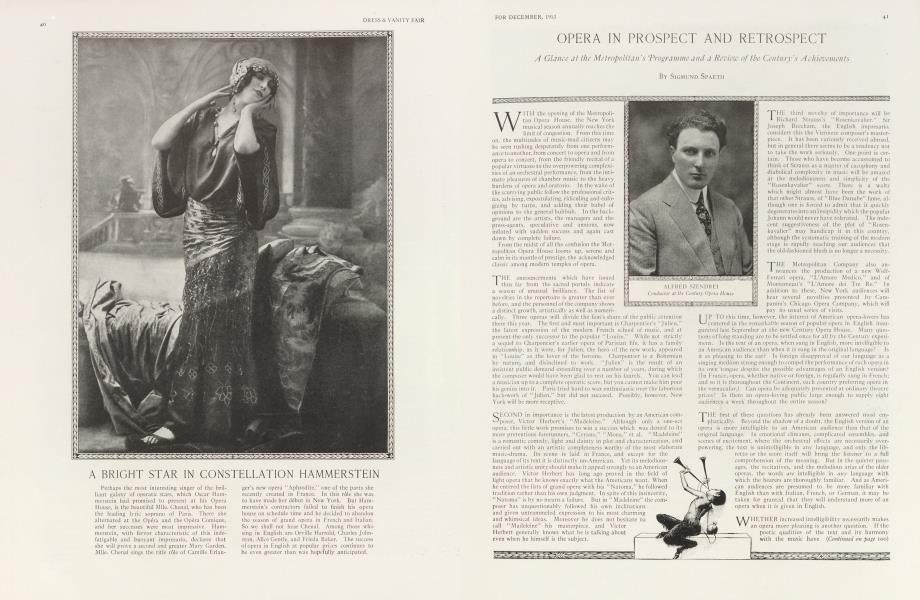
THERE is no reason why the performances at the Century Opera House should not be first-class in every way. The scenery and costumes are up to the highest standards; the orchestra, chorus and ballet are competent; the principals include two baritones of the first rank (Mr. Chalmers and Mr. Kreidler) one thoroughly satisfactory basso, (Mr. Kaufman) a tenor with a potentially great voice (Mr. Kingston) two very fair sopranos (Miss Ewell and Miss Scott) a remarkably good dramatic contralto, (Miss Howard) a mezzo whose singing and acting are adequate (Miss Jordan) and at least one conductor of temperament and energy (Mr. Szendrei). The material is there. If the game is played fairly the public will receive an astonishing return for its money. And thus, too, the ultimate question of the existence of such an opera-loving public will be solved. For a potential audience needs only a little encouragement to become a permanent reality. Such an audience will be as quickly built up through a few lavish successes as it will be destroyed by a few dismal failures.
AT PRESENT the popular attitude is still one of sympathetic and helpful interest in a scheme believed to be essentially philanthropic. But an unguarded disclosure of box-office secrets may easily change that attitude in time, much as the popular attitude toward "infant industries" changed perceptibly after the "protective" tariff had nursed them into full-grown corporations.
Subscribers have complete access to the archive.
Sign In Not a Subscriber?Join Now
