Sign In to Your Account
Subscribers have complete access to the archive.
Sign In Not a Subscriber?Join NowTHE BENJAMIN ALTMAN COLLECTION OF PAINTINGS
A Brief Consideration of the Metropolitan Museum's Latest Heritage
NOT more than twenty years ago French critics laughed without malice, in well ordered words, at the American art of collecting. Germans treated the same subject with a very expressive shrug of heavy shoulders. France told of the Rembrandts of the nineteenth century with which our collectors had burdened themselves and drew a picture of us in which pork packers, the cream of the nation, stalked out of myriad slaughter houses to purchase, in a moment of rest, a fancy Fragonard finished a month ago in a busy studio of the Batignolles, where the busses turn about to return to the heart of Paris. We were convinced, through authoritative evidence, that American collecting was a matter of names, of vanity, of pure ignorance. Fortunately we were not meek and humble, for in that case the private collections of Europe would have remained rich in old masters, and a good many old families, surrounded by the treasures of their antiquity, in debt.
BUT the years have rolled by and occasionally nowadays a Dr. Bode finds his way to our barbarous shores and returns home to shrug his shoulders after another fashion. The French laugh has turned, in the French simile, yellow. The British nation, despite a desperate appeal to patriotism and the brandishing of subscription lists, could not save the greatest of Rembrandt landscapes, "The Old Mill," which now reposes in the collection of Mr. P. A. B. Widener. It could not save, with the same efforts, the Velasquez portrait of Philip IV, the one with the flowered coat that is in the Fifth Avenue house of Mr. Henry C. Frick, nor yet the Holbein "Lady Lee" that the late Mr. Benjamin Altman kept in another brownstone mansion a few blocks away. They say now, with something of wisdom and something of justice over there, that American collecting is demoniacal.
SINCE the death of Benjamin Altman it has been generally conceded, here as abroad, that the collection he formed so quietly is to be numbered among the first of those gathered privately in the history of the world. And since he has left this collection en bloc to the Metropolitan Museum of Art, the significance of this statement is doubled. For, remembering the great Morgan loan, it means that our museum, but fortyseven years old, is to be numbered among the world museums, inferior only to such great ones as the National Gallery, the Prado, the Hermitage, and the Louvre. With these, however, we cannot hope to compete any more than we can hope to catch up to our fathers in age. And yet a collection like Mr. Altman's would be a valuable accession to any museum. It contains not alone examples of the work of the great painters of history, but great examples of their work. Few other private collections may boast names such as these in the Altman collection — Rembrandt, Hals, Velasquez, Van Dyck, Holbein, Mantegna, Vermeer of Delft, Boticelli, Fra Angelico, Fillipino Lippi, Antonella de Messina, Francia, Titian, Verrochio, Cosimo Tura, Albrecht Durer, Gerard David, Ruysdael, Jan Steen, Van Orley, and Dirk Boutts.
HERE is the greatest of the Spaniards, Velasquez, with a portrait of his patron and friend Philip IV that ranks with those in the National Gallery. This portrait had once been in the collection of the Duchess of Villerhermosa. It is a full length and shows Philip standing, clad in black, wearing the order of the Golden Fleece and the cape prescribed by the severe court etiquette. The art of Velasquez is here fully developed, rich, vibrant, forceful, and as only Velasquez could be, refined. His "Supper at Emmaus" is another Altman conquest.
Frans Hals who, technically, is the greatest painter of all time is represented with the "Merry Company" at one time in the collection of the late King Leopold of Belgium, and "Young Cavalier" both of which are, according to Doctor Bode "quite the most distinguished." The first of these was loaned by Mr. Altman to the Hudson-Fulton Exhibition at the Metropolitan Museum and is in the gay earlier mood of Hals, when he painted accurately as always, but with swaggering ease and vivacity, permitting himself laughter and carrying his art joyously along with him.
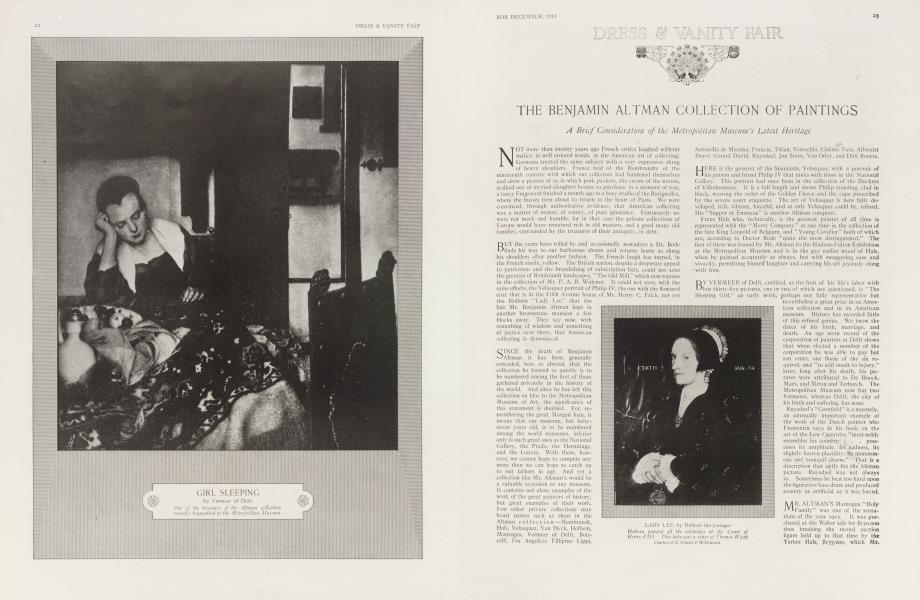
BY VERMEER of Delft, credited, as the fruit of his life's labor with but thirty-five pictures, one or two of which are questioned, is "The Sleeping Girl," an early work, perhaps not fully representative but nevertheless a great prize in an American collection and in an American museum. History has recorded little of this refined genius. We know the dates of his birth, marriage, and death. An age worn record of the corporation of painters at Delft shows that when elected a member of the corporation he was able to pay but ten cents, one florin of the six required, and "to add insult to injury," later, long after his death, his pictures were attributed to De Hooch, Maes, and Metsu and Terborch. The Metropolitan Museum now has two Vermeers, whereas Delft, the city of his birth and suffering, has none. Ruysdael's "Cornfield" is a masterly, an unusually important example of the work of the Dutch painter who Fromentin says in his book on the art of the Low Countries "most nobly resembles his country , . . possesses its amplitude, its .sadness, its slightly barren placidity, its monotonous and tranquil charm." That is a description that aptly fits the Altman picture. Ruysdael was not always so. Sometimes he beat too hard upon the figurative bass drum and produced scenery as artificial as it was forced.
MR. ALTMAN'S Mantegna "Holy Family" was one of the sensations of the year 1912. It was purchased at the Weber sale for $150,000 thus breaking the record auction figure held up to that time by the Yerkes Hals, $137,000, which Mr. Frick now owns. Executed in distemper it is to-day in a remarkable state of preservation, absolutely unblemished by those modern vandals the restorers. Curiously enough it was not recorded in the book on Mantegna. Dr. Bode, however, seeing it, authenticated it and for once was upheld by Dr. Berenson. It is a majestic picture, such a one as inspired Aubrey Beardsley in that copy published in the Yellow Book with which he attempted to put his critics to rout.
Another of the Altman pictures brought vividly to the public attention by the lure of price is the Holbein "Lady Lee." She was Margaret Wyatt, a sister of Thomas Wyatt known to fame, because he lamented so dolefully the ladies who loved him not. Lady Lee, this portrait suggests, must have looked upon her brother with scorn. She was severe, austere, apt to discover triviality in life and to damn it without mincing words. She was a fine subject for the painter of Henry VI11 who revelled in severe lines. This will be the third Holbein at the museum. The others are of men.
Mr. Altman owned four examples of the work of Hans Memling who is almost as rare in this country as Vermeer. His Van Dycks were of the Marchesa Durazzo, from the Rudolf Kann collection and of a man, entitled "The Astronomer." These are serious examples, elegant, but not, as is too often the case with this fine gentleman, artificial. Van Dyck could upon occasion be true to himself. He was true to himself in these pictures.
Mr. Altman's first pictures, purchased some thirty odd years ago were by the men of Barbizon. A little later we find him buying Mauves, find him, as it were, called to Holland. Eventually he bought his first old master, a Rembrandt. And then he gradually weeded all or nearly all the modern canvases from his collection to make room for more Rembrandts, The moderns apparently did not stand his test, the test of intimacy. He had a passion for perfection, for a particular perfection—for depth and honesty. A painter had to speak to him with all his heart and with a big brave heart. That is why eventually he owned fourteen exceptional Rembrandts; why perhaps he returned the Velasquez " Duke of Olivares" after it had hung in his gallery for a month or more; why the modern love of language ended by annoying him.
NO OTHER single collector possessed so many Rembrandts, and moreover, these in the Altman collection covering the last thirty yearsof the great Dutchman's life, were of the fullest and richest period. The most important of them is the forceful and kindly portrait entitled "An Old Woman Cutting Her Nails." Immediately after it might be placed the "Woman With a Pink," a portrait of Magdalen Van Loo, the wife of Rembrandt's son, Titus, who figures prominently in the Altman Collection, as though the collector's love of the painter extended to the members of his family. Thus there is a portrait of Titus painted in 1635, and one, "The Man With the Magnifying Glass," painted in 1668, a year before the father's death; and still another, according to the Metropolitan Museum authorities, from 1658, which has been known as "The Portrait of a Young Man" called Thomas Jacobsz Haring, and "The Auctioneer." The resemblance of this portrait to the Titus of the picture called "The Man With the Magnifying Glass'' caused the Museum's decision that they were both of the same subject. The other Rembrandts are the "Man With the Steel Gorget," 1644; "An Old Woman With a White Ruff," 1635; "Pilate Washing His Hands," 1655; "Portrait of Rembrandt," 1660; "Portrait of a Man," 1641;" Portrait of a Young Woman," 1633; " Portrait of Hendrickje Stoeffels," and the "Toilette of Bathsheba After the Bath," 1656. This last picture was the last addition to the Altman Collection. It was purchased from the Steengracht Collection, sold in Paris last summer, for $220,000, and remains to-day the high auction record. But three of these Rembrandts, "The Auctioneer," "The Lady with a Pink," purchased out of the Rudolf Kann collection, and the "Portrait of a Young Man" have been publicly shown in this country. Mr. Altman lent them with three other Dutch pictures to the Museum for the Hudson-Fulton Exhibition.
(Continued on page 108)
(Continued from page 26)
MR. MORGAN, in his art of collecting indulged a passion for power worthy of the house of Medici. He did not want certain fine things. He had no particular taste. He wanted all fine things. He bought a La Tour one day and a Rembrandt the next. He would have liked to own the museums of the world, and weeding them, as collectors must, be would have weeded only the mediocre examples and kept intact the best examples of all schools, of all nations, periods, mediums. He was frantically catholic and never loved art half so well as he did power of possession. Mr. Altman was his direct antithesis as a collector. He wanted to see a soul shine out of a picture. He wanted, with Carlyle, to remove the clothes and see the naked man. His collection contains, examples, to the exclusion of all others of the strong men of the world's art, the men who, no matter how great the struggle, by natural force rather than by borrowed learning or erudition, shoved their heads above the common level and gained immortality; gained it because they were men and not because they were masters of a craft.
IT WILL be said that the possession of a Boticelli should militate against this philosophy particularly as Mr. Berenson, with all the blandness of an authority, describing Mr. Altman's "Last Communion of St. Jerome" wrote: "Boticelli was the greatest master of line Europe ever had." But he does not tell us, as Mr. Altman might have done of his own Boticelli, of the gust of true poetic feeling, of nature's rhythmic song, that moved the man to express himself with a sinuous cadence. Boticelli was not rugged like Rembrandt nor positive like Hals. He was lyric. He sang when he walked in the fields inspired by the choir of nature singing around him. And Mr. Altman gathered that picture to him because, whether in poetry or prose, it displayed the heart of a man and displayed it exceptionally well. When we demand particular objects for our affection we separate them from the world around. We see only what we want to see. Boticelli with pure love, built out of nature a harmonious concord.
I HAVE made a particular note of this Boticelli because in the many articles that have been published about Mr. Altman's collection we read more of painting than we do of art; and because the painting or language of Boticelli is too often dwelt upon to the exclusion of his art or expression. Mr. Altman, unlike most of his brothers in the collecting world, was his own judge, and we may safely surmise that he was not a judge of painting, though he proved himself, throughout his collection, an implacable judge of men. We find him indeed, leaning at all times upon this judgment. He lived with his pictures and only gathered pictures that he loved. In verification of this we have but to consider the singular method he employed, his fear and hatred of publicity. This led him to extremes that have caused him to be pointed out as an eccentric. Perhaps he was an eccentric. He bought pictures with the greatest possible secrecy and shut the doors of his gallery to all but close friends and acknowledged experts. He did not want to be known as a collector, rarely, if ever, expressed himself upon matters of art, sought always pleasure and not fame. In short, he was a genuine art lover, not merely a collector.
Subscribers have complete access to the archive.
Sign In Not a Subscriber?Join Now


