
Sign In to Your Account
Subscribers have complete access to the archive.
Sign In Not a Subscriber?Join NowWHISPERS from the WINGS
Acton Davies
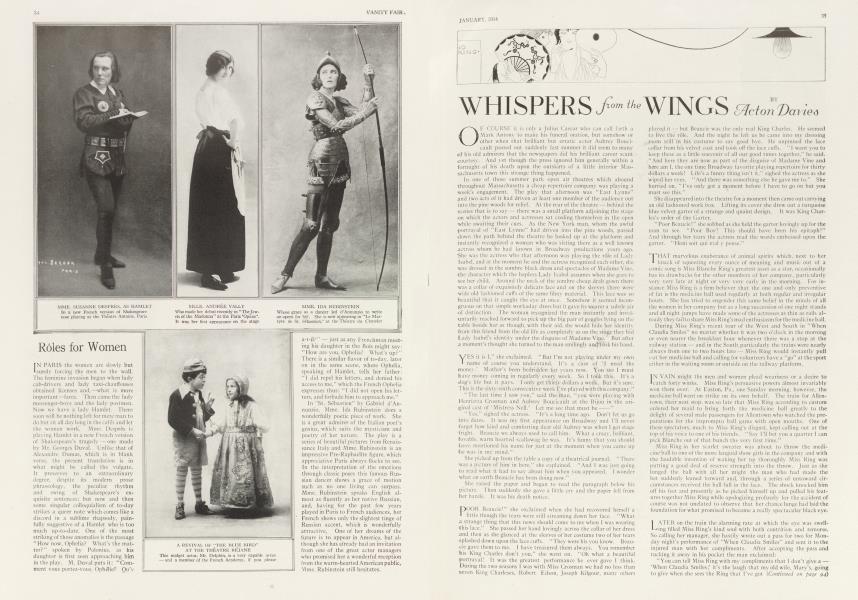
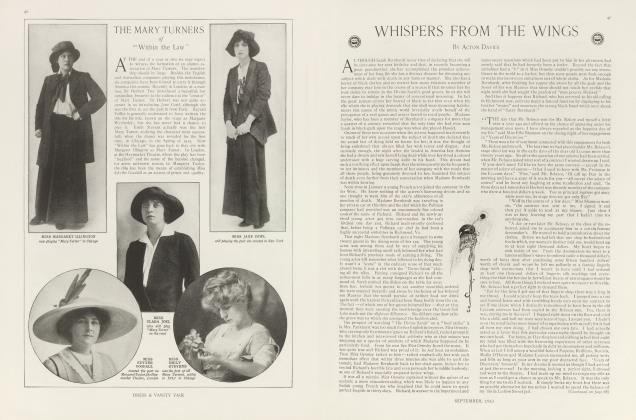
FF COURSE it is only a Julius Caesar who can call forth a Mark Antony to make his funeral oration, but somehow or other when that brilliant but erratic actor Aubrey Boucicault passed out suddenly last summer it did seem to many of his old admirers that the newspapers did his brilliant career scant courtesy. And vet though the press ignored him generally within a fortnight of his death upon the outskirts of a little interior Massachusetts town this strange thing happened.
In one of those summer park open air theatres which abound throughout Massachusetts a cheap repertoire company was playing a week's engagement. The play that afternoon was "East Lynne" and two acts of it had driven at least one member of the audience out into the pine woods for relief. At the rear of the theatre — behind the scenes that is to say — there was a small platform adjoining the stage on which the actors and actresses sat cooling themselves in the open while awaiting their cues. As the New York man, whom the awful portrayal of "East Lynne" had driven into the pine woods, passed down the path behind the theatre he looked up at the platform and instantly recognized a woman who was sitting there as a well known actress whom he had known in Broadway productions years ago. She was the actress who that afternoon was playing the role of Lady Isabel, and at the moment he and the actress recognized each other, she was dressed in the sombre black dress and spectacles of Madame Vine, the character which the hapless Lady Isabel assumes when she goes to see her child. Around the neck of the sombre cheap drab gown there was a collar of exquisitely delicate lace and on the sleeves there were wide old fashioned cuffs of the same filmy material. This lace was so beautiful that it caught the eye at once. Somehow it seemed incongruous on that simple workaday dress but it gave its wearer a subtle air of distinction. The woman recognized the man instantly and involuntarily reached forward to pick up the big pair of goggles lying on the table beside her as though, with their aid, she would hide her identity from this friend from the old life as completely as on the stage they hid Lady Isabel's identity under the disguise of Madame Vipe. But after a moment's thought she turned to the man smilingly andTdok his hand.
YES it is I," she exclaimed. "But I'm not playing under my own name of course you understand. It's a case of 'I need the money.' Mother's been bedridden fpr years now. You see I must Lave money coming in regularly every week. So I took this. It's a dog's life but it pays. I only get thirty dollars a week. But it's sure. This is the sixty-sixth consecutive week I've played with this company."
"The last time I saw you," said the man, "you were playing with Henrietta Crosman and Aubrey Boucicault at the Bijou in the original cast of ' Mistress Nell.' Let me see that must be-"
"Yes," sighed the actress. "It's a long time ago. Don't let us go into dates. It was my first appearance on Broadway and I'll never forget how kind and comforting dear old Aubrey was when I got stage fright. Beaucie we always used to call him. What a crazy, brilliant, Jovable, warm hearted scallawag he was. It's funny that you should have mentioned his name for just at the moment when you came up (he was in my mind."
She picked up from the table a copy of a theatrical journal. "There was a picture of him in here," she explained. "And I was just going to read what it had to sav about him when you appeared. I wonder what on earth Beaucie has been doing now."
She raised the paper and began to read the paragraph below his picture. Then suddenly she gave a little cry and the paper fell from her hands. It was his death notice.
POOR Beaucie!" she exclaimed when she had recovered herself a little though the tears were still streaming down her face. "What a strange thing that this news should come to me when I was wearing this lace." She passed her hand lovingly across the collar of her dress and then as she glanced at the sleeves of her costume two of her tears splashed down upon the lace cuffs. "They were his you know. Beaucie gave them to me. I have treasured them always. You remember Lis King Charles don't you," she went on. "Oh what a beautiful portrayal! It was the greatest performance he ever gave I think. During the two seasons I was with Miss Crosman we had no less than seven King Charleses, Robert Edson, Joseph Kilgour, many others played it — but Beaucie was the only real King Charles. He seemed to live the role. And the night he left us he came into my dressing room still in his costume to say good bye. He unpinned the lace collar from his velvet coat and took off the lace cuffs. " I want you to keep these as a little souvenir of all our good times together," he said. "And here they are now as part of the disguise of Madame Vine and here am I, the one time Broadway favorite playing repertoire for thirty dollars a week! Life's a funny thing isn't it," sighed the actress as she wiped her eyes. "And there was something else he gave me to." She hurried on, " I've only got a moment before I have to go on but you must see this."
She disappeared into the theatre fora moment then came out carrying an old fashioned work box. Lifting its cover she drew out a turquoise blue velvet garter of a strange and quaint design, It was King Charles's order of the Garter.
"Poor Beaucie!" she sobbed as she held the garter lovingly up for the man to see. "Poor Boy! This should have been his epitaph!" And through her tears the actress read the words embossed upon the garter. "Honi soit qui mal y pense."
THAT marvelous exuberance of animal spirits which, next to her knack of squeezing every ounce of meaning and music out of a comic song is Miss Blanche Ring's greatest asset as a star, occasionally has its drawbacks for the other members of her company, particularly very very late at night or very very early in the morning. For instance Miss Ring is a firm believer that the one and only preventive of fat is the medicine ball used regularly at both regular and irregular hours. She has tried to engender this same belief in the minds of all the women in her company but as a long succession of one night stands and all night jumps have made some of the actresses as thin as rails already they fail to share M iss Ring's mad enthusiasm for the medicine ball.
During Miss Ring's recent tour of the West and South in "When Claudia Smiles" no matter whether it was two o'clock in the morning or even nearer the breakfast hour whenever there was a stop at the railway station — and in the South particularly the trains were nearly always from one to two hours late — Miss Ring would instantly pull cut her medicine ball and calling for volunteers have a "go" at the sport either in the waiting room or outside on the railway platform.
IN VAIN might the men and women plead weariness or a desire to catch forty winks. Miss Ring's persuasive powers almost invariably won them over. At Easton, Pa., one Sunday morning, however, the medicine ball went on strike on its own behalf. The train for Allentown, their next stop, was so late that Miss Ring according to custom ordered her maid to bring forth the medicine ball greatly to the delight of several male passengers for Allentown who watched the preparations for the impromptu ball game with open mouths. One of these spectators, much to Miss Ring's disgust, kept calling out at the top of his voice to one of his friends. "Say I'll bet you a quarter I can pick Blanche out of that bunch the very first time."
Miss Ring in her scarlet sweater was about to throw the medicine ball to one of the more languid show girls in the company and with the laudable intention of waking her up thoroughly Miss Ring was putting a good deal of reserve strength into the throw. Just as she lunged the ball with all her might the man who had made the bet suddenly leaned forward and, through a series of untoward circumstances received the ball full in the face. The shock knocked him off his feet and presently as he picked himself up and pulled his features together Miss Ring while apologizing profusely for the accident of course was not unelated to observe that her chance lunge had laid the foundation for what promised to become a really spectacular black eye.
LATER on the train the alarming rate at which the eye was swelling filled Miss Ring's kind soul with both contrition and remorse. So calling her manager, she hastily wrote out a pass for two for Monday night's performance of "When Claudia Smiles" and sent it to the injured man with her compliments. After accepting the pass and tucking it away in his pocket the man exclaimed:
"You can tell Miss Ring with my compliments that I don't give a — 'When Claudia Smiles;' it's the laugh that my old wife, Mary's, going to give when she sees the Ring that I've got troubling me. She'll never fall for that medicine ball yarn — not in a thousand years.
(Continued on page 94)
Continued from page 35
UP in Brattleboro, Vt., the theatregoing public have been complaining lately that they have had too many " rep" companies and moving picture functions and not enough legitimate attractions. In front of the Opera House the other day an irate old farmer buttonholed the owner of the theatre and after lodging a violent protest on the decadence of things dramatic in that vicinity remarked: "Say, the nearest thing you've given us to Shakespeare this season has been "St. Elmo" and the "Girl in the Taxi" why don't you drop a postal to that Sothern-Marlowe outfit and see if they won't come up and give us something a little more high class."
It was in another town not a hundredmiles from Brattleboro that the manager of the theatre recently discovered a new means of luring audiences into his play house. Traveling companies were in the habit of renting his theatre outright for fifteen dollars a night but this did not entitle them to the use of the furnace so after several audiences had been almost frozen stiff in the orchestra chairs the townspeople declared that hereafter he might as well keep his house closed until the warm weather came as no citizen, unless he was a voluntary candidate for pneumonia, would dream of entering the building. This ultimatum worried the manager considerably so when the next traveling company, a comic opera, came along he decided to charge them twenty dollars but to turn on all the steam heat.
On noon of the day when the performance of "Alma Where Do You Live" twenty small boys were engaged by the manager to parade up and down Main Street with placards on their backs having this mystic announcement:
"Hot Comic Opera at the Opera House To-night.
Come One Come All.
And This Time You Won't Have To Blow Your Fingers to Keep' Em Warm.
Our Pipes Is as Hot as The Show."
IN THE archives of the Hippodrome 1 there is a huge scrap book in which the Management have carefully preserved all the strange and extraordinary requests for free seats which have come to them from time to time. But weird as many of these requests are the one which Press Representative Ben Atwell cherishes most was written by a young woman whom he had met on several occasions.
"My dear Friend," it ran, "1 know you will be shocked to hear of the death of my dear mother. She died suddenly in Vienna yesterday but as I cannot get a ship until Saturday if you could send me a box for the Hippodrome for tomorrow night I should be infinitely obliged."
Subscribers have complete access to the archive.
Sign In Not a Subscriber?Join Now
