Sign In to Your Account
Subscribers have complete access to the archive.
Sign In Not a Subscriber?Join NowCASUAL CUT-OUTS
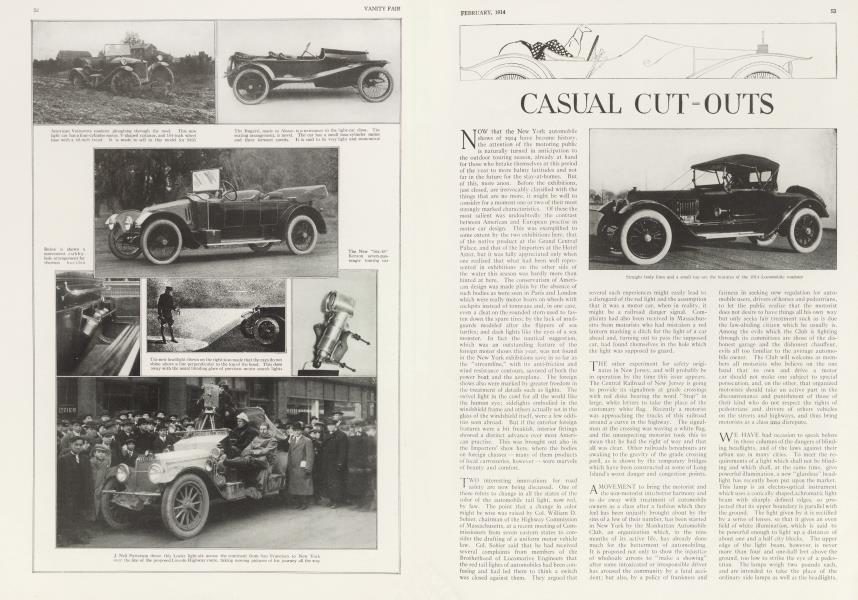
NOW that the New York automobile shows of 1914 have become history, the attention of the motoring public is naturally turned in anticipation to the outdoor touring season, already at hand for those who betake themselves at this period of the year to more balmy latitudes and not far in the future for the stay-at-homes. But of this, more anon. Before the exhibitions, just closed, are irrevocably classified with the things that are no more, it might be well to consider for a moment one or two of their most strongly marked characteristics. Of these the most salient was undoubtedly the contrast between American and European practise in motor car design. This was exemplified to some extent by the two exhibitions here, that of the native product at the Grand Central Palace, and that of the Importers at the Hotel Astor, but it was fully appreciated only when one realized that what had been well represented in exhibitions on the other side of the water this season was hardly more than hinted at here. The conservatism of American design was made plain by the absence of such bodies as were seen in Paris and London which were really motor boats on wheels with cockpits instead of tonneaus and, in one case, even a cleat on the rounded stern used to fasten down the spare tires; by the lack of mudguards modeled after the flippers of sea turtles; and dash lights like the eyes of a sea monster. In fact the nautical suggestion, which was an outstanding feature of the foreign motor shows this year, was not found in the New York exhibitions save in so far as the "streamline," with its anti-friction and wind resistance contours, savored of both the power boat and the aeroplane. The foreign shows also were marked by greater freedom in the treatment of details such as lights. The swivel light in the cowl for all the world like the human eye; sidelights embodied in the windshield frame and others actually set in the glass of the windshield itself, were a few oddities seen abroad. But if the exterior foreign features were a bit freakish, interior fittings showed a distinct advance over most American practise. This was brought out also in the Importers' show here, where the bodies on foreign chasses — many of them products of local carrosseries, however — were marvels of beauty and comfort.
TWO interesting innovations for road safety are now being discussed. One of these refers to change in all the states of the color of the automobile tail light, now red, by law. The point that a change in color might be wise was raised by Col. William D. Sohier, chairman of the Highway Commission of Massachusetts, at a recent meeting of Commissioners from seven eastern states to consider the drafting of a uniform motor vehicle law. Col. Sohier said that he had received several complaints from members of the Brotherhood of Locomotive Engineers that the red tail lights of automobiles had been confusing and had led them to think a switch was closed against them. They argued that several such experiences might easily lead to a disregard of the red light and the assumption that it was a motor car, when in reality, it might be a railroad danger signal. Complaints had also been received in Massachusetts from motorists who had mistaken a red lantern marking a ditch for the light of a car ahead and, turning out to pass the supposed car, had found themselves in the hole which the light was supposed to guard.
THE other experiment for safety originates in New Jersey, and will probably be in operation by the time this issue appears. The Central Railroad of New Jersey is going to provide its signalmen at grade crossings with red disks bearing the word "Stop" in large, white letters to take the place of the customary white flag. Recently a motorist was approaching the tracks of this railroad around a curve in the highway. The signalman at the crossing was waving a white flag, and the unsuspecting motorist took this to mean that he had the right of way and that all was clear. Other railroads hereabouts are awaking to the gravity of the grade crossing peril, as is shown by the temporary bridges which have been constructed at some of Long Island's worst danger and congestion points.
A MOVEMENT to bring the motorist and the non-motorist into better harmony and to do away with treatment of automobile owners as a class after a fashion which they feel has been unjustly brought about by the sins of a few of their number, has been started in New York by the Manhattan Automobile Club, an organization which, in the nine months of its active life, has already done much for the betterment of automobiling. It is proposed not only to show the injustice of wholesale arrests to "make a showing" after some intoxicated or irresponsible driver has aroused the community by a fatal accident; but also, by a policy of frankness and fairness in seeking new regulation for automobile users, drivers of horses and pedestrians, to let the public realize that the motorist does not desire to have things all his own way but only seeks fair treatment such as is due the law-abiding citizen which he usually is. Among the evils which the Club is fighting through its committees are those of the dishonest garage and the dishonest chauffeur, evils all too familiar to the average automobile owner. The Club will welcome as members all motorists who believe on the one hand that to own and drive a motor car should not make one subject to special persecution, and, on the other, that organized motorists should take an active part in the discountenance and punishment of those of their kind who do not respect the rights of pedestrians and drivers of others vehicles on the streets and highways, and thus bring motorists as a class into disrepute.
WE HAVE had occasion to speak before in these columns of the dangers of blinding headlights, and of the laws against their urban use in many cities. To meet the requirements of a light which shall not be blinding and which shall, at the same time, give powerful illumination, a new "glareless" headlight has recently been put upon the market. This lamp is an electro-optical instrument which uses a conically shaped,achromatic light beam with sharply defined edges, so projected that its upper boundary is parallel with the ground. The light given by it is rectified by a series of lenses, so that it gives an even field of white illumination, which is said to be powerful enough to light up a distance of about one and a half city blocks. The upper edge of the light beam, however, is never more than four and one-half feet above the ground, too low to strike the eye of a pedestrian. The lamps weigh two pounds each, and are intended to take the place of the ordinary side lamps as well as the headlights.
Subscribers have complete access to the archive.
Sign In Not a Subscriber?Join Now
