Sign In to Your Account
Subscribers have complete access to the archive.
Sign In Not a Subscriber?Join NowMONTESSORI METHODS IN GOLF
Marshall Whitlatch
SIGNORA MONTESSORI, through exercises which teach the child correct muscular movements, teaches reading and writing by a method which produces no strain upon the child's intellect. I have designed a scheme to parallel her idea to show golfers how to perfect themselves by learning correct movements, with particular emphasis on movements to differentiate from the method of the majority of golfers, who seem to think that correct poses or stances, and aiming, in repose, was the way to solve the problem and was the basis from which to start.
In a former article I coined the term "master-path" to describe that part of the path of the head of the club, beginning an inch or two before reaching the ball and passing straight through the center of the ball for about a foot. This is the only part of the swing that it is possible to give any conscious attention to successfully. I have recently made the following experiment to show friends what I mean by studying the master-path and forgetting all the rest.
I HAVE allowed them to put me in all kinds of stances, and I showed them that I could get away a good ball notwithstanding. The same experiment was followed in respect to the grip, etc. This showed me how much I had overestimated the importance of stance in the past. The method I followed was to find from a trial swing or two exactly where the master-path was and observe how the club acted at that point, and when I stepped up to the ball I concentrated all my attention upon hitting it. The feeling or sense of where the club head would go without any other mental process, enabled me to get the ball away.
I have seen Jerome Travers get his ball in some very tough lies, where he had to assume positions which I am quite sure he never had been in before, and yet those who have seen him will recall how well he succeeds in getting the ball out of them. It will be recalled how carefully he concentrated his attention on hitting his ball after he had assumed the best position or stance he could under the circumstances.
The whole of the mental process is to observe carefully in the address when waggling the club over the ball what the direction of the master-path is and then, adjusting oneself so that with the best swing that can be made under the circumstances, the ball will go off on the desired line.
CONSTANT study of the stance or grip or anything else than the master-path is of absolutely no value, and will be a direct interference with a player's obtaining that kind of muscular education which enables him to make a golf stroke successfully.
I wish to say that this path is a straight line and not a curved line, as is generally pictured. That is, the player must try to make his club head go along an imaginary straight line and not an imaginary curved line. The reason is that, in attempting to make the club head go along a straight line, the player will let his hands go out after the ball, while if he attempts to make a curved line, he will draw in his hands. The "follow through," as it is called, will be killed if the hands are drawn in, and a sliced ball will result.
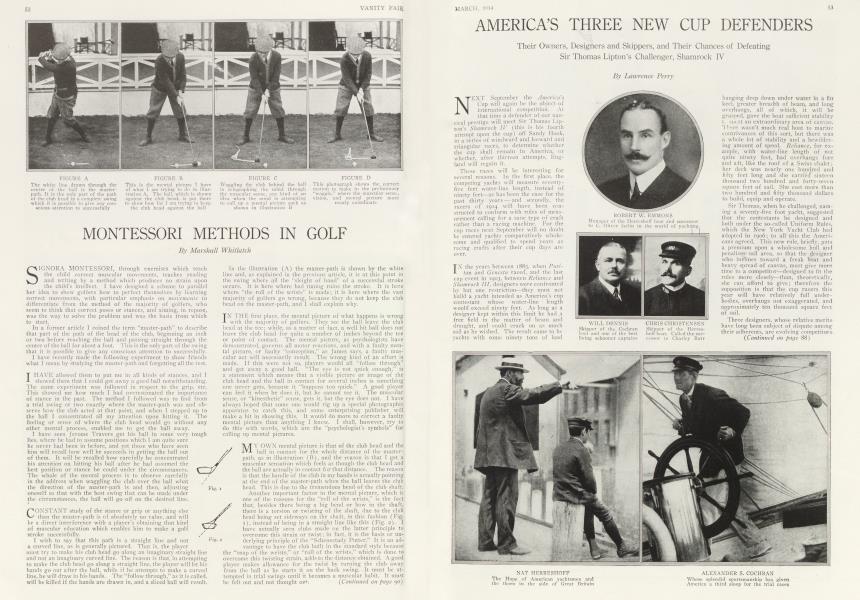
In the illustration (A) the master-path is shown by the white line and, as explained in the previous article, it is at this point in the swing where all the "sleight of hand" of a successful stroke occurs. It is here where bad timing ruins the stroke. It is here where "the roll of the wrists" is made; it is here where the vast majority of golfers go wrong, because they do not keep the club head on the master-path, and I shall explain why.
IN THE first place, the mental picture of what happens is wrong with the majority of golfers. They see the ball leave the club head at the tee; while, as a matter of fact, a well hit ball does not leave the club head for quite a number of inches beyond the tee or point of contact. The mental picture, as psychologists have demonstrated, governs all motor reactions, and with a faulty mental picture, or faulty "conception," as James says, a faulty muscular act will necessarily result. The wrong kind of an effort is made. If this were not so, players would all "follow through" and get away a good ball. "The eye is not quick enough," is a statement which means that a visible picture or image of the club head and the ball in contact for several inches is something one never gets, because it "happens too quick." A good player can feel it when he does it, but he cannot see it. The muscular sense, or "kinesthetic" sense, gets it, but the eye does not. I have always hoped that some one would rig up a special photographic apparatus to catch this, and some enterprising publisher will make a hit in showing this. It would do more to correct a faulty mental picture than anything I know. I shall, however, try to do this with words, which are the "psychologist's symbols" for calling up mental pictures.
MY OWN mental picture is that of the club head and the ball in contact for the whole distance of the masterpath, as in illustration (B), and the reason is that I get a muscular sensation which feels as though the club head and the ball are actually in contact for that distance. The reason is that the handle of the club in my hands is actually pointing at the end of the master-path when the ball leaves the club head. This is due to the tremendous bend of the club shaft.
Another important factor in the mental picture, which is one of the reasons for the "roll of the wrists," is the fact that, besides there being a big bend or bow in the shaft, there is a torsion or twisting of the shaft, due to the club head being set sideways on the shaft, in this fashion (Fig. I), instead of being in a straight line like this (Fig. 2). I have actually seen clubs made on the latter principle to overcome this strain or twist; in fact, it is the basis or underlying principle of the "Schenectady Putter." It is an advantage to have the club built in the standard style because the "snap of the wrists," or "roll of the wrists," which is done to overcome this twisting strain, adds to the distance obtained. A good player makes allowance for the twist by turning the club away from the ball as he starts it on the back swing. It must be attempted in trial swings until it becomes a muscular habit. It must be felt out and not thought out
(Continued on page 90)
(Continued from page 52)
A great many players who can hit the ball, can not drive it off straight, and invariably get a slice or a hook, and it is solely because of the faulty mental picture they have. Because they cannot get a visible image of the bow in the shaft and the twist of the club, they hit the ball without making any allowance for these facts, and they hit too hard and hit too soon, or make all their effort to "smack" the ball away.
Because the real inside or secret of a successful effort cannot be consciously seen, on account of the speed with which everything happens on the master-path, players try all sorts of remedies like changing the stance, grip and other things, instead of realizing that unless the club face when it is in contact with the ball is kept squared with the desired line of flight during the entire distance of the master-path it is not possible to send the ball away on that line.
In illustration C, I show the way great numbers of golfers make their preliminary waggle, o*r "feel out," of the stroke. They stop the'club short of the ball, and some go through the same motion with the club head a couple of inches lower than shown here, actually on a level with the hall. This actually predisposes them to stop their swing at that point, because through their muscular sense they are educating their muscles to that sensation, and they are set to balance themselves and be comfortable in that position, and then they wonder why they lose their balance, or pull in their hands and get a sliced ball, when they make their actual swing. It is due to an instinctive effort to keep their balance, which will work through the muscular sense in spite of themselves, and far quicker than they can give thought to it. It will take a very good golfer to bring off a good shot with that scheme of address.
In illustration D, I show the way to educate the muscles by an exercise that makes the club head go through a preliminary master-path a few inches above the ball, and then, when everything is ready, by putting the club head behind the ball lightly, the player will have obtained a good preliminary muscular sensation of the correct movement to make. Do not forget that the club head is faced to get the ball up. All the player has to think of is to send his club along the masterpath.
Subscribers have complete access to the archive.
Sign In Not a Subscriber?Join Now
