Sign In to Your Account
Subscribers have complete access to the archive.
Sign In Not a Subscriber?Join NowTHE SHOPS OF VANITY FAIR
Traveling Almost as Fast as the Sun, Fashions Appear in Paris Today and Are Here Tomorrow
THE alertness of the shops, both large and small, their constant and conscientious effort to place before the public, which grows more discriminating each season, apparel that is at once smart, wearable, and reasonable in price, is most noticeable at this time of the year when one season is gradually merging into another. A fashion is conceived in Paris; a week later it appears—if only photographically—in America, its good points are instantly seized upon and, in less time than it takes to tell, the innovation is on sale in the shops at a price that, in itself, offers a distinct appeal.
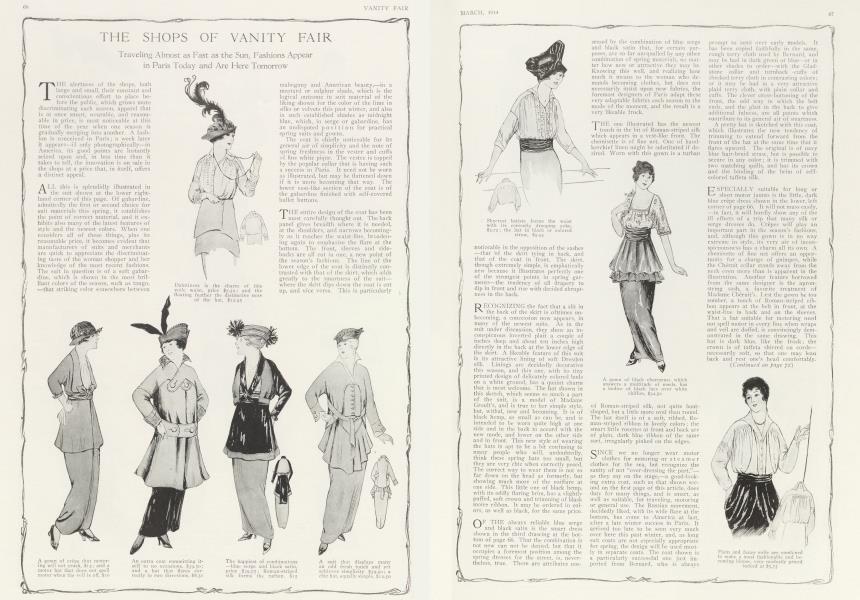
ALL this is splendidly illustrated in the suit shown at the lower righthand corner of this page. Of gabardine, admittedly the first or second choice for suit materials this spring, it establishes the point of correct material, and it exhibits also many of the latest features of style and the newest colors. When one considers all of these things, plus its reasonable price, it becomes evident that manufacturers of suits and merchants are quick to appreciate the discriminating taste of the woman shopper and her knowledge of the most recent fashions. The suit in question is of a soft gabardine, which is shown in the most brilliant colors of the season, such as tango, —that striking color somewhere between mahogany and American beauty,—in a mustard or sulphur shade, which is the logical outcome in suit material of the liking shown for the color of the lime in silks or velvets this past winter, and also in such established shades as midnight blue, which, in serge or gabardine, has an undisputed position for practical spring suits and gowns.
The coat is chiefly noticeable for its general air of simplicity and the note of spring freshness in the vestee and cuffs of fine white pique. The vestee is topped by the popular collar that is having such a success in Paris. It need not be worn as illustrated, but may be flattened down if it is more becoming that way. The lower vest-like section of the coat is of the gabardine finished with self-covered bullet buttons.
THE entire design of the coat has been most carefully thought out. The back panel gives breadth where it is needed, at the shoulders, and narrows becomingly as it reaches the waist-line, broadening again to emphasize the flare at the bottom. The front, sleeves and sidebacks are all cut in one, a new point of the season's fashions. The line of the lower edge of the coat is distinctly contrasted with that of the skirt, which adds greatly to the smartness of the suit— where the skirt dips down the coat is cut up, and vice versa. This is particularly noticeable in the opposition of the sashes —that of the skirt tying in back, and that of the coat in front. The skirt though extremely simple, is emphaticall) new because it illustrates perfectly one of the strongest points in spring garments—the tendency of all drapery tc dip in front and rise with decided abruptness in the back.
RECOGNIZING the fact that a slit in the back of the skirt is ofttimes unbecoming, a concession now appears, in many of the newest suits. As in the suit under discussion, they show an inconspicuous inverted plait a couple of inches deep and about ten inches high directly in the back at the lower edge of the skirt. A likeable feature of this suit is its attractive lining of soft Dresden silk. Linings are decidedly decorative this season, and this one, with its tiny printed design of delicately colored buds on a white ground, has a quaint charm that is most welcome. The hat shown in this sketch, which seems so much a part of the suit, is a model of Madame Groult's, and is true to her simple style, but, withal, new and becoming. It is of black hemp, as small as can be, and is intended to be worn quite high at one side and in the back to accord with the new mode, and lower on the other side and in front. This new style of wearing the hats is apt to be a bit confusing to many people who will, undoubtedly, think these spring hats too small, but they are very chic when correctly posed. The correct way to wear them is not so far down on the head as formerly, but showing much more of the coiffure at one side. This little one of black hemp, with its oddly flaring brim, has a slightlv puffed, soft crown and trimming of black moire ribbon. It may be ordered in colors, as well as black, for the same price.
THE always reliable blue serge and black satin is the smart dress shown in the third drawing at the bottom of page 66. That the combination is not new can not be denied, but that it occupies a foremost position among the spring dresses for the street, is, nevertheless, true. There are attributes possessed by the combination of blue serge and black satin that, for certain purposes, are so far unequalled by any other combination of spring materials, no matter how new or attractive they may be. Knowing this well, and realizing how much it means to the woman who demands becoming clothes, but does not necessarily insist upon new fabrics, the foremost designers of Paris adapt these very adaptable fabrics each season to the mode of the moment, and the result is a very likeable frock.
THE one illustrated has the newest touch in the bit of Roman-striped silk which appears in a vest-like front. The chemisette is of fine net. One of handkerchief linen might be substituted if desired. Worn with this gown is a turban of Roman-striped silk, not quite boatshaped, but a little more oval than round. The hat itself is of a soft, ribbed, Roman-striped ribbon in lovely colors; the smart little rosettes at front and back are of plain, dark blue ribbon of the same sort, irregularly pinked on the edges.
SCINCE we no longer wear motor clothes for motoring or steamer clothes for the sea, but recognize the sanity of not "over-dressing the part,"— as they say on the stage,—a good-looking extra coat, such as that shown second on the first page of this article, does duty for many things, and is smart, as well as suitable, for traveling, motoring or general use. The Russian movement, decidedly liked, with its wide flare at the bottom, has come to America at last, after a late winter success in Paris. It arrived too late to be seen very much over here this past winter, and, as long suit coats are not especially appropriate for spring, the design will be used mostly in separate coats. The coat shown is a particularly successful one just imported from Bernard, who is always prompt to send over early models. It has been copied faithfully in the same, rough terry cloth used by Bernard, and may be had in dark green or blue—or in other shades to order—with the Gladstone collar and turnback -cuffs of checked terry cloth in contrasting colors; or it may be had in a very attractive plaid terry cloth, with plain collar and cuffs. The clever cross-buttoning of the front, the odd way in which the belt ends, and the plait in the back to give additional fulness, are all points which contribute to its general air of smartness.
A pretty hat is sketched with this coat, which illustrates the new tendency of trimming to extend forward from the front of the hat at the same time that it flares upward. The original is of navy blue hair-braid straw, but is possible to secure in any color; it is trimmed with two matching quills, and has its crown and the binding of the brim of selfcolored taffeta silk.
FSPECIALLY suitable for long or — short motor jaunts is the little, dark blue crepe dress shown in the lower, left corner of page 66. It will not muss easily, —in fact, it will hardly show any of the ill effects of a trip that many silk or serge dresses do. Crepes will play an important part in the season's fashions, and, although this gown is in no way extreme in style, its very air of inconspicuousness has a charm all its own. A chemisette of fine net offers an opportunity for a change of guimpes, while the Chéruit collar stands away from the neck even more than is apparent in the illustration. Another feature borrowed from the same designer is the apronstring sash, a favorite treatment of Madame Cheruit's. Lest the gown be too somber, a touch of Roman-striped ribbon appears at the belt in front, at the waist-line in back and on the sleeves. That a hat suitable for motoring need not spell motor in every line when wraps and veil are doffed, is convincingly demonstrated in the same drawing. This hat is dark blue, like the frock; the crown is of taffeta shirred on cords— necessarily soft, so that one may lean back and rest one's head comfortably.
(Continued on page 72)
(Continued from page 66)
The short hemp brim, becomingly tilted up in back, is trimmed in front by a bouquet of tiny silk roses in three colors. This hat may also be ordered in other shades.
ONE of the soft black dresses as essential in a wardrobe as the blue serge, one-piece frock, is shown at the middle of page 67. The skirt, made of a soft, excellent quality of charmeuse, with a plaited pannier, finished at the bottom by a ruffle of fine, black, silk net, bound by a narrow band of the crepe meteor, is smart but not extreme. The wide belt, which ends at the left side of the back, in a full net bow, bound with satin, gives the dress a long-waisted effect that is most becoming. The belt is an important feature of the new gowns, frequently indeed sounding the most characteristic note.
The waist itself is a simple model made of an effective, wide-mesh black lace over white
chiffon; the manner in which the sleeves arc put in gives it an effect not unlike a bolero. A silk rose of a lovely American beauty shade is fastened upon the right shoulder as an added bit of ornament. This gown may be had in black, a lovely mouse-colored taupe, or in serpent green—a rich, colorful green, deeper and colder than Empire green, and very fashionable this season.
The spring's waists are particularly becoming, principally because of the attractively-shaped yokes that appear on most of them, and the softness of the materials and trimming. The exquisitely sheer batiste blouse, forming the illustration at the upper left corner of page 67 is as finely embroidered as a very dainty handkerchief. Put together with fine entredeux, it has a pretty vest-effect and a new cuff, and is shirred in an attractive manner onto a deep yoke. The collar, rather high in back and low and pointing at the side-front, is similar to that which appears on many of the season's prettiest models. The hat shown with it is of black hemp, fashioned after a becoming, conservative mushroom model. A puff of taffeta extends high on one side and low on the other, where it is caught by a soft bow. This hat may be had in colored or black straw.
OF THE finest voile, hand-embroidered in a design of eyelets and dots, the simple blouse, serving for the first illustration in the article, on page 66, is delightfully cool and sheer in effect, and has the appearance of a hand-made blouse, although it actually is put together by machine. The three-quarter-length sleeves are finished by a tucked cuff, edged by a ruffle of lace. A very attractive hat, which is easy to wear, because of the modest sweep of the up-turning brim that also manages to turn outward at the back in the newest fashion, is made of purple hemp with a soft taffeta crown and upstanding trimming of heckle feathers. It may be had to order in black or in straws of other colors. The waist at the upper left corner of this same page comes in pink, yellow, or white batiste, daintily trimmed with a puffing and frill of white batiste put on with entredeux, which is used also to join the seams. Colored waists of both batiste and handkerchief linen will undoubtedly enjoy a decided vogue this spring. They have been worn in Paris for some time, and have gradually found favor in America. This one has a cool, crisp air, due both to the combination of material and the pretty, boyish
collars and cuffs. Worn with this blouse is a pretty, moire hat, shown in black and colors, which has the new, rolling brim and a smart trimming of two fans of the moire.
AN EXCELLENT example of the new Gladstone collar used on a very smart waist is shown in the sketch at the upper right corner of this page. It is made of handkerchief linen, and has a plain chemisette, in contrast to the tucked ones that were so much in favor last year. The turnback cuffs are also a new touch seen on many of this season's blouses.
Collars, sleeves and yokes are the thermometers of waist fashions, and the waist illustrated at the lower right corner of page 67 is novel in all three points—the collar, known as the "san souci," fits the neck closely at the back and slopes gracefully in the front. The waist itself is of white voile, and the collar and cuffs of fancy voile.
Subscribers have complete access to the archive.
Sign In Not a Subscriber?Join Now

