Sign In to Your Account
Subscribers have complete access to the archive.
Sign In Not a Subscriber?Join NowIN THE LITERARY GARDEN
New Novels by Coningsby Dawson, W. B. Maxwell and Eleanor Hallowell Abbott— and the First Attempt of Robert Dunn
Henry Brinsley
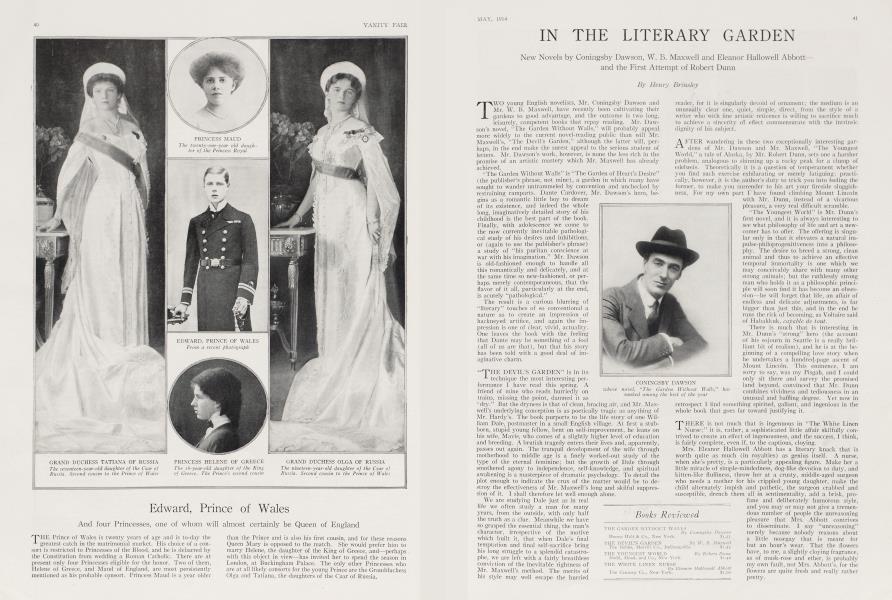
TWO young English novelists, Mr. Coningsby Dawson and Mr. W. B. Maxwell, have recently been cultivating their gardens to good advantage, and the outcome is two long, leisurely, competent books that repay reading. Mr. Dawson's novel, "The Garden Without Walls," will probably appeal more widely to the current novel-reading public than will Mr. Maxwell's, "The Devil's Garden," although the latter will, perhaps, in the end make the surest appeal to the serious student of letters. Mr. Dawson's work, however, is none the less rich in the promise of an artistic mastery which Mr. Maxwell has already achieved.
"The Garden Without Walls" is "The Garden of Heart's Desire" (the publisher's phrase, not mine), a garden in which many have sought to wander untrammeled by convention and unchecked by restraining ramparts. Dante Cardover, Mr. Dawson's hero, begins as a romantic little boy to dream of its existence, and indeed the whole long, imaginatively detailed story of his childhood is the best part of the book.
Finally, with adolescence we come to the now currently inevitable pathological study of his desires and inhibitions, or (again to use the publisher's phrase) a study of "his puritan conscience at war with his imagination." Mr. Dawson is old-fashioned enough to handle all this romantically and delicately, and at the same time so new-fashioned, or perhaps merely contemporaneous, that the flavor of it all, particularly at the end, is acutely "pathological."
The result is a curious blurring of "literary" touches of so conventional a nature as to create an impression of hackneyed artifice, and again the impression is one of clear, vivid, actuality.
One leaves the book with the feeling that Dante may be something of a fool (all of us are that), but that his story has been told with a good deal of imaginative charm.
"THE DEVIL'S GARDEN" is in its technique the most interesting performance I have read this spring. A have read this spring, friend of mine who reads hurriedly on trains, missing the point, damned it as "dry." But the dryness is that of clean, bracing air, and Mr. Maxwell's underlying conception is as poetically tragic as anything of Mr. Hardy's. The book purports to be the life story of one William Dale, postmaster in a small English village. At first a stubborn, stupid young fellow, bent on self-improvement, he leans on his wife, Mavis, who comes of a slightly higher level of education and breeding. A brutish tragedy enters their lives and, apparently, passes out again. The tranquil development of the wife through motherhood to middle age is a finely worked-out study of the type of the eternal feminine; but the growth of Dale through smothered agony to independence, self-knowledge, and spiritual awakening is a masterpiece of dramatic psychology. To detail the plot enough to indicate the crux of the matter would be to destroy the effectiveness of Mr. Maxwell's long and skilful suppression of it. I shall therefore let well enough alone.
We are studying Dale just as in real life we often study a man for many — years, from the outside, with only half the truth as a clue. Meanwhile we have so grasped the essential thing, the man's character, irrespective of the motive which built it, that when Dale's final temptation and final self-sacrifice bring his long struggle to a splendid catastrophe, we are left with a fairly breathless conviction of the inevitable rightness of Mr. Maxwell's method. The merits of his style may well escape the hurried reader, for it is singularly devoid of ornament; the medium is an unusually clear one, quiet, simple, direct, from the style of a writer who with fine artistic reticence is willing to sacrifice much to achieve a sincerity of effect commensurate with the intrinsic dignity of his subject.
A FTER wandering in these two exceptionally interesting gardens of Mr. Dawson and Mr. Maxwell, "The Youngest World," a tale of Alaska, by Mr. Robert Dunn, sets one a harsher problem, analogous to shinning up a rocky peak for a clump of edelweis. Theoretically it is a question of temperament whether you find such exercise exhilarating or merely fatiguing; practically, however, it is the author's duty to trick you into feeling the former, to make you surrender to his art your fireside sluggishness. For my own part I have found climbing Mount Lincoln with Mr. Dunn, instead of a vicarious pleasure, a very real difficult scramble.
"The Youngest World" is Mr. Dunn's first novel, and it is always interesting to see what philosophy of life and art a newcomer has to offer. The offering is singular only in that it elevates a natural impulse-philoprogenitiveness into a philosophy. The desire to breed a strong, clean animal and thus to achieve an effective temporal immortality is one which we may conceivably share with many other strong animals; but the ruthlessly strong man who holds it as a philosophic principle will soon find it has become an obsession—he will forget that life, an affair of endless and delicate adjustments, is far bigger than just this, and in the end he runs the risk of becoming, as Voltaire said of Habakkuk, capable de tout.
There is much that is interesting in Mr. Dunn's "strong" hero (the account of his sojourn in Seattle is a really brilliant bit of realism), and he is at the beginning of a compelling love story when he undertakes a hundred-page ascent of Mount Lincoln. This eminence, I am sorry to say, was my Pisgah, and I could only sit there and survey the promised land beyond, convinced that Mr. Dunn combines vividness and tediousness in an unusual and baffling degree. Yet now in
retrospect I find something spirited, gallant, and ingenious in the whole book that goes far toward justifying it.
'T'HERE is not much that is ingenuous in "The White Linen -*• Nurse;" it is, rather, a sophisticated little affair skilfully contrived to create an effect of ingenousness, and the success, I think, is fairly complete, even if, to the captious, cloying.
Mrs. Eleanor Hallowell Abbott has a literary knack that is yvorth quite as much (in royalties) as genius itself. A nurse, when she's pretty, is a particularly appealing figure. Make her a little miracle of simple-mindedness, dog-like devotion to duty, and kitten-like fluffiness, throw her at a crusty, middle-aged surgeon who needs a mother for his crippled young daughter, make the child alternately impish and pathetic, the surgeon crabbed and susceptible, drench them all in sentimentality, add a brisk, profane and deliberately humorous style, and you may or may not give a tremendous number of people the unreasoning pleasure that Mrs. Abbott contrives to disseminate. I say "unreasoning" merely because nobody reasons about a little nosegay that is meant for but an hour's wear. That the flowers have, to me, a slightly cloying fragrance, as of musk-rose and ether, is probably my own fault, not Mrs. Abbott's, for the flowers are quite fresh and really rather pretty.
Books Reviewed
THE GARDEN WITHOUT WALLS
By Coningsby Dawson Henry Holt & Co., New York. $i-35
THE DEVIL'S GARDEN By IV. B. Maxwell
The Bobbs, Merrill Co., Indianapolis. $1.35
THE YOUNGEST WORLD
Dodd, Mead, and Co., New York.
By Robert Dunn $1.40
THE WHITE LINEN NURSE
By Eleanor Hallowell Abbott The Century Co., New York. $1.00
Subscribers have complete access to the archive.
Sign In Not a Subscriber?Join Now