Sign In to Your Account
Subscribers have complete access to the archive.
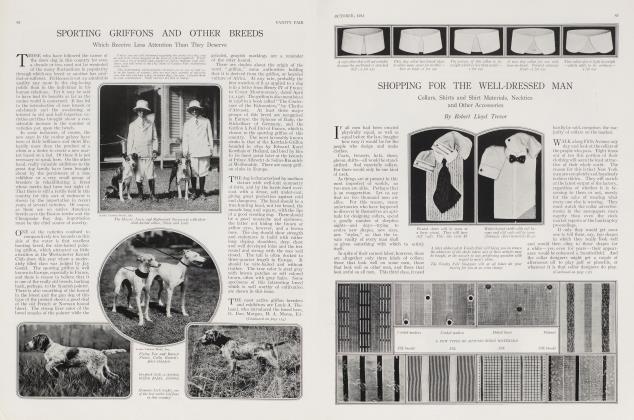
Sign In Not a Subscriber?Join NowSHOPPING FOR THE WELL-DRESSED MAN
Collars, Shirts and Shirt Materials, Neckties and Other Accessories
Robert Lloyd Trevor
IF all men had been created physically equal, as well as equal before the law, imagine how easy it would be for the people who design and make clothes.
Coats, trousers, hats, shoes, gloves, shirts—all would be standardized. And especially collars.
For there would only be one kind of neck.
As things are at present in this most imperfect of worlds, no two men are alike. Perhaps that is an exaggeration. Let us say that no two thousand men are alike. For this reason, many unfortunates who have happened to discover in themselves an apti tude for designing collars, spend a goodly number of sleepless nights-and days-trying to evolve new shapes, new sizes, new "styles," so that the in nate vanity of every man shall be given something with which to satisfy itself.
In spite of their earnest labor, however, there are altogether only three kinds of collars: those that look well on some men, those that look well on other men, and those that look awful on all men. This third class, it need
A letter addressed to Vanity Fair will bring you in return the addresses of the shops where any of these articles may be bought, or the answer to any perplexing question with regard to men's attire.
The Vanity Fair Shoppers will at all times do your buying for you at no extra charge
hardly be said, comprises the majority of collars on the market.
WALK along Fifth Avenue any day and look at the collars of the people who pass. Eight times out of ten this portion of their clothing will seem the least attractive of their whole outfit. The reason for this is that New York men are completely and hopelessly fashion ridden. They will snatch at the latest output of the factory, regardless of whether it is becoming to them or not, merely for the sake of wearing what every one else is wearing. They must watch the collar advertisements in the newspapers more eagerly than even the stock market reports or the bankruptcy proceedings.
If only they would get some one to tell them, say, two shapes in which they really look well and would then cling to those shapes for a while—yes, even for years—their appearance would be enhanced a hundredfold. And the collar designers might get a couple of afternoons off to play golf or pinochle, or whatever it is that collar designers do play.
A FEW TYPES OF AUTUMN SHIRT MATERIALS
Continued on page 136
Continued from page 83
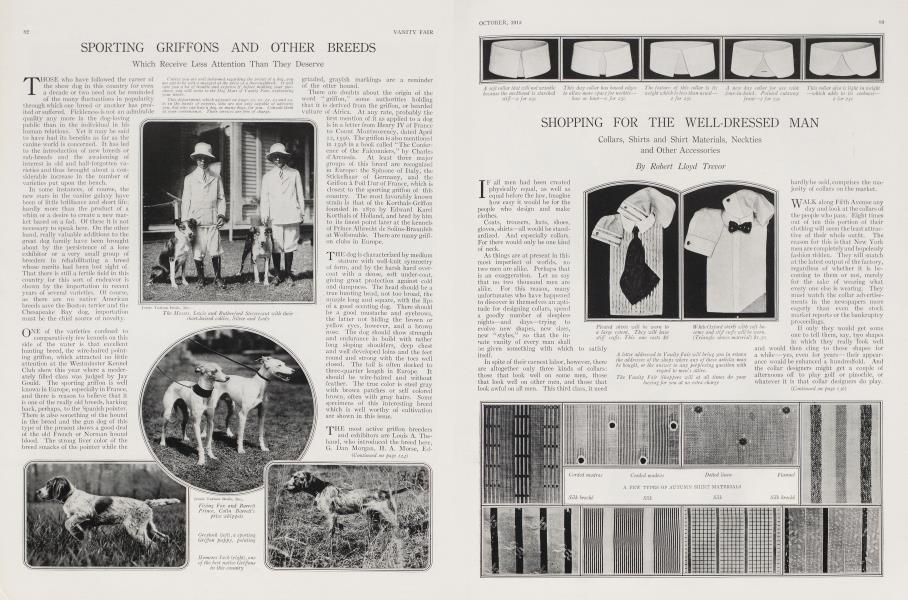
THE collars shown on page 83 are of the very latest vintage. The beauty of them is, however, that no one could tell it from a casual glance at them. With the exception of the second from the left end, there is nothing particularly novel about them; and that one is nothing but a well-known, tried model with a slight improvement. As you can see, it is bowed in front, in order to allow ample tie space. When in use it looks just like the somewhat old and exceedingly pleasant shape that has two parallel vertical edges, setting about a quarter of an inch apart.
The middle collar and the one on the extreme right arc not new shapes. But they are good, and their novelty lies in their thickness, which is less than usual, with the result that they are lighter and cooler. Between them is a sort of combination of the two. It has a cut-away front coming to a sharp angle: a conservative collar, neither exciting nor dowdy. At the extreme left is a semi-soft invention, designed to do away with that untidy, wrinkled appearance given to their wearers by most soft collars. It has a stiff, starched neckband.
SHIRTS and neckties arc, broadly speaking, the only mediums in which the modern man may express his taste for color. And—again broadly speaking—the average man would be wise to entrust their choosing to trained decorators.
At any rate, one thing is certain, and that is that no man—unless he have a large assortment of each commodity,—-should trust himself to buy one without the other. He ought to buy his shirts and his neckties at the same time. By so doing he would measurably reduce eyestrain in the community.
It must not be inferred from this that shirts and neckties should match. Of course, they may match. But not only is that a rudimentary way of obtaining effects; it is also apt to produce a monotony, and even studied monotony is a cloying form of art. The most interesting combination of shades, or colors, is one which gives contrast. Bear this principle in mind when buying your shirts and neckties. Bear in mind also, the fact that there are good and bad contrasts. Any contrast that is self-proclaiming is a bad contrast.
The swatches of shirt materials shown on page 83 cannot, naturally enough, pretend to cover the entire field. That would require an entire volume the size of a city directory. They do, however, indicate in a measure the sort of patterns that will be most in evidence in and about New York. Ninety per cent, of all the shirts worn will carry striped designs. The rest will be devoted to small spots or plain weaves. Most men will probably wear linen or its slightly heavier ally, corded madras. Some will wear flannel and some silk. Linen is obviously the most practical, since it is best able to withstand the criminal depredations of laundries. Flannel is apt to shrink; while silk seems as a rule to evaporate after its third acid bath.
A FEW TYPES OF AUTUMN NECKTIES
Continued on page 138
Continued from page 136
AS for neckties, it is hard to forecast a vogue for any one type of design; although the race will probably be close between stripes and small spots woven into the fabric, rather than stamped on it. Crochetted ties, which were done to death two or three seasons ago, will also be in evidence. The chief point in their favor was that scarf pins could be thrust in and out of them without tearing unsightly holes. And with the decline of the scarf pin these ties lost much of their popularity. At their worst they are thin, narrow strips of poor looking wood-fibre; at their best they are lustrous and loosely-knit of heavy silk.
THE day of the gay bandanna has long since past, but there seems to be a tendency to revert to their more moderate cousins, the colored French linen handkerchief, two of which are displayed here. They are dainty things, not strikingly masculine. Need I say more?
Dressing gowns vary but little here below. Their styles, praise be, are pretty inactive. This one, of light weight flannel, with satin faced lapels and cuffs, is a pleasant, comfortable garment of many virtues.
THE most popular thing illustrated in this department during the past year was the sleeping suit of light, porous wool shown in October 1914. Here it is again. It combines warmth without weight admiraably, and manages to fit without binding. These suits may be obtained in several sizes, for children as well as adults
The Vanity Fair Shoppers will gladly tell you where any of these articles may be bought. Or, should it be more convenient the Shoppers will buy them for you at no extra charge
Subscribers have complete access to the archive.
Sign In Not a Subscriber?Join Now

