

Sign In to Your Account
Subscribers have complete access to the archive.
Sign In Not a Subscriber?Join NowHARRY PAYNE WHITNEY'S "WHILEAWAY"
A Yacht Which Marks An Important Point of Departure in American Cruising Craft
CAPTAIN PRESCOTT VAN TUYL
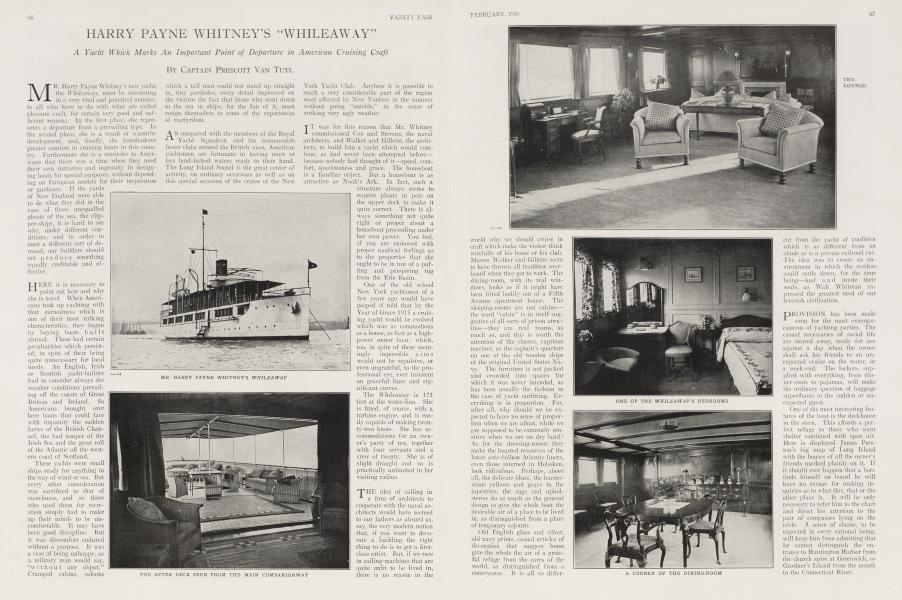
MR. Harry Payne Whitney's new yacht, the Whileaway, must be interesting in a very vital and practical manner, to all who have to do with what are called pleasure craft, for certain very good and sufficient reasons. In the first place, she represents a departure from a prevailing type. In the second place, she is a result of scientific development, and, finally, she foreshadows greater comfort in cruising boats in this country. Furthermore she is a reminder to Americans that there was a time when they used their own initiative and ingenuity in designing boats for special purposes, without depending on European models for their inspiration or guidance. If the yards of New England were able to do what they did in the case of those unequalled ghosts of the sea, the clipper-ships, it is hard to see why, under different conditions, and in order to meet a different sort of demand, our builders should not produce something equally creditable and effective.
HERE it is necessary to point out how and why she is novel. When Americans took up yachting with that earnestness which is one of their most striking characteristics, they began by buying boats built abroad. These had certain peculiarities which persisted, in spite of their being quite unnecessary for local needs. An English, Irish or Scottish yacht-builder had to consider always the weather conditions prevailing off the coasts of Great Britain and Ireland. So Americans brought over here boats that could face with impunity the sudden furies of the British Channel, the bad temper of the Irish Sea and the great roll of the Atlantic off the western coast of Scotland.
These yachts were small ships ready for anything in the way of wind or sea. But every other consideration was sacrificed to that of stanchness, and so those who used them for recreation simply had to make up their minds to be uncomfortable. It may have been good discipline. But it was discomfort endured without a purpose. It was a case of being unhappy, as a military man would say, "without any object." Cramped cabins, saloons which a tall man could not stand up straight in, tiny portholes, every detail impressed on the victims the fact that those who went down to the sea in ships, for the fun of it, must resign themselves to some of the experiences of martyrdom.
AS compared with the members of the Royal Yacht Squadron and the innumerable lesser clubs around the British coast, American yachtsmen are fortunate in having more or less land-locked waters ready to their hand. The Long Island Sound is the great center of activity, on ordinary occasions as well as on this special occasion of the cruise of the New York Yacht Club. Anyhow it is possible to reach a very considerable part of the region most affected by New Yorkers in the summer without going "outside," in the sense of striking very ugly weather.
was for this reason that Mr. Whitney commissioned Cox and Stevens, the naval architects, and Walker and Gillette, the architects, to build him a yacht which would combine, as had never been attempted before— because nobody had thought of it—speed, comfort, spaciousness and grace. The houseboat is a familiar object. But a houseboat is as attractive as Noah's Ark. In fact, such a structure always seems to require plants in pots on the upper deck to make it quite correct. There is always something not quite right or proper about a houseboat proceeding under her own power. You feel, if you are endowed with proper nautical feelings as to the properties that she ought to be in tow of a puffing and perspiring tug from the Erie Basin.
One of the old school New York yachtsmen of a few years ago would have gasped if told that by the Year of Grace 1915a cruising yacht would be evolved which was as commodious as a house, as fast as a highpower motor boat; which, too, in spite of these seemingly impossible aims would not be repulsive, or even ungrateful, to the professional eye, ever insistent on graceful lines and significant curves.
The Whileaway is 175 'feet at the water-line. She is fitted, of course, with a turbine engine, and is easily capable of making twenty-two knots. She has accommodations for an owner's party of ten, together with four servants and a crew of twenty. She is of slight draught and so is practically unlimited in her visiting radius.
THE idea of calling in a firm of architects to cooperate with the naval architects would have seemed to our fathers as absurd as, say, the very modern notion that, if you want to decorate a building the right thing to do is to get a firstclass artist. But, if we race in sailing-machines that are quite unfit to be lived in, there is no reason in the world why we should cruise in craft which make the visitor think wistfully of his home or his club. Messrs. Walker and Gillette seem to have thrown all tradition overboard when they got to work. The dining-room, with its real windows, looks as if it might have been lifted bodily out of a Fifth Avenue apartment house. The sleeping-rooms are not cabins— the word "cabin" is in itself suggestive of all sorts of prison atrocities—they are real rooms, as much so, and this is worth the attention of the chance, captious mariner, as the captain's quarters on one of the old wooden ships of the original United States Navy. The furniture is not packed and crowded into spaces for which it was never intended, as has been usually the fashion in the case of yacht outfitting. Everything is in proportion. For, after all, why should we be expected to have no sense of proportion when we are afloat, while we are supposed to be extremely sensitive when we are on dry land? As for the dressing-rooms they make the boasted resources of the latest ante-bellum Atlantic liners, even those interned in Hoboken, look ridiculous. Perhaps, above all, the delicate blues, the harmonious yellows and grays in the tapestries, the rugs and upholsteries do as much as the general design to give the whole boat the desirable air of a place to be lived in, as distinguished from a place of temporary sojourn.
Old English glass and silver, old navy prints, casual articles of decoration that suggest home give the whole the air of a grateful refuge from the cares of the world, as distinguished from a conveyance. It is all so different from the yacht of tradition which is as different from an abode as is a private railroad car. The idea was to create an environment in which the restless could settle down, for the time being—loaf a n d invite their souls, as Walt Whitman expressed the greatest need of our feverish civilization.
PROVISION has been made even for the most extemporaneous of yachting parties. The casual necessaries of social life are stowed away, ready for use against a day when the owner shall ask his friends to an unexpected cruise on the water, or a week-end. The lockers, supplied with everything, from dinner-coats to pajamas, will make the ordinary question of baggage superfluous to the sudden or unexpected guest.
One of the most interesting features of the boat is the deckhouse in the stern. This affords a perfect refuge to those who want shelter combined with open air. Here is displayed James Preston's big map of Long Island with the houses of all the owner's friends marked plainly on it. If it should ever happen that a bore finds himself on board he will have no excuse for making inquiries as to what this, that or the other place is. It will be only necessary to refer him to the chart and direct his attention to the pair of compasses lying on the table. A sense of shame, to be expected in every rational being, will keep him from admitting that he cannot distinguish the entrance to Huntington Harbor from the church spire at Greenwich, or Gardner's Island from the mouth to the Connecticut River.
Subscribers have complete access to the archive.
Sign In Not a Subscriber?Join Now
