Sign In to Your Account
Subscribers have complete access to the archive.
Sign In Not a Subscriber?Join NowSHOPPING FOR THE WELL-DRESSED MAN
ROBERT LLOYD TREVOR
A Word About Riding Suits and Several More Regarding Traveling Accessories
IF you are a lover of horses, and are fascinated by statistics, the fact that there are some 3,000,000 automobiles in the United States might cause you considerable alarm. But before you are completely overwhelmed let me add that the past few years have witnessed a steadily increasing participation in hunting, riding and polo on the part of our great minority.
When the automobile made its appearance horsemen were openly uneasy about it. Clearly, they thought (mind you, I didn't say they thought clearly) here is a vulgar innovation which threatens to divert attention from the one royal sport of which America can boast; a sport borrowed from England, engendered and patronized by England's kings. But in spite of the trepidation of a few, Americans in general remained loyal to the horse, and the wealthier class, with characteristic abandon, built their garages without tearing down their stables.
IT is really quite impressive to think that we should have continued faithful to a sport which was threatened with becoming unfashionable. Of course we had England's example before us, but even so, one usually has to travel rather slowly, and frequently backwards, to keep in the footsteps of English social conventions; and America is too fond of rapidly changing fads to go slowly even in the matter of fashions.
The increasing amount of interest displayed in riding has been stimulated chiefly, I imagine, by the international polo contests. On Long Island and in Westchester County particularly there has been a great deal of interest taken in the sport. Naturally this has resulted in a standardized costume; for riding suits are all cut to the same pattern even though they vary in materials.
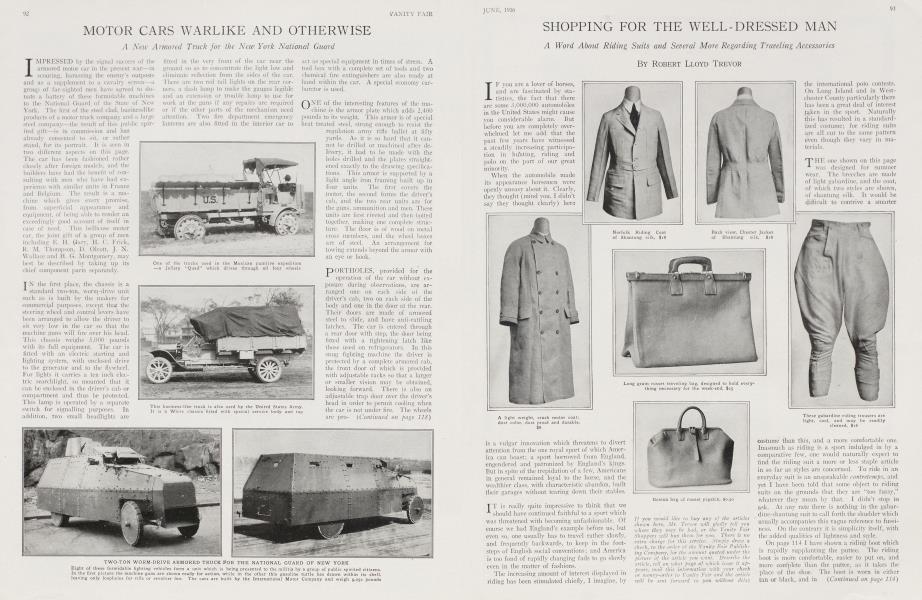
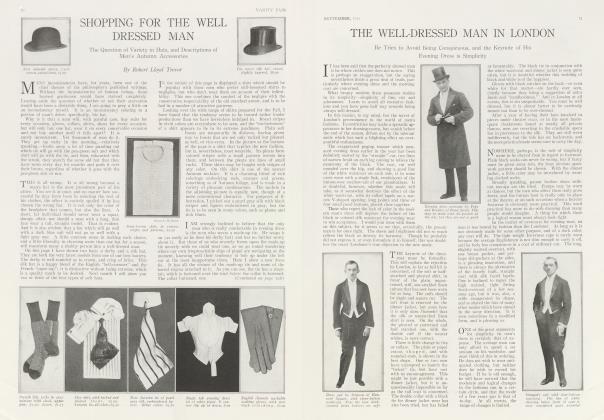
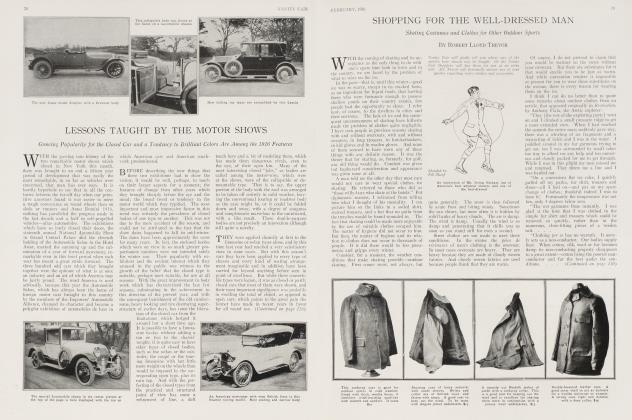
THE one shown on this page was designed for summer wear. The breeches are made of light gabardine, and the coat, of which two styles are shown, of shantung silk. It would be difficult to contrive a smarter costume than this, and a more comfortable one. Inasmuch as riding is a sport indulged in by a comparative few, one would naturally expect to find the riding suit a more or less staple article in so far as styles are concerned. To ride in an everyday suit is an unspeakable contretemps, and yet I have been told that some object to riding suits on the grounds that they are "too fussy,'' whatever they mean by that. I didn't stop to ask. At any rate there is nothing in the gabardine-shantung suit to call forth the shudder which usually accompanies this vague reference to fussiness. On the contrary it is simplicity itself, with the added qualities of lightness and style.
On page 114 I have shown a riding boot which is rapidly supplanting the puttee. The riding boot is more comfortable, easier to put on, and more complete than the puttee, as it takes the place of the shoe. The boot is worn in either tan or black, and in the latter color (of course, black isn't a color, but you know what I mean) makes an interesting contrast when worn with the suit described above.
If you would like to buy any of the articles shown here, Mr. Trevor will gladly tell you where they may be had, or the Vanity Fair Shoppers will buy them for you. There is no extra charge for this service. Simply draw a check, to the order of the Vanity Fair Publishing Company, for the amount quoted under the picture of the article you want. Describe the article, tell on what page of which issue it appears, mail this information with your check or money-order to Vanity Fair and the article will be sent forward to you without delay
(Continued on page 114)
(Continued from page 93)
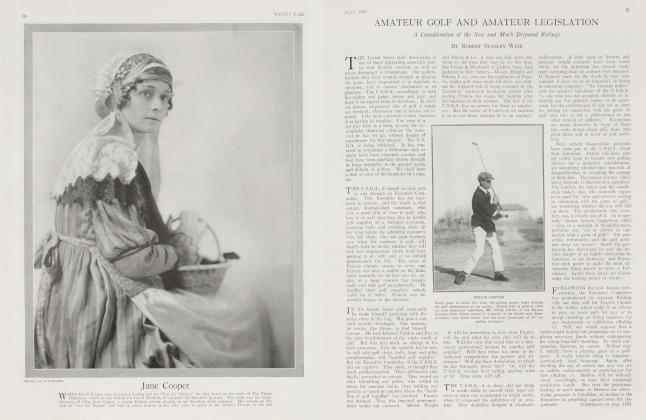
AND now, while I am in the midst of describing things, observe the motor coat on page 93. At first blush you might proclaim it the counterpart of innumerable others you have seen or worn on countless occasions. Well, for the most part, it is, and in that fact, coupled with the exceedingly modest price for which it sells, lies its seductiveness. Crash has always been considered a particularly suitable material for shunting off dust, and when you get a double breasted coat with a collar that fits like a boa constrictor around your neck you are, from your ears down, immune from dust germs or any of the other bacilli which scientists tell us wander around unmolested in the air.
IN regard to traveling, there is one axiom that some haberdashing geniuses have proved to be quite incorrect, i.e., given a starting point, your luggage grows in proportion to the distance you travel. In fact there seems to have been a general conspiracy to discredit Euclid, for "compactness" is the shibboleth by which luggage manufacturers have managed to get more clothes into the square inch than they could formerly get into cubic yards. By all means the smartest and most serviceable week-end bag I have ever seen is the one pictured on page 93. In a state of repose it resembles somewhat the lawyer's brief case, and can be closed quite flat if desired. Even when filled to the utmost—and it has considerable capacity— this unusually interesting article takes up very little room.
THE Boston bag, also illustrated on page 93, has returned to popular favor again after a somewhat hectic career. For those who have not, met it before let me say that it is a cross between a brief case and a suitcase; it might even be called a brief suitcase. It is admirable for carrying papers and documents from the office to the home and quite as suitable and convenient for carrying any small articles which the motorist wishes to put in it while traveling. Often I have wondered why some person, whose business it was to wonder about such things, didn't invent a pair of brushes that could be slipped into a suitcase without occupying more space than the law of dimensions allows them. And while I was still wondering, there suddenly appeared on the market the flat military brushes illustrated at the top of this page. That these brushes are flat does not hinder them in the slightest degree from performing their functions. On the contrary, they are as serviceable as others.
If you would like to buy any of the articles shown here, Mr. Trevor will gladly tell you where they may be had, or the Vanity Fair Shoppers will buy them for you. There is no extra charge for this service. Send a check for the amount quoted under the picture of the article you want and the article will be sent to you at once
Subscribers have complete access to the archive.
Sign In Not a Subscriber?Join Now
