Sign In to Your Account
Subscribers have complete access to the archive.
Sign In Not a Subscriber?Join NowCommon Faults in Bidding at Auction
Where Most of the Average Player's Money is Thrown Away
R. F. FOSTER
THE most common and expensive faults in the bidding at auction are in bidding suits that have no defensive value, and in bidding no-trumpers when the hand is a much better or safer suit contract.
The above refers to what are called free bids such as the dealer's first say, or any bid which the player is not forced to make in order to overcall his partner or opponents.
In secondary bids, or in forced bids, the routine of bidding takes on a new complexion. This whole question of secondary bids, and the modifications necessitated by them will be considered in the next issue of Vanity Fair.
Trumps Are Bid For; Not Made
THE chief fault with the initial suit-bids of the average player is that he thinks of nothing beyond having the suit he names as the trump. He forgets that his bid does not make the trump, although many persons use the expression in their bids; "I make it hearts." The trump is "made" by the three other players at the table, after the first bidder has expressed his opinion. They have just as much to say about it as he has, and they may accept or reject his proposition. The result is that the hand may eventually be played not only upon another declaration, but by the opponents, instead of by the first bidder or his partner.
If the first bid made were final, and the suit named by the first bidder were sure to be the trump, almost every suit bid we see at auction would be safe, if not technically correct. Even if the only object were to show the partner the silit one would like to have for the trump, the bid having no other significance, the majority of the declarations made would be beyond criticism.
Two Objects in Bidding
BUT there is a secondary object in all original or free bids, especially the dealer's; or that of some player to his left, if he passes. This secondary object is. to inform the partner where he may expect to find some valuable assistance, in case he has sometning better to declare, or wishes to play the hand; or where he may depend upon the bidder for some sure tricks, in case he wishes^ to know the best defence, if the opponents get tire final declaration.
Experience and calculation have shown that the minimum for this purpose .should be two sure tricks; not two tricks that are. sure only if the lead comes in a certain way or if the partner has certain cards, but tricks that arev. sure in themselves. These are usually referred to as aces and kings; but there .are only three combinations that are counted as good for two sure tricks in one suit. These are:
AK A Q J KQJ
No suit is a good free bid that is not headed by one or other of these combinations, unless there is enough in another suit to make up for the deficiency in the suit that is named. Convention requires one sure trick at least in the suit, and another trick in some suit that is not named; such as ace queen to five hearts, and the ace of clubs. Without the club, the heart suit is not a free bid. Failing this defensive strength, the bid should be postponed until the second round. All suits which are not bid on the first round, are conventionally assumed to be good only, if trumps, and to be of little use for defensive purposes; one trick at the most.
Misleading the Partner
FREE bids in suits which have no defensive value, or only one trick, may lead the partner into serious loss in two different ways. He may depend upon the suit for some assistance for his own bids, especially to fill out the only weak spot in a no-trumper, or for defence against the opponents' bids, neither of which will be forthcoming. The first result is very common, and extremely annoying to a good partner. To illustrate, here is a hand in which this .dependence on the original bid entirely upset the partner's calculations:
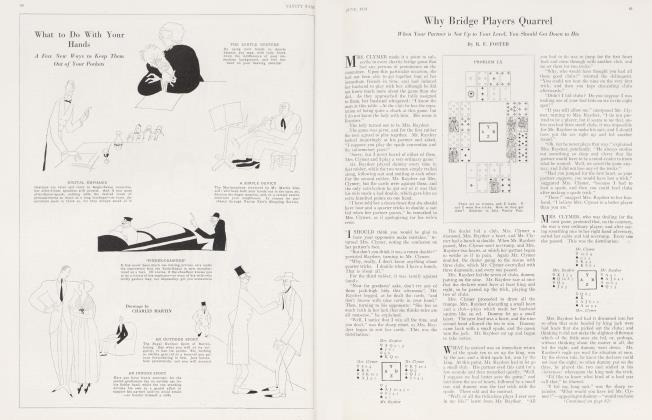
Z dealt and bid a club. Leave him with this bid, unopposed, and he will make the odd trick easily, perhaps two by cards. But the three others at the table have something to say about it. A bid a spade and Y two hearts. B assisted the spades and Y went to three hearts. He counts his six trumps as probably good for six tricks. . The ace of diamonds is seven, and his partner's two clubs, nine. When overcalled with three spades he went to four hearts, being willing to risk the loss of a trick rather than let the opponents make three odd at spades, and perhaps the game.
A and B can make three by cards at spades, but no more. All that Y made at hearts was two odd, as B led a spade and A came right back with a trump, to disarm dummy. Give £ two sure tricks in clubs and not only are Y's calculations sound, but B would never have assisted the spades, and three hearts would have been all that would be necessary to get the contract Or, let the clubs be a secondary bid, and Y will not count upon his partner for any tricks.
In case the opponents get the winning declaration, this, initial error of bidding a defenceless suit may lead the partner into what he considers a safe or sure double. Take this case:
This hand of Z's is a typical postponed, or secondary heart bid, yet he makes a free bid of it. If he were sure his bid would be final, there is no fault to find with it, because even as a secondary bid the combined hands are good for three odd at hearts. It is this occasional success with bad bids that leads so many players to persevere with them, and to overlook the frequent losses they entail.
But let us see what happens when the opponents are strong enough to bid and finally get the contract, Y being left under the impression that Z has some defensive strength in the heart suit. A bid spades, Y two hearts and they finally got it up to four spades over four hearts. Y cannot see how it is possible for A to make ten tricks, so he doubles the four spades, just as A would have doubled five hearts.
Y followed the rule and led his partner's declared suit. A won the first two rounds and led a third, dummy discarding all three of hia clubs. Z, of course, led the trump. A played the ace and led the diamond. Y now figures that by making sure of the ace of diamonds he may still defeat the contract if he can make a club trick, so he led the king and another trump. A cleverly played the jack and nine, unblocking B's trumps. This allowed B to get in on the trump lead and make the king of diamonds. A trumped the next diamond with the queen of spades and Ted the trey, making four by cards, doubled.
The Difference It Makes
NOW look what a difference it would have made if Z had avoided the error of bidding hearts initially. • Let him postpone that bid until the second round, and Y will know that he has no defence in the„heart suit, and will not lead it, but will start with the clubs, and two by cards is then the limiit of possibility for A. Therefore if A bids more than; two, he will be set. If he does not, Z will make his three odd at hearts.
Suits Better Than No-Trumps
THE other fault, which is extremely common among untaught players, even those who have had experience enough to know better, is biddirig no-trumps upon hands that are much safer suit bids. It is an old saying among players of experience that "anything may happen to a no-trumper." This is because not one in ten is without its weak spot. The usual excuse for this . preference for no-trumps is that it is easier to win the game with a no-trumper than with a suit. This is true only provided that you have, enough tricks in the hand to go game at no-trumps. It is not true when you have tricks enough in a suit bid, and not enough in the no-trumper. Herq is an example:
Continued on page 88
Continued from page 57
Z dealt on the rubber game and bid no-trump, instead of a spade. Having the lead, A passed, Y and B saying nothing. A led his fourth-best club and set the no-trumper for four tricks, aces easy, Z making two spades and a diamond at the end.
If Z starts with the correct bid, one spade, it does not matter whether A bids the clubs or not, nor how far he goes. Y will assist the spades, as he can ruff clubs, and as the cards lie Z can make five by cards easily with spades for trumps, instead of being set for 200 at no-trumps. All that A and B can make is their two red aces, as Z can give Y three ruffs in clubs.
THE result of the no-trumper cannot be called an unfortunate distribution of the cards, because it is nothing but bad bidding. Gize Z any of the three other hands for his dummy and the
original spade bid will win more than no-trumps.
Testing by Transposition THIS is often a good test of a bid. Give the player one of his opponent's hands or each in turn. Transpose the hands of A and Y, giving A the four spades and dummy only the nine. Y will take Z out with no-trumps, and make a little slam.
Suppose that B's cards are opposite Z, with the four spades still on his left. A will lead the diamond and Z will make at least the odd trick, even if A and B get up a cross-ruff right at the start by B's leading a club right up to the king, after winning the first diamond lead. This would be an improbable play. At no-trumps, all Z could make would be two by cards, with 30 aces against him. If B does not lead the club, Z makes three odd at spades.
Subscribers have complete access to the archive.
Sign In Not a Subscriber?Join Now
