


Sign In to Your Account
Subscribers have complete access to the archive.
Sign In Not a Subscriber?Join NowOn the Genius of Dégas
An Appreciation of His Art and the Nature of His Artistic Influence
ARTHUR SYMONS
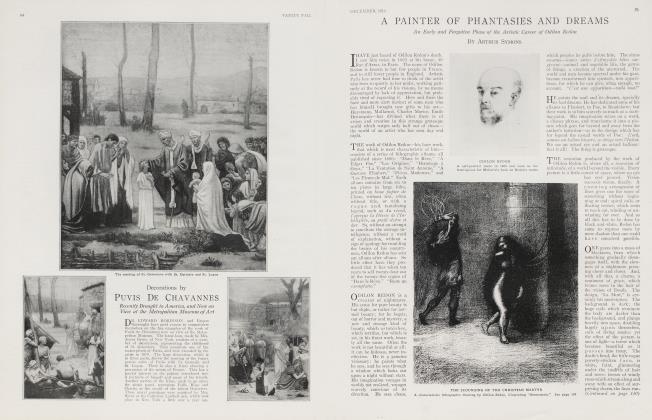
THE epithet fin de siecle has been given, somewhat loosely, to a great deal of modern French art, and to art which, in one way or another, seems to attach itself to contemporary names. Out of the great art of Manet, the serious art of Degas, the exquisite art of Whistler, all, in such different ways, so modern, there has come into existence a new, very far from great or serious or really exquisite kind of art, which has expressed itself largely in the Courrier Français, the Gil Blas Illustre, and the posters. It comes into competition with the music halls; half contemptuously, it popularizes itself. It finds its own in the 18th century, so that Willette becomes a kind of witty Watteau of Montmartre; it juggles with iron bars and masses of shadow, like Lautrec. And, in its direct assault on the nerves, it pushes naughtiness to obscenity, degrades observation into caricature, dexterity of line and handling being cultivated as one cultivates a particular, deadly botte in fencing.
And this art, this art of the day and hour, competes not merely with the appeal and the popularity of the theatrical spectator, but directly with theatrical methods, the methods of stage illusion. The art of the ballet counts for much; in the evolution of many favorite effects of contemporary drawing, and not merely because Degas has drawn dancers, with his reserved, essentially classical mastery of form. By its rapidity of flight within bounds, by its bird-like and flower-like caprice of color and motion, by that appeal to the imagination which comes from its silence (to which music is but like an accompanying shadow, so closely, so discreetly, does it follow the feet of the dancers), by its appeal to the eyes and to the senses, its adorable artificiality, the ballet has tempted almost every draughtsman, as the interiors of music-halls have also been singularly tempting, with their extraordinary tricks of light, their suddenness of gesture, their triumphant tinsel, their fantastic humanity. And pantomime, too, in the French and correct, rather than in the English and incorrect, sense of the word, has had its significant influence. In those pathetic gaieties of Willette, in the windy laughter of the frivolities of Cheret, it is the masquerades, the English clown or acrobat seen at the Folies-Bergère, painted people mimicking puppets, who have begotten this masquerading humanity of posters and illustrated papers. And the point of view is the point of view of Pierrot—
le subtil genie De sa malice infinie De poete-grimacier— (Verlaine's "Pierrot Gamin.")
IN Rodin's drawings there is little of the delicacy of beauty. And here, it would seem (if indeed accident did not enter so largely into the matter) that a point in sentiment had been reached in which the perverse idealism of Baudelaire has disappeared, and a simpler kind of cynicism takes its place. In these astonishing drawings from the nude we see woman carried to a farther point of simplicity than even in Degas: woman the animal; woman, in a strange sense, the idol. Not even the Japanese have simplified drawing to this illuminating scrawl of four lines, enclosing the whole mystery of the flesh.
Degas, also, has done something that neither the painter nor the draughtsman of Europe has ever done. He studies nature under the paint by which woman, after all, makes herself more woman; the ensign of her trade, her flag as the enemy. He gets the nature of this artificial thing,—that the Japanese had in a sense invented—and the skin underneath it, and the soul under the skin. Watteau and the Court painters have given us the dainty exterior charm of the masquerade, woman when she plays at being woman, among "lyres and flutes." Degas has done much more than this, with other elements in his pure design. The drawing of Degas, setting itself new tasks, exercises its technique upon shapeless bodies in tubs, and the strained muscles of the dancer's leg as she does "side-practice." What he has not done, and others in our time have done, is taking all the ugliness of sex disguising itself for its own ends: that new nature which vice and custom make out of the honest curves and colors of natural things.
Continued on page 90
Continued from page 60
YET Degas, with all his genius and. his cunning instinct for contrasted colors and pure outlines and luxurious attitudes and marvelous mastery of design, has never achieved such drawings as certain of Rodin's; for instance, as one where a woman faces you, her legs thrown above her head; as, for instance, one where she faces you with legs thrust out before her, the soles of her feet seem close and gigantic. She squats like a toad, she stretches herself like a cat, she stands rigid, she lies abandoned. Every movement of her body, violently agitated by the remembrances, or the expectation, or the act of desire, is seen at an expressive moment. She turns on herself in a hundred different attitudes, turning always upon the central pivot of the sex, which emphasizes itself with a fantastic and frightful monotony. It is a machine in movement, a monstrous, devastating machine, working mechanically, and possessed by the one rage of the animal.
And these drawings, with their violent simplicity of appeal, have the distinction of all abstract thought or form. Even in Degas there is (as I have said) a certain luxury, a possible sensual and sexual appeal, in these heavy and creased bodies bending in tubs and streaming a sponge over huddled shoulders. But in Rodin's drawings luxury becomes geometrical; its axioms are demonstrated algebraically. It is the unknown X which sprawls, in this sprawling entanglement of animal life, over the damped paper, between these pencil strokes.
WHEN Gustave Moreau is at his best (as when the cactus, his favorite flower, becomes a marvel of rosy flame: when he tries to make the leaves mysterious, not by painting them as they are, but in softening what is sharply artificial and unreal in the actual thing), when his color is almost a disguise, and the conventional drawing, the doll-like figures, the forced emphasis, the prettinesses, are buried out of sight under clots of paint, out of which the sunlight sucks a fiercer brilliance, there are moments when it is possible to compare him with Degas, the painter of modern things, whose work is to be seen in the Louvre and in the Luxembourg. What Moreau does with color combined with outside reality, Degas does—and more discreetly, with color caught in real things: a hanging on a wall, a carpet under the feet, a frame of theatrical scenery, which becomes a vision as he looks at it, and the equivalent of imagination. And in Degas the beauty is a part of truth, a beauty which our eyes are too jaded to distinguish in the things around us.
I find a curious coincidence in the word I have used, "jaded", in these sentences that Pater wrote on Le Byron de nos Jours of Browning: "In this poem we have a single moment of passion thrown into relief in this exquisite way. Those two jaded Parisians are not intrinsically interesting; they only begin to interest us, when thrown into a choice situation. But to discriminate that moment to make it appreciable by us, that we may find it, what a cobweb of allusions, what doubt and treble reflections of the mind upon itself, what an artificial light is constructed and broken over the chosen situation; on how fine a needle's point that little world of passion is balanced! Yet, in spite of this intricacy, the poem has the clear ring of a central motive; we receive from it the impression of one imaginative soul, of a single creative art."
Degas, then, finds in real things, seen at the right moment, all the flames and all the jewels of Moreau. And thus, in his acceptance of reality, he has created a new and vital form of art, while Moreau in his rejection of time and space, has but combined pictures out of other pictures. His art was sterile from the first, and but repeats the ineffectual spells of a solitary magician. But at least he lived his own life, among his chosen spectres.
TT has been said that beauty can only be rendered by fine technique, but that beauty can be found in technique only. Degas is typical of the school to which subject - matter is indifferent, treatment everything. Or it would be more correct to say that the uglier the subject, the better excuse does it give for virtuosity of technique; so that Degas in his revolt against the academic treatment of the nude, pretty under impossible conditions, strips a middleaged model, sets her to stand in a tin bath and squeeze a sponge over her shoulders, so that the attitude reveals every thickening crease of flesh, every falling away of contour, every physical degradation of age, the very impress of the whalebones of the corset, the line which darkens, the neck where the collar of the dress had ended. Painting the dancer, he takes us behind the scenes, showing us two homely girls in practising-dress, straining a leg forward and backward, while the shoulderblades stand out like knives, and the whole body aches with effort. And Degas does what he wants, his pictures have the beauty of consummate skill, they have all that ingenuity of mind and mastery of line can give us; they are miraculous pieces of drawing, which every artist must admire, as he would admire a drawing by Leonardo; but there they end, where the Leonardo drawing does but begin.
AGAIN, where Velasquez accepts A life, making it distinguished by his way of seeing it, not so much choosing from among its moments as compelling a moment to give up the secret of a life time; where Whistler gives us the ghost of the river, people who are the phantasms of moods and moments, a whole shadowy world, in which beauty trembles and flutters, and is a breath escaping upon a sigh; so when Degas paints one of his finest pictures L'Absinthe, done perhaps in the same manner as Le Bon Rock of Manet, he gives one, in his more modern way, an equal vision of reality. The man is Desboutins, a Bohemian painter, in a mood of grim dissatisfaction, who is just as living as the depraved woman who sits beside him—before the glass of absinthe that shines like an enormous and sea-green jewel—with eyes in which much of her shameful existence is betrayed, without pity, without malice.
These are not mysterious like Whistler's creations, in whose pictures the mystery is for the most part indefinable. They are unlike his fashionable women who draw on their gloves in the simplest of daily attitudes; unlike his portraits of children, who stand in the middle of the floor to be looked at; unlike his men in black coats who are thinking thoughts which they hide from us. Degas' two people have the vividness of hallucination. And how far from the dull insistence of ordinary life, from the unmeaning or deceiving mask which most people present to the world, are these actual and uncommon people whom he has dreamed on canvas, and they are there!
Continued from page 90
TN Manet there is nothing but good painting. Look at a girl's head, and you will find in it a magic which is not magic at all, as far as magic is an evasion or a message from outside nature: the life that is there is a life of frank paint, neither asserting nor correcting itself; there is no sentiment which we can be conscious of, no tenderness as with Carriere, yet still less is there the scientific coldness of Cezanne. It is as if the painters were like the sun itself; an energy beyond good and evil, an immense benevolence, creating without choice or preference out of the need of giving birth to light. There never was such homage to light, to light as the principle of life as Le Linge, where the vivifying rays of that impartial sunlight can soak with equal thirst into the ugliness of the child and into the loveliness of the linen. And you may hate the picture as you may hate a day of overpowering heat, yet be no more able to get away from it than you could withdraw from the ardor of nature.
FOR, to Manet, in his vision of the world, everything existed in hard outline. In seeing, and in rendering what he saw, Manet has, above all, audacity; he cannot conceal his delight in the paint which comes out of his brush like life itself. Think of his Olympia, which in one room of the Luxembourg deadens and empties of life every picture hung near it, as Whistler's Portrait of his Mother does in the next room.
Never, as Watteau, "a seeker after something in the world, that is there in no satisfying measure or not at all," Degas, implacable farouche, the inexorable observer of women's flesh, in the wings of music-halls, in cafe-concerts, loves and hates and adores this strange mystery of women's flesh, which he evokes, often curiously poisonous, but always with a caressing touch, a magic atmosphere that gives heat and life and light to all his pictures. Where Renoir is Pagan and sensual, Degas is sensuous and a moralist. In the purity of his science, the perhaps impurity of his passion, he is inimitable. Is not his style—for painters have their own styles —the style of sensation—a style which is almost entirely made of sensations? He flashes on our vision la vrai verite of things, the very essence of them—not so much the essence of truth as of what appears in the visible world, of the visible world to the eyes that see it. And—if I may invent an image— he "coners" the soul of inner things outwardly realized.
COLORS have their passions like lovers. In Degas they flame and burn and turn furious and amorous. In his pastels the flesh lives more vividly than in any modem painter; that is to say, in his peculiar and particular method of painting, in which he is as astonishingly original as Manet. No one ever painted maquillage as he does, nor the strokes of light that shine on a dancer's eyes, nor the silk of her rose-coloured tights that outline her nervous legs; nor the effects—sudden and certain—of what I have seen for years from the stage: silhouettes and faces and bodies and patches of light, a cigarette in a man's mouth; and, in the wings, miracles of change, of caprice, of fantasy, of what seems and is not an endless motion of the dancers. I do not for one moment imagine that there is one secret,—however secret that might be to most observers—that he has not observed, caught and rendered, with that sudden instinct that guides one's imagination.
I am one of those who have shared his passion for those adorable creatures; created, one supposes, for the pleasure of appealing to our senses and for the pleasures that they give and take.
Intoxicatingly Her eyes across the footlights gleam (The wine of love, the wine of dream) Her eyes, that gleam for me! And O, intoxicatingly, When, at the moment's close, She dies into the rapture of repose, Her eyes, that gleam for me!
I have always felt that the rhythm of dancing is a kind of arrested music; as Degas has certainly often done: as in the feet that poise, the silent waves of wandering sound of her body's melody, and her magic. He gives ravishing beauty in his Danseuses sc baissant when he catches the exquisite instant as they bend, legs crossed, the right hand placed lightly on the floor of the stage, the left one "in almost one straight line from the shoulder; giving to both the same gestures, the same (what one has so often seen) half slipping off of the corsage from the stooping shoulders, and, with the indication of their thin arms, their favourite decorations: the bracelet round the wrist, the necklace round the throat that flies out in the mere wind of their arrested attitude.
DEGAS sees no demons in the air nor malice in every bush and bough as Lautrec did; nor does he see passion as the infamy of our hearts, a shameless and perilous thing that strips naked the body of life. Yet, I think I am right in saying that he did see all these things, as in La Chanteuse Verte, where a hideous woman bows to the audience, in a red dress, with vulgar gestures; she has sung an obscene song; she has not what is called le trac; but, as she interrogates her public, knows that they must respond to her desires, she, who flatters all the vices. And again when a brazen creature opens her mouth wide, like a vampire, if one can imagine a vampire in a cafe concert dressed abominably and wearing flowers, certainly the sensation he gives is marvellous; for beyond her gleam the orange rosy lights of Les Ambassadeurs and below her one sees glimpses of vague Parisian heads. And, in one of his astounding paintings of a night cafe there is a crudity of color, a brutal vigor, with a kind of hatred of these prostitutes, ugly and hideously alive, whose faces fill the spaces between white pillars, as the noises of the Boulevard dwindle into an ominous silence. And this iswhere "l'artiste parait avoir ete attire par l'aspect canaille et lamentable a la fois de certaines types de filles."
The painter of modern life, Degas has the genius of the Parisians; not that he paints Paris, but that he always paints in Paris; and so for him, as for Balzac and Baudelaire, the choice of what one chooses in Paris has a new savor, like scented wine. Dancinggirls, washerwomen in the laundries and those exquisite young girls one sees every dawn in Paris carrying linen, singers in cafe-concerts, jockeys, naked women, women in baths, in dressingrooms and in shops, in the stalls and in the boxes with their men: these are his chief delights,—the inconceivable delights of one of so fine a temperament, of such sensitive nerves, of such experienced eyes, whose vision's intensity is daunted by human faces in movement, always with a sense of movement on even what is arrested, in the factitious light of gas, in fact in all forms of shades and lights that this magician in paint has revealed to us.
FROM the first one required a certain initiation in order to understand his surprising originality, his dazzling audacity, his absolute sincerity to that form of art that he created. Exactly the same occurred in the cases of Delacroix and of Baudelaire. It is impossible not to see the influence of that great painter in Degas; not only in their marriages and adulteries of colours. "The design of creation is the privilege of the man of genius," wrote Baudelaire, profoundly. Both, like nature. had a horror of the void. Both give the sensation of what such imaginations can create—not as the genius of Goya created monsters and devils and witches and depraved monks and Satanical Sabbats—but the finite in the infinite; visions produced by prodigious conceptions', "Cartooned" as it were, beforehand, by a process intensely conscious, patient and silent. In Delacroix's pictures are eagle-headed creatures contemplating the sun, serpent women coiled with serpents; and, in what is symbolical in Degas' pictures, there are curious analogies with these. "Comme tous ceux de mon age," said Delacroix to Baudelaire, in words Degas might have used, "j'ai connu plusieurs passions; mais ce n'est que dans le travail que je me suis parfaitement heureux."
Continued from page 92
TAKE, for instance, this pastel. One sees a box that gives on the stage, with the rose-red colour of a halflifted screen, showing the sombre purple of the ceiling; a woman's profile leans over from the balcony above the box as she gazes on the singers as they shout; the line of her. cheeks is heightened by the heat of the hall, the blood rises in her cheek-bones, whose sanguine colour, as ardent as in the ears, fades away on her forehead. Compare certain dashes of strong colours on this pastel with what one sees in the Massacre de Scio of Delacroix: a Greek or Turkish sachet painted in the foreground, knotted with white knots, crude and brutal in their extremes of tonality. Suppose you efface this sachet, the harmony of the picture would be destroyed.
DÉGAS sees in woman all that is irresponsible for good and evil, all that is unreliable in her brain and will, all that is alluring in her variability. He sees women vividly disturbing men's lives—now a modern Circe, now a modern Thais. He sees more than that: he sees what these women neither see nor know; not even what their dreams might reveal to them; not even what their lovers imagine they know of their mistresses. He is never impartial; he never judges them. He takes them as they are—as perhaps no painter ever did—lets them know that he takes them as they are, that he treats them as they are; and then alone with them in his studio, he disposes of them as he likes: but, always, he paints. And the rest to him is more or less indifferent. He shows their animality with a kind of ironical disdain—-not that of the man of the world; but with the cruelty of a creator of Images of Good and Evil. A man of singular, but not of universal genius, he seems to have chosen deliberately, I do not say his limits—for he has none, in a literal sense—but such limits as gave him entire scope for the revelation of exactly what his genius, in Blake's phrase, "dictated to him." And so, his work being done, Degas leaves a sense of intense regret behind him; having created a new art in painting: that is to say, in painting the Sex he adored, without pity and without malice.
Subscribers have complete access to the archive.
Sign In Not a Subscriber?Join Now


