Sign In to Your Account
Subscribers have complete access to the archive.
Sign In Not a Subscriber?Join NowWar Minds
Are We Setting Up Housekeeping in Our Literary Trenches?
F. M. COLBY
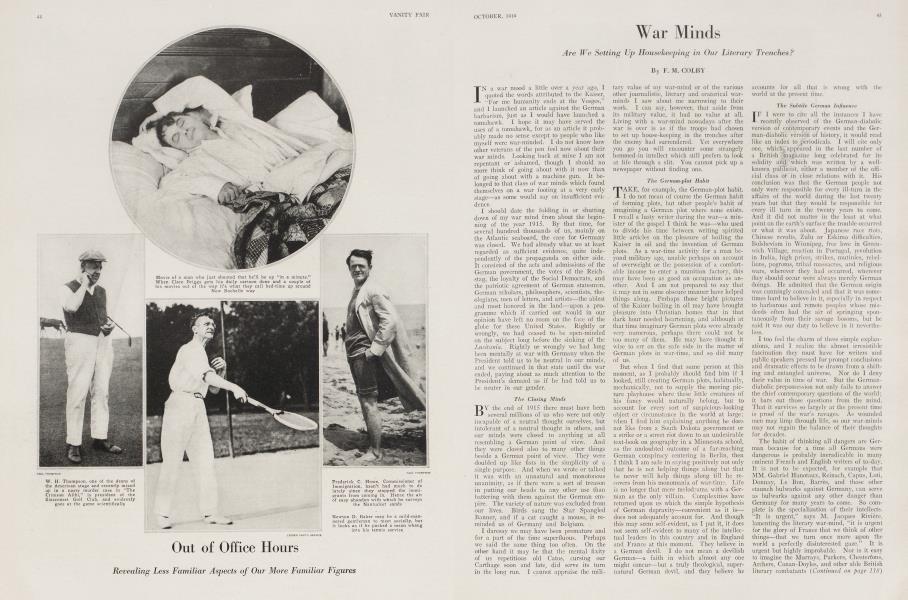
IN a war mood a little over a year ago, I quoted the words attributed to the Kaiser, "For me humanity ends at the Vosges," and I launched an article against the. German barbarism, just as I would have launched a tomahawk. I hope it may have served the uses of a tomahawk, for as an article it probably made no sense except to people who like myself were war-minded. I do not know how other veterans of the pen feel now about their war minds. Looking back at mine I am not repentant or ashamed, though I should no more think of going about with it now than of going about with a machine gun. It belonged to that class of war minds which found themselves on a war footing at a very early stage—as some would say on insufficient evidence.
I should date the folding in or shutting down of my war mind from about the beginning of the year 1915. By that time, for several hundred thousands of us, mainly on the Atlantic seaboard, the case for Germany was closed. We had already what we at least regarded as sufficient evidence, quite independently of the propaganda on either side. It consisted of the acts and admissions of the German government, the votes of the Reichstag, the loyalty of the Social Democrats, and the patriotic agreement of German statesmen, German scholars, philosophers, scientists, theologians, men of letters, and artists—the ablest and most honored in the land—upon a programme which if carried out would in our opinion have left no room on the face of the globe for these United States. Rightly or wrongly, we had ceased to be open-minded on the subject long before the sinking of the Lusitania. Rightly or wrongly we. had long been mentally at war with Germany when the President told us to be neutral in our minds, and we continued in that state until the war ended, paying about as much attention to the President's demand as if he had told us to be neuter in our gender.
The Closing Minds
BY the end of 1915 there must have been several millions of us who were not only incapable of a neutral thought ourselves, but intolerant of a neutral thought in others, and our minds were closed to anything at all resembling a German point of view. And they were closed also to many other things beside a German point of view. They were doubled up like fists in the simplicity of a single purpose. And when we wrote or talked it was with an unnatural and monotonous unanimity, as if there were a sort of treason in putting our heads to any other use than battering with them against the German empire. The variety of nature was excluded from our lives. Birds sang the Star Spangled Banner, and if a cat caught a mouse, it reminded us of Germany and Belgium.
I daresay we may have been premature and for a part of the time superfluous. Perhaps we said the same thing too often. On the oth«r hand it may be that the mental fixity of us repetitious old Catos, cursing our Carthage soon and late, did serve its turn in the long run. I cannot appraise the military value of my war-mind or of the various other journalistic, literary and oratorical warminds I saw about me narrowing to their work. I can say, however, that aside from its military value, it had no value at all. Living with a war-mind nowadays after the war is over is as if the troops had chosen to set up house-keeping in the trenches after the enemy had surrendered. Yet everywhere you go you will encounter some strangely hemmed-in intellect which still prefers to look at life through a slit. You cannot pick up a newspaper without finding one.
The German-plot Habit
TAKE, for example, the German-plot habit. I do not mean of course the German habit of forming plots, but other people's habit of imagining a German plot where none exists. I recall a lusty writer during the war—a minister of the gospel I think he was—who used to divide his time between writing spirited little articles on the pleasure of boiling the Kaiser in oil and the invention of German plots. As a war-time activity for a man beyond military age, unable perhaps on account of overweight or the possession of a comfortable income to enter a munition factory, this may have been as good an occupation as another. And I am not prepared to say that it may not in some obscure manner have helped things along. Perhaps those bright pictures of the Kaiser boiling in oil may have brought pleasure into Christian homes that in that dark hour needed heartening, and although at that time imaginary German plots were already very numerous, perhaps there could not be too many of them. He may have thought it wise to err on the safe side in the matter of German plots in war-time, and so did many of us.
But when I find that same person at this moment, as I probably should find him if I looked, still creating German plots, habitually, mechanically, not to supply the moving picture playhouse where these little creatures of his fancy would naturally belong, but to account for every sort of suspicious-looking object or circumstance in the world at large; when I find him explaining anything he does not like from a South Dakota government or a strike or a street riot down to an undesirable text-book on geography in a Minnesota school, as the undoubted outcome of a far-reaching German conspiracy centering in Berlin, then I think I am safe in saying positively not only that he is not helping things along but that he never will help things along till he recovers from his monomania of war-time. Life is no longer that mere melodrama with a German as the only villain. Complexities have returned upon us which the simple hypothesis of German depravity—convenient as it is— does not adequately account for. And though this may seem self-evident, as I put it, it does not seem self-evident to many of the intellectual leaders in this country and in England and France at this moment. They believe in a German devil. T do not mean a devilish German—a faith in which almost any one might concur—but a truly theological, supernatural German devil, and they believe he accounts for all that is wrong with the world at the present time.
The Subtile German Influence
IF I were to cite all the instances I have recently observed of the German-diabolic version of contemporary events and the German-diabolic version of history, it would read like an index to periodicals. I will cite only one, which appeared in the last number of a British magazine long celebrated for its solidity and which was written by a wellknown publicist, either a member of the official class of in close relations with it. His conclusion was that the German people not only were responsible for every ill-turn in the affairs of the world during the last twenty years but that they would be responsible for every ill turn in the twenty years to come. And it did not matter in the least at what point on the earth's surface the trouble occurred or what it was about. Japanese race riots, Chinese revolts, Zulu or Eskimo difficulties, Bolshevism in Winnipeg, free love in Greenwich Village, reaction in Portugal, revolution in India, high prices, strikes, mutinies, rebellions, pogroms, tribal massacres, and religious wars, wherever they had occurred, wherever they should occur were always merely German doings. He admitted that the German origin was cunningly concealed and that it was sometimes hard to believe in it, especially in respect to barbarous and remote peoples whose misdeeds often had the air of springing spontaneously from their savage bosoms, but he said it was our duty to believe in it nevertheless.
I too feel the charm of these simple explanations, and I realize the almost irresistible fascination they must have for writers and public speakers pressed for prompt conclusions and dramatic effects to be drawn from a shifting and entangled universe. Nor do I deny their value in time of war. But the Germandiabolic prepossession not only fails to answer the chief contemporary questions of the world; it bars out those questions from the mind. That it survives so largely at the present time is proof of the war's ravages. As wounded men may limp through life, so our war-minds may not regain the balance of their thoughts for decades.
The habit of thinking all dangers are German because for a time all Germans were dangerous is probably ineradicable in many eminent French and English writers of to-day. It is not to be expected, for example that MM. Gabriel Hanotaux, Reinach, Capus, Loti, Donnay, Le Bon, Barres, and those other staunch bulwarks against Germany, can serve as bulwarks against any other danger than Germany for many years to come. So complete is the specialization of their intellects. "It is urgent," says M. Jacques Rivière, lamenting the literary war-mind, "it is urgent for the glory of France that we think of other things—that we turn once more upon the world a perfectly disinterested gaze." It is urgent but highly improbable. Nor is it easy to imagine the Murrays, Parkers, Chesterfons, Archers, Conan-Doyles, and other able British literary combatants ever again quite achieving a sense of proportion in human affairs. And no one can blame them if they do not. But for the American war-mind there is less excuse, and there is no need of our continuing to use a pen as if in co-operation with a bayonet on the battlefield.
Continued on page 118
Continued from page 45
Cooler Reflections
WHETHER I am rid of my war mind now, I cannot say, but if I were writing that article against Germany to-day, I should not quote as a sentiment peculiar to the Kaiser, "For me humanity ends at the Vosges." I should realize that it was not peculiar to the Kaiser but the common property of all aggressive national states at the culminating moment of their selfishness. I should know that they all had had their moments when humanity ended for them at their Vosges. I should know that it was the essence of every imperialism to have its Vosges, beyond which there was less than humanity, and, that there had been a hundred imperialisms, and not merely one. I should confess, to myself at least, that in my own country at one time humanity ended, and was believed by many pious folk to end, in a shade of the complexion, that at another date it ended at the Rio Grande, and that for aught I know to a good many of my fellow citizens—Senators, Congressmen and other patriotic public characters among them—it may end at the Rio Grande to-day. In time of peace it seems unwise to attack a country with a phrase that can be turned against your own. In time of war the sort of curses that you hurl do not seem to matter.
Subscribers have complete access to the archive.
Sign In Not a Subscriber?Join Now
