Sign In to Your Account
Subscribers have complete access to the archive.
Sign In Not a Subscriber?Join NowThe Anarchists of Taste
Who First Broke the Rules of Harmony, in the Modern World?
EDMUND WILSON, Jr.
HOWEVER sterile one may consider a great deal of the New Poetry, the New Music and the New Art, it seems to me that most of the criticism of them is superficial and based on a fallacy. It is assumed that the modern artist deliberately makes art ignoble and anarchic. We are informed by the guardians of the treasures of the past, (that is, usually, of the English XIXth century), that the Ornsteins and the Marinettis and the vers librists have thrown tradition overboard: they have broken all the rules; they have ridden roughshod over Culture; they are bent upon shattering the pure ideals and the severe classic forms which Dr. Henry van Dyke and the critics of The Nation are so anxious to have saved. 'Literary Bolshevism' has now become the proper phrase to describe their activities. The vers librists, the advanced composers and the futurist painters are supposed to have conspired in a plot to blow up the temple of the Muses. "The new poetry", said Professor Paul Shorey on a recent occasion, "lacks morality, harmony, distinction and idea of beauty."
Now, there is probably a certain amount ot truth in this point of view,—that is, it is true that the New Art represents a reaction against Victorian floridness and inanity, just as political radicalism is the inevitable result of Victorian laissez-faire. And here in America the reaction is, perhaps, all the more rowdy because, during our own Victorian Age, we had no such lyrics as Ulysses and Dover Beach to redeem our innumerable Psalms of Life and Thanatopses. Then, too, almost the only firstrate poetry we had .was written by an enemy of the rules—Walt Whitman.
A native American poet, with an authentic inspiration, looked back naturally to him rather than to Tennyson. But Whitman, for all his novelty, was still a master of harmonies: he bore always about him the majestic rhythm of the sea on Long Island shore. Neither he, nor the spirit of reaction, nor the thirty-year-old experiments with vers libre in France can account for American writers like Mr. Edgar Lee Masters and Mr. Maxwell Bodenheim. Nor can we explain the new forms satisfactorily on the democratic theory: that vers libre has become popular because anybody can write it, and Futurism prevalent because anybody can paint Futurist pictures, that these things, in short, are the consequence of the neglect of discipline and taste which has come in with the lowering of standards in a democratic society.
The Chanips-Elysees vs. Michigan Avenue
NO: it is pretty safe to assume, when a certain form of art becomes popular, not only among the fools and imposters, but also among the genuine artists, that this form is one that satisfies peculiarly the need for expression of the time and has been invented by the voice of the time as the accent proper to it. Vers libre is as much the proper form of expression for XXth century America as the classic heroic couplet was for XVIIIth century England, or the gorgeous rhetoric of Hugo for French Romanticism. The things which really demand to be said have always found a style of their own, and we shall understand modem forms better when we have examined the sort of reactions which demand expression in America at the present time.
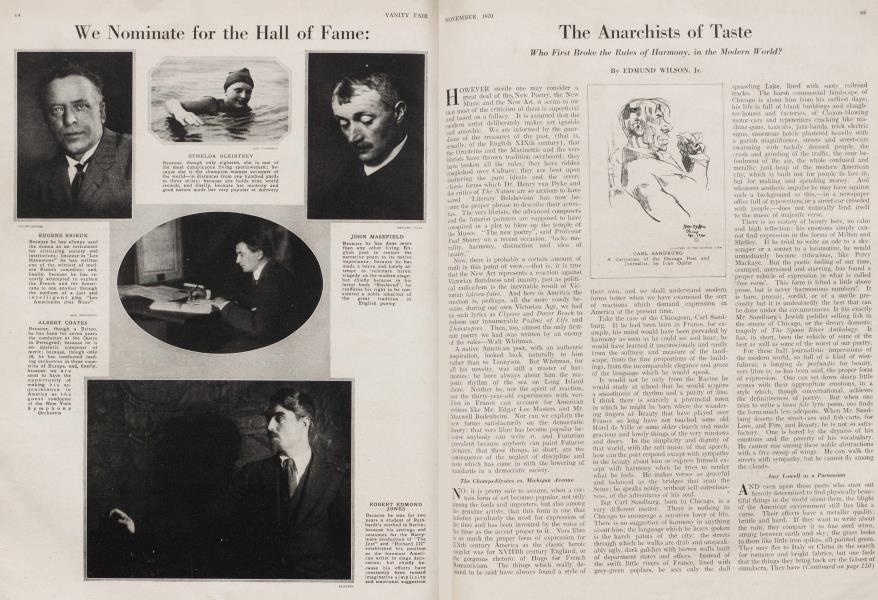
Take the case of the Chicagoan, Carl Sandburg. If he had been born in France, for example, his mind would have been pervaded by harmony as soon as he could see and hear; he would have learned it unconsciously and easily from the softness and measure of the landscape, from the fine proportions of the buildings, from the incomparable elegance and grace of the language which he would speak.
It would not be only from the Racine he would study at school that he would acquire a smoothness of rhythm and a purity of line. I think there is scarcely a provincial town in which he might be born where the wandering fingers of Beauty that have played over France so long have not touched some old Hotel de Ville or some older church and made gracious and lovely things of the very windows and doors. In the simplicity and dignity of that world, with the soft music of that speech, how can the poet respond except with sympathy to the beauty about him or express himself except with harmony when. he tries to render what he feels. He makes verses as graceful and balanced as the bridges that span the Seine; he speaks nobly, without self-consciousness, of the adventures of his soul.
But Carl Sandburg, born in Chicago, is a very different matter. There is nothing in Chicago to encourage a sensitive lover of life. There is no suggestion of harmony in anything about him; the language which he hears spoken is the harsh patois of the city; the streets through which he walks are drab and unspeakably ugly, dark gulches with barren walls built of department stores and offices. Instead of the swift little rivers of France, lined with grey-green poplars, he sees only the dull sprawling Lake, lined with sooty railroad tracks. The harsh commercial landscape of Chicago is about him from his earliest days; his life is full of blank buildings and slaughter-houses and factories, of Claxon-blowing motor-cars and typewriters cracking like machine-guns, taxicabs, jazz-bands, trick electric signs, enormous hotels plastered heavily with a garish magnificence, streets and street-cars swarming with tackily dressed people, the crash and grinding of the traffic, the sour befoulment of the air, the whole confused and metallic junk-heap of the modern American city, which is built not for people to live in, but for making and spending money. And whatever aesthetic impulse he may have against such a background as this,—in a newspaper office full of typewriters, or a street-car crowded with people,—does not naturally lend itself to the music of majestic verse.
There is no ecstasy of beauty here, no calm and high reflection: his emotions simply cannot find expression in the forms of Milton and Shelley. If he tried to write an ode to a skyscraper or a sonnet to a locomotive, he would immediately become ridiculous, like Percy Mackaye. But the poetic feeling of our time, cramped, untrained and starving, has found a proper vehicle of expression in what is called 'free verse'. This form is lifted a little above prose, but is never 'harmonious numbers'. It is bare, prosaic, sordid, or of a sterile preciosity but it is undoubtedly the best that can be done under the circumstances. It fits exactly Mr. Sandburg's Jewish peddler selling fish in the streets of Chicago, or the dreary domestic tragedy of The Spoon River Anthology. It has, in short, been the vehicle of some of the best as well as some of the worst of our poetry.
For these half journalistic impressions of the modem world, so full of a kind of wistfulness, a longing de profundis for beauty, vers libre is, as has been said, the proper form of expression. One can set down sharp little scenes with their appropriate emotions, in a style which, though conversational, achieves the definitiveness of poetry. But when one tries to write a bona fide lyric poem, one finds the form much less adequate. When Mr. Sandburg deserts the street-cars and fish-carts, for Love, and Fire, and Beauty, he is not so satisfactory. One is bored by the dryness of his emotions . and the poverty of his vocabulary. He Cannot rise among these noble abstractions with a free sweep of wings. He can walk the streets with sympathy, but he cannot fly among the clouds.
Amy Lowell as a Parnassian
AND even upon those poets who start out fiercely determined to find physically beautiful things in the world about them, the blight of the American environment still lies like a curse. Their effects have a metallic quality, brittle and hard. If they want to write about the rain, they compare it to fine steel wires, strung between earth and sky; the grass looks to them like little iron spikes, all painted green. They may flee to Italy or China in the search for romance and bright fabrics, but one feels that the tilings they bring back are the falsest of simulacra. They have stood in the presence of beautiful things, but they have not learned how to see them. They have never been supplied with the emotion through which such things should be known. An aesthetic sense bred in Chicago, or even in Boston, has been stinted and crippled from childhood against enjoying the colours of the world. The poet may write of the dyes of the East or the magnificence of Can Grande's Castle, but it will be with a faculty which has been sterilized by a mechanical and bourgeois environment.
(Continued on page 110)
(Continued, from page 65)
That is the reason why people like Amy Lowell have taken to writing descriptions exactly in the spirit of Leconte de Lisle, but in free verse. Miss Lowell has laid down the fallacious doctrine of the French Parnassians,—the doctrine from which Symbolism rescued French poetry at the end of the last century. She practices a hard objectivity, without either ideas or emotion. Describe what you see in the external world; never mind about anything else. And, alas! this is all that she and most of her compatriots can do. Americans do not feel; they can only see. And they succeed in this style of poetry even less well than the Parnassians did; for the French had, at least, the sonorous roll and at times the stately emotion of the noble classic tradition, while the modem American Imagists, rendered even more sterile and prosaic, have not even these respectable qualities to make their hardness go down more easily. If Huysmans once called Leconte de Lisle "le quincaillier sonore", he would certainly call Miss Lowell "le quincaillier tout court".
And as for music and painting, they have suffered as much as poetry from the aspect of the modern world. A picture of Coney Island, for example, that is all discordant yellows and greens and glaring explosions of light, is perhaps really the only way that Coney Island can be represented. Such a wild confusion of harsh colours and jagged angular shapes really does correspond to the impression that one carries away from an amusement park. The appearance of the modern city, with its anarchic disregard of harmony, its domination by machinery and its forest of surfaces and corners, is really accurately rendered by Futurism and Cubism, and we have Mr. Paul Rosenfeld's assurance that its sounds are heard in the music of Stravinsky and Leo Ornstein. These works are not the results of enjoyment, of a calm drinking deep of things seen; they are the grating and bewildered cries of exasperated nerves.
Yes, outraged university professons, poets left over from the nineties, oldmaidishly caustic writers in the respectable reviews, it is not the artists of to-day who have done away with culture. It is not poor Mr. Sandbum who is the enemy of Virgil, nor even Mr. Leo Ornstein who is warring against Bach. These men only found themselves in love with life at a time when life was loved but little: they were filled with joy by the shapes of things as they saw them bright in the sun. The things that they saw may have bees machines or amusement parks or office buildings,—they may have been the dull and vulgar people of the offices and streets,—but to the artist they became appearances of a divine wonder. And wherever these things were seen through the real artist's eyes, however ungainly the medium through which the artist has spoken, we have had documents which, although they may be forgotten by more civilized ages than this, are nevertheless among the most valid and alive which our own age has to show.
No, it is not the artists who are responsible for blackening the face of Apollo; it is the commercialism of the time which has blackened the face of the world. It is not the poets whom you should denounce: it was not they who first broke the rules,—the rules of harmony and order and measure and taste. These things began to decline simultaneously with the progress of the industrial revolution,—with the rise of the bourgeois and the tradesman, who put a tradesman's valuation on everything that the human mind could imagine or the human hand construct They made the cities into hideous hives and disfigured the countryside with sign-boards; they led all the imagination of the country to devote itself to advertising and most of its scientific ingenuity to expend itself in contriving machines by which tasks already monotonous might be multiplied into tasks more intolerable still.
It is they and not the artists who were the true anarchists of taste!—the shopkeeper and the manufacturer who moulded the world to their likeness and to whose bourgeois ideals you yourselves, professors and critics, have proved among the promptest apologists and the fiercest supporters!
Subscribers have complete access to the archive.
Sign In Not a Subscriber?Join Now
