Sign In to Your Account
Subscribers have complete access to the archive.
Sign In Not a Subscriber?Join NowThe Bull-Fight vs. The Prize-Fight
A Spanish Novelist Discusses the Comparative Merits of Spanish and American Sport
RAMÓN PEREZ DE AYALA
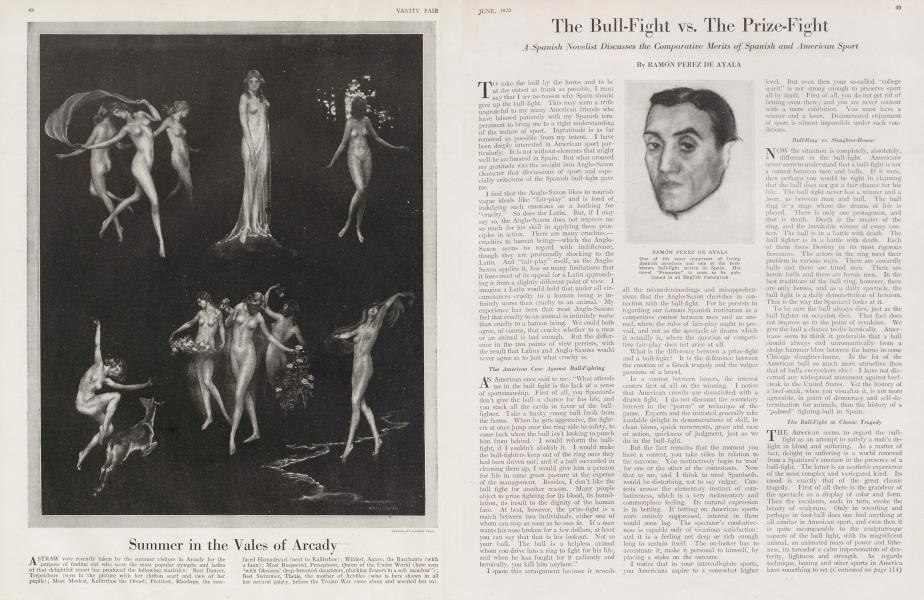
TO take the bull by the horns and to be at the outset as frank as possible, I must say that I see no reason why Spain should give up the bull-fight. This may seem a trifle ungrateful to my many American friends who have labored patiently with my Spanish temperament to bring me to a right understanding of the nature of sport. Ingratitude is as far removed as possible from my intent. I have been deeply interested in American sport particularly. It is not without elements that might well be acclimated in Spain. But what aroused my gratitude was the insight into Anglo-Saxon character that discussions of sport and especially criticisms of the Spanish bull-fight gave me.
I find that the Anglo-Saxon likes to nourish vague ideals like "fair-play" and is fond of indulging such emotions as a loathing for "cruelty." So does the Latin. But, if I may say so, the Anglo-Saxon does not impress me so much for his skill in applying these principles in action. There are many cruelties,— cruelties to human beings—which the AngloSaxon seems to regard with indifference, though they are profoundly shocking to the Latin. And "fair-play" itself, as the AngloSaxon applies it, has so many limitations that it loses most of its appeal for a Latin approaching it from a slightly different point of view. I imagine a Latin would hold that under all circumstances cruelty to a human being is infinitely worse than cruelty to an animal. My experience has been that most Anglo-Saxons feel that cruelty to an animal is infinitely worse than cruelty to a human being. We could both agree, of course, that cruelty whether to a man or an animal is bad enough. But the difference in the two points of view persists, with the result that Latins and Anglo-Saxons would never agree as to just what cruelty is.
The American Case Against Bull-Fighting
AN American once said to me: "What offends me in the bull fight is the lack of a sense of sportsmanship. First of all, you Spaniards don't give the bull a chance for his life, and you stack all the cards in favor of the bullfighter. Take a husky young bull fresh from the farms. When he gets aggressive, the fighters at once jump over the ring side to safety, to come back when the bull isn't looking to punch him from behind. • I would reform the bullfight, if I couldn't abolish it. I would make the bull-fighters keep out of the ring once they had been driven out; and if a bull succeeded in cleaning them up, I would give him a pension for life in some green pasture at the expense of the management. Besides, I don't like the bull fight for another reason. Many people object to prize fighting for its blood, its humiliation, its insult to the dignity of the human face. At best, however, the prize-fight is a match between two individuals, either one of whom can stop as soon as he sees fit. If a man wants his nose broken for a few dollars, at least you can say that that is his lookout. Not so your bull. The bull is a helpless animal whom you drive into a ring to fight for his life, and when he has fought for it Gallantly and heroically, you kill him anyhow."
I quote this arraignment because it reveals all the misunderstandings and misapprehensions that the Anglo-Saxon cherishes in connection with the bull-fight. For he persists in regarding our famous Spanish institution as a competitive contest between men and an animal, where the rules of fair-play ought to prevail, and not as the spectacle or drama which it actually is, where the question of competitive fair-play does not arise at all.
What is the difference between a prize-fight and a bull-fight? It is the difference between the emotion of a Greek tragedy and the vulgar passions of a brawl.
In a contest between boxers, the interest centers first of all on the winning. I notice that American crowds are dissatisfied with a drawn fight. I do not discount the secondary interest in the "points" or technique of the game. Experts and the initiated generally take laudable delight in demonstrations of skill, in clean blows, quick movements, grace and ease of action, quickness of judgment, just as we do in the bull-fight.
But the fact remains that the moment you have a contest, you take sides in relation to the outcome. You instinctively begin to 'root' for one or the other of the contestants. Now that to me, and I think to most Spaniards, would be disturbing, not to say vulgar. Contests arouse the elementary instinct of combativeness, which is a very rudimentary and commonplace feeling. Its natural expression is in betting. If betting on American sports were entirely suppressed, interest in them would soon lag. The spectator's combativeness is capable only of vicarious satisfaction; and it is a feeling not deep or rich enough long to sustain itself. The on-looker has to accentuate it, make it personal to himself, by placing a stake on the outcome.
I notice that in your intercollegiate sports, you Americans aspire to a somewhat higher level. But even then your so-called "college spirit" is not strong enough to preserve sport all by itself. First of all, you do not get rid of lotting even there; and you are never content with a mere exhibition. You must have a winner and a laser. Disinterested enjoyment of sport is almost impossible under such conditions.
Bull-Ring vs. Slaughter-House
NOW the situation is completely, absolutely, different in the bull-fight. Americans never seem to understand that a bull-fight is not a contest between men and bulls. If it were, then perhaps you would be right in claiming that the bull does not get a fair chance for his life. The bull fight never has a winner and a loser, as between man and bull. The bull ring is a stage where the drama of life is played. There is only one protagonist, and that is death. Death is the master of the ring, and the inevitable winner of every contest. The bull is in a battle with death. The bull fighter is in a battle with death. Each of them faces Destiny in its most rigorous fierceness. The actors in the ring meet their problem in various ways. There are cowardly bulls and there are timid men. There are heroic bulls and there are heroic men. In the best traditions of the bull ring, however, there are only heroes, and as a daily spectacle, the bull fight is a daily demonstration of heroism. That is the way the Spaniard looks at it.
To be sure the bull always dies, just as the bull fighter on occasion dies. That fact does not impress us to the point of revulsion. We give the bull a chance to die heroically. Americans seem to think it preferable that a bull should always end unromantically from a sledge hammer blow between the horns in some Chicago slaughter-house. Is the lot of the American bull so much more attractive than that of bulls everywhere else? I have not discerned any widespread movement against beefsteak in the United States. Yet the history of a beef-steak, when you visualize it, is not more agreeable, in point of democracy and self-determination for animals, than the history of a "palmed" fighting-bull in Spain.
The Bull-Fight as Classic Tragedy
THE American seems to regard the bullfight as an attempt to satisfy a mob's delight in blood and suffering. As a matter of fact, delight in suffering is a world removed from a Spaniard's emotion in the presence of a bull-fight. The latter is an aesthetic experience of the most complex and variegated kind. Its mood is exactly that of the great classic tragedy. First of all there is the grandeur of the spectacle as a display of color and form. Then the incidents, each in turn, evoke the beauty of sculpture. Only in wrestling and perhaps in foot-ball does one find anything at all similar in American sport, and even then it is quite incomparable to the sculpturesque aspects of the bull fight, with its magnificent animal, an animated mass of power and litheness, its toreador a calm impersonation of dexterity, lightness and strength. As regards technique, boxing and other sports in America have something to-set off against the combination of precision, quickness of wit, and coolness of judgment that bull-fights require; but American sports never demand the combination of such qualities with unflinching courage in the presence of death.
(Continued on page 114)
(Continued from page 49)
But at this point the bull-fight becomes distinctive and unique. Humanitarians, have tried to reform the bullfight by eliminating the last act, the killing of the bull. That is like playing Macbeth and leaving out the final tragedy, or transforming that wonderful drama into a farce by making the soultorn sinner of Shakespeare repent and join the Salvation Army. Remove the death of the bull and you remove the soul of the bull-fight. Death there is exactly analogous to Fate in the Greek tragedy. The struggle is beautiful and heroic precisely because its outcome is fixed and immutable, precisely because it is in vain. So the struggle of humanity against death is in vain. But that is no reason for dying unheroically. The Spaniard sees in the bull-fight all the pathos of human destiny and all the grandeur of human heroism.
Americans may not blame me, then, if I find the combative rivalries of American sports somewhat insipid, and the unsightly details of the prize-fight somewhat revolting. Your boxing matches have nothing to take my mind off the blood—except the bet; and I prefer to make my money in other ways.
American sport serves well, I suppose, the youthful exuberance of a young people. It reflects the competitive spirit of America, the desire to succeed and to succeed by surpassing. It has its cruelties, too, in the humiliation of the loser. The bull-fight stimulates the contemplative, philosophical subtleties of an older civilization, and finds its true spirit in the assthetic, non-combative plane.
That is why I prefer the bull-fight to all kinds of competitive contests. Not that our national sport is without defects. In a tradition so ancient there are survivals that might be modified without damage to the essence of the game. A substitute might be found, for instance, for the episode wnere horses are employed, so much to the disgust of our Anglo-Saxon critics. But in a country as old as Spain, reforming the bull-fight is as serious a business as reforming religion generally is. The bull-fight is one of the last institutions we shall get to in the process of our reforms.
Subscribers have complete access to the archive.
Sign In Not a Subscriber?Join Now
