Sign In to Your Account
Subscribers have complete access to the archive.
Sign In Not a Subscriber?Join NowAmerican Influence On the Rules of Golf
A Discussion of Certain Moot Points in the Game, with the Opinions of Some Eminent Authorities
JOHN G. ANDERSON
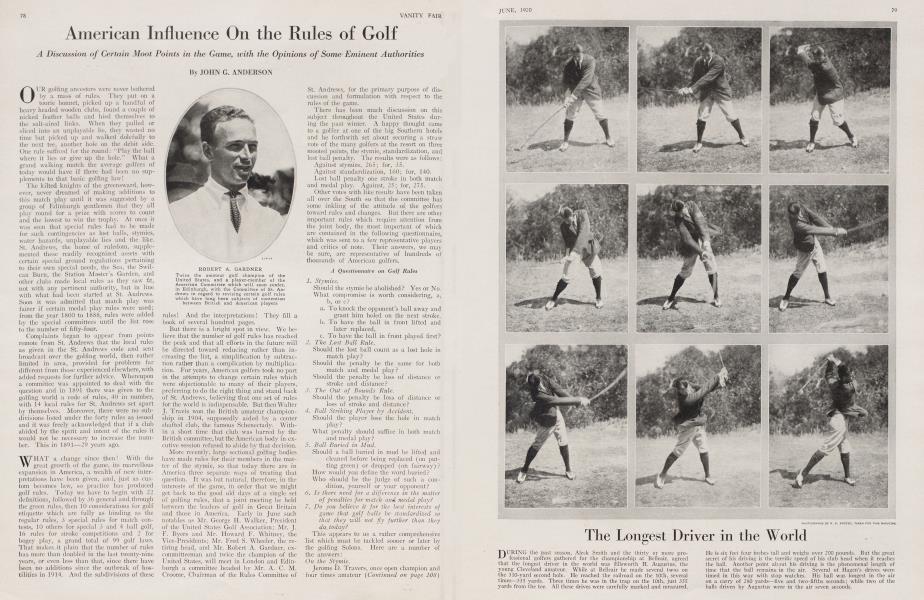
OUR golfing ancestors were never bothered by a mass of rules. They put on a toorie bonnet, picked up a handful of heavy headed wooden clubs, found a couple of nicked feather balls and hied themselves to the salt-aired links. When they pulled or sliced into an unplayable lie, they wasted no time but picked up and walked dolefully to the next tee, another hole on the debit side. One rule sufficed for the round: "Play the ball where it lies or give up the hole." What a grand walking match the average golfers of today would have if there had been no supplements to that basic golfing law!
The kilted knights of the greensward, however, never dreamed of making additions to this match play until it was suggested by a group of Edinburgh gentlemen that they all play round for a prize with scores to count and the lowest to win the trophy. At once it was seen that special rules had to be made for such contingencies as lost balls, stymies, water hazards, unplayable lies and the like. St. Andrews, the home of ruledom, supplemented these readily recognized assets with certain special ground regulations pertaining to their own special needs, the Sea, the Swilcan Burn, the Station Master's Garden, and other clubs made local rules as they saw fit, not with any pertinent authority, but in line with what had been started at St. Andrews. Soon it was admitted that match play was fairer if certain medal play rules were used; from the year 1800 to 1888, rules were added by the special committees until the list rose to the number of fifty-four.
Complaints began to appear from points remote from St. Andrews that the local rules as given in the St. Andrews code and sent broadcast over the golfing world, then rather limited in area, provided for problems far different from those experienced elsewhere, with added requests for further advice. Whereupon a committee was appointed to deal with the question and in 1891 there was given to the golfing world a code of rules, 40 in number, with 14 local rules for St. Andrews set apart by themselves. Moreover, there were no subdivisions listed under the forty rules as issued and it was freely acknowledged that if a club abided by the spirit and intent of the rules it would not be necessary to increase the number. This in 1891—29 years ago.
WHAT a change since then! With the great growth of the game, its marvellous expansion in America, a wealth of new interpretations have been given, and, just as custom becomes law, so practice has produced golf rules. Today we have to begin with 22 definitions, followed by 36 general and.through the green rules, then 10 considerations for golf etiquette which are fully as binding as the regular rules, 3 special rules for match contests, 10 others for special 3 and 4 ball golf, 16 rules for stroke competitions and 2 for bogey play, a grand total of 99 golf laws. That makes.it plain that the number of rules has more than doubled in the last twenty-nine years, or even less than that, since there have been no additions since the outbreak of hostilities in 1914. And the subdivisions of these rules! And the interpretations! They fill a book of several hundred pages.
But there is a bright spot in view. We believe that the number of golf rules has reached the peak and that all efforts in the future will be directed toward reducing rather than increasing the list, a simplification by subtraction rather than a complication by multiplication. For years, American golfers took no part in the attempts to change certain rules which were objectionable to many of their players, preferring to do the right thing and stand back of St. Andrews, believing that one set of rules for the world is indispensable. But then Walter J. Travis won the British amateur championship in 1904, supposedly aided by a center shafted club, the famous Schenectady. Within a short time that club was barred by the British committee, but the American body in excutive session refused to abide by that decision.
More recently, large sectional golfing bodies have made rules for their members in the matter of the stymie, so that today there are in America three separate ways of treating that question. It was but natural, therefore, in the interests of the game, in order that we might get back to the good old days of a single set of golfing rules, that a joint meeting be held between the leaders of golf in Great Britain and those in America. Early in June such notables as Mr. George H. Walker, President of the United States Golf Association; Mr. J. F. Byers and Mr. Howard F. Whitney, the Vice-Presidents; Mr. Fred S. Wheeler, the retiring head, and Mr. Robert A. Gardner, excommitteeman and twice the champion of the United States, will meet in London and Edinburgh a committee headed by Mr. A. C. M. Croome, Chairman of the Rules Committee of St. Andrews, for the primary purpose of discussion and formulation with respect to the rules of the game.
There has been much discussion on this subject throughout the United States during the past winter. A happy thought came to a golfer at one of the big Southern hotels and he forthwith set about securing a straw vote of the many golfers at the resort on three mooted points, the stymie, standardization, and lost ball penalty. The results were as follows: Against stymies, 265; for, 35.
Against standardization, 160; for, 140. Lost ball penalty one stroke in both match and medal play. Against, 25; for, 275.
Other votes with like results have been taken all over the South so that the committee has some inkling of the attitude of the golfers toward rules and changes. But there are other important rules which require attention from the joint body, the most important of which are contained in the following questionnaire, which was sent to a few representative players and critics of note. Their answers, we may be sure, are representative of hundreds of thousands of American golfers.
A Questionnaire on Golf Rules
1. Stymies.
Should the stymie be abolished?. Yes or No. What compromise is worth considering, a, b, or c?
a. To knock the opponent's ball away and grant him holed on the next stroke,
b. To have the ball in front lifted and later replaced,
c. To have the ball in front played first? 2. The Lost Ball Rule.
Should the lost ball count as a lost hole in match play?
Should the penalty be the same for both match and medal play?
Should the penalty be loss of distance or stroke and distance?
2. The Out of Bounds Rule.
Should the penalty be loss of distance or loss of stroke and distance?
4. Ball Striking Player by Accident.
Should the player lose the hole in match
play ?
What penalty should suffice in both match and medal play?
5. Ball Buried in Mud.
Should a ball buried in mud be lifted and cleaned before being replaced (on putting green) or dropped (on fairway)?
How would you define the word buried?
Who should be the judge of such a condition, yourself or your opponent?
6. Is there need for a difference in the matter of penalties for match and medal play?
7. Do you believe it for the best interests of
game that golf balls be standardized so that they will not fly further than they do today?
This appears to us a rather comprehensive list which must be tackled sooner or later by the golfing Solons. Here are a number of the answers:
On the Stymie.
Jerome D. Travers, once open champion and four times amateur champion of the United States, says: When a player stymies himself he should suffer the penalty. Otherwise, he need not.
(Continued on page 108)
(Continued from page 78)
Oswald Kirkby, Metropolitan champion: Stymies should be abolished. If a compromise, b.
Frank H. Hoyt, Lesley Cup member and leading player of the Engineers' Country Club: No stymies except where a player stymies himself.
Sherrill Sherman, semi-finalist in national amateur: Play stymies when you stymie yourself. Lost Ball Rule.
All four of the above players believe that the hole should not be lost when the ball is lost. Two of them, Travers and Sherman, agree that stroke and distance should be the penalty in both match and medal play. Mr. Kirkby would have distance lost only, while Mr. Hoyt would have distance in match and stroke and distance in medal.
Out of Bounds Rule.
Mr. Travers believes that stroke and distance should be the penalty while the other three agree on distance only. It might be remarked that Mr. Francis Ouimet is a firm advocate of stroke and distance as a penalty for an outof-bounds shot.
Ball Striking Player by Accident.
Here again the former champion is matched against the other three. Mr. Travers states that the hole should be forfeited if the ball strikes player or his caddy, but the others are not in favor of this drastic penalty.
Apropos of this question it may be said here that no player would ever try to hit or get hit, and that not once in a hundred times would any benefit accrue from the accident. Jim Barnes lost the Metropolitan championship a few years ago because in playing out of a bunker he failed to get the necessary loft, and the ball bounced back from the side of the trap, hit him and nestled in a large footprint. That mishap cost him two extra strokes.
Ball Buried in Mud.
Unanimity of opinion. Every one of these crack golfers believes that the ball should be lifted and cleaned and replaced when buried on putting green, and cleaned and dropped when on the fairway. The test is whether the ball is resting in a depression made by itself and the opponent can be the judge, for golf is essentially a game of fairness. Mr. Travers speaks from bitter experience when he says:
"Having lost the finals of an important championship through my ball being buried on the putting green and also in the fairway, through no fault of my own, but because of the soggy condition of the course, I feel that the rule is unfair and ought to be changed. I am not sure how you would define the word buried, but in all championship matches there should be a referee who could decide the question."
Need for Difference in Penalties in Match and Medal Play.
Three of the golfers believe that with slight exceptions there is no necessity for the many differences which are rampant in our rules today. Mr. Travers is of the opinion that the penalties in these two cannot be made absolutely uniform.
Standardization.
There is need for some action looking towards the checking of greater distance Jhan we can secure today, says the former champion, while the other golfers and critics believe that the question need not be touched upon by the committee.
Mr. J. L. C. Jenkins, amateur champion of Great Britain, in speaking of standardization, says:
"I am in favor of the principle of a standardization whereby a player would compete on terms of equality, but I doubt its practicability."
Mr. F. C. Newton, captain of the Massachusetts team, believes in standardization, the abolition of the stymie question, and a stroke penalty for a lost ball.
Mr. D. E. Sawyer, crack golfer, says:
"In my opinion, the rules of golf should be few and those, few as simple as possible. Complicated rules give leniency. One should play the game or quit. Stymies should not count unless the player-stymies himself. Nor should a lost ball mean the loss of the hole."
Mr. J. S. Worthington, former Irish open champion, writes:
"Abolish the stymie, clean and replace a ball buried on putting green. Nor is there need for material difference in rules for match or medal play."
It is evident that there is plenty of ammunition, if needed by the delegates in presenting America's status with respect to rule changes. The six hundred thousand golfers are intensely interested in the questions before the joint bodies and the fact that thousands of them have stated their beliefs in print has brought the question nearer home. No tradition is hurt by changing the rules, since we have shown that the number has doubled in the past quarter century and that nothing whatever has been gained by this multiplication. Now we are on a new tack, that of simplifying. It's not an enviable task, but it has world-wide significance and power. America is fortunate to have such fine sportsmen, who are willing to put aside personal convenience for the sake of the game.
Subscribers have complete access to the archive.
Sign In Not a Subscriber?Join Now
