Sign In to Your Account
Subscribers have complete access to the archive.
Sign In Not a Subscriber?Join NowThe Luck o' the Game
Golf, and the Arrows of Its Outrageous Fortune
JOHN G. ANDERSON
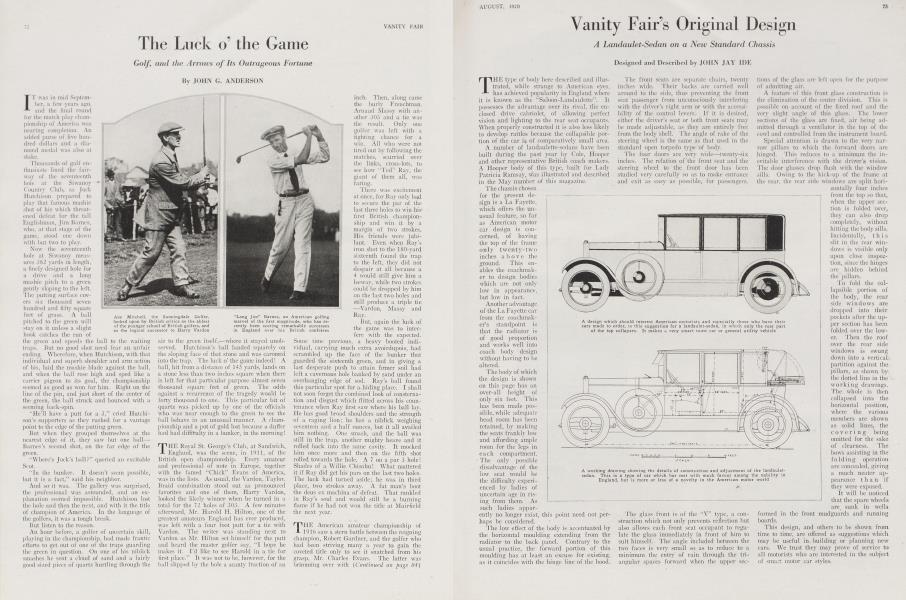
IT was in mid September, a few years ago. and the final round for the match play championship of America was nearing completion. An added purse of five hundred dollars and a diamond medal was also at stake.
Thousands of golf enthusiasts lined the fairway of the seventeenth hole at the Siwanoy Country Club, as Jock Hutchison prepared to play that famous mashie shot of his which threatened defeat for the tall Englishman, Jim Barnes, who, at that stage of the game, stood one down with but two to play.
Now the seventeenth hole at Siwanoy measures 382 yards in length, a finely designed hole for a drive and a long mashie pitch to a green gently sloping to the left.
The putting surface covers six thousand seven hundred and fifty square feet of grass. A ball pitched to the green will stay on it unless a slight hook catches the run of the green and speeds the ball to the waiting traps. But no good shot need fear an unfair ending. Wherefore, when Hutchison, with that individual and superb shoulder and arm action of his, laid the mashie blade against the ball, and when the ball rose high and sped like a carrier pigeon to its goal, the championship seemed as good as won for him. Right on the line of the pin, and just short of the center of the green, the ball struck and bounced with a seeming back-spin.
"He'll have a putt for a 3," cried Hutchison's supporters as they rushed for a vantage point to the edge of the putting green.
But when they grouped themselves at the nearest edge of it, they saw but one ball— Barnes's second shot, on the far edge of the green.
"Where's Jock's ball?" queried an excitable Scot.
"In the bunker. It doesn't seem possible, but it is a fact," said his neighbor.
And so it was. The gallery was surprised, the professional was astounded, and an explanation seemed impossible. Hutchison lost the hole and then the next, and with it the title of champion of America. In the language of the golfers, it was a tough break.
But listen to the reason.
An hour before, a golfer of uncertain skill, playing in the championship, had made frantic efforts to get out of one of the traps guarding the green in question. On one of his niblick smashes he sent a cloud of sand and a fairly good sized piece of quartz hurtling through the
air to the green itself,—where it stayed unobserved. Hutchison's ball landed squarely on the sloping face of that stone and was caromed into the trap. The luck o' the game indeed! A ball, hit from a distance of 145 yards, lands on a stone less than two inches square when there is left for that particular purpose almost seven thousand square feet of green. The odds against a recurrence of the tragedy would be forty thousand to one. This particular bit of quartz was picked up by one of the officials who was near enough to the green to see the ball behave in an unusual manner. A championship and a pot of gold lost because a duffer had had diffieulty in a bunker, in the morning!
THE Royal St. George's Club, at Sandwich, England, was the scene, in 1911, of the British open championship. Every amateur and professional of note in Europe, together with the famed "Chick" Evans of America, was in the lists. As usual, the Vardon, .Taylor, Braid combination stood out as pronounced favorites and one of them, Harry Vardon, looked the likely winner when he turned in a total for the 72 holes of 303. A few minutes afterward, Mr. Harold H. Hilton, one of the greatest amateurs England has ever produced, was left with a four foot putt for a tie with Vardon. The writer was standing next to Vardon as Mr. Hilton set himself for the putt and heard the master golfer say, "I hope he makes it. I'd like to see Harold in a tie for first place." It was not to be, however, for the ball slipped by the hole a scanty fraction of an
inch. Then, along came the burly Frenchman, Arnaud Massy with another 303 and a tie was the result. Only one golfer was left with a fighting chance for a win. All who were not tired out by following the matches, scurried over the links, cross-lots, to see how "Ted" Ray, the giant of them all, was faring.
There was excitement at once, for Ray only had to secure the par of the last three holes to win his first British championship and win it by a margin of two strokes. His friends were jubilant. Even when Ray's iron shot to the 180-yard sixteenth found the trap to the left, they did not despair at all because a 4 would still give him a leeway, while two strokes could be dropped by him on the last two holes and still produce a triple tie —Vardon, Massy and Ray.
But, again the luck of the game was to interfere with the expected. Some time previous, a heavy booted individual, carrying much extra avoirdupois, had scrambled up the face of the bunker that guarded the sixteenth green, and in giving a last desperate push to attain firmer soil had left a cavernous hole banked by sand under an overhanging edge of sod. Ray's ball found this particular spot for a. hiding place. I shall not soon forget the combined look of consternation and disgust which flitted across his countenance when Ray first saw where his ball lay. He has good broad shoulders and the strength of a raging lion; he has a niblick weighing seventeen and a half ounces, but it all availed him nothing. One smash, and the ball was still in the trap, another mighty heave and it rolled back into the same cavity. It mocked him once more and then on the fifth shot rolled towards the hole. A 7 on a par 3 hole! Shades of a Willie Chisolm! What mattered it if Ray did get his pars on the last two holes. The luck had turned aside; he was in third place, two strokes away. A fat man's boot the deus ex machina of defeat. That rankled in Ray's soul and would still be a burning flame if he had not won the title at Muirfield the next year.
THE American amateur championship of 1916 saw a stern battle between the reigning champion, Robert Gardner, and the golfer who had been striving many a year to gain the coveted title only to see it snatched from his grasp, Mr. Charles Evans. The latter was brimming over with confidence all morning and he twirled his mashie with nonchalant ease in the afternoon when he stood four up. But Gardner is never beaten; he has too many memories of matches pulled out of the fire and he hung on like grim death. A beautiful 4 at the sixth, a 3 at the seventh, a 2 at the ninth and he was but one down and striding on with renewed confidence. Evans was beginning to look worried, wondering, perhaps, if after all the cup of victory was to be snatched away from him. The feeling was intensified at the very next hole where he sliced his drive to a trap, was barely out on the next and then lay fifty feet from the pin in three with Gardner six yards away from the hole in two. "The match is all square. Let's hurry to the next green. Evans is cracking. That makes four out of the last five that Gardner's won." These and kindred remarks floated through the ranks of the gallery.
Continued on page 84
Continued from page 72
But wait a moment. Golf ever defies the expected. Evans stepped up to his ball, aimed rather carelessly as if he knew the hole was lost, but that a perfunctory putt must be made, and then tapped the sphere a goodly rap. It caught two distinct undulations and, before one could gasp, had found its way into the hole. A cheer rent the sky. Evans was again in his confident scoring mood and Gardner never again had a chance. A happy-go-lucky putt, the luck o' the game turning a rout into a great victory. Have you ever heard of that other famous amateur duel at Westward Ho, between the incomparable Johnny Ball, eight times amateur champion of Great Britain, and the present day star of stars, Abe Mitchell ? Mr. Ball, the Hoylake golfer, never could get the lead from his younger opponent and, but for another bit of good fortune, would have lost the title. At the crucial hole in the afternoon, Ball drove a long ball which was somewhat off the line. It was raining hard and umbrellas were in use. Plop went the ball on the umbrella carried by a lady golfer and, bouncing high in the air, it went to the well cut fairway.
It was Mitchell's turn to drive and he, too, left the straight and narrow path, and likewise hit the top of an open umbrella. But, instead of finding
a happy lie on the fairway, his ball was caromed into a soggy bunker which caused him to lose the hole and brought him back to level terms. Ball won the match at the second extra hole. The tilted angle of a couple of umbrellas spelled defeat for one and victory for the other.
THERE are many other instances of good fortune which might be recorded here. In the open championship at Prestwick, in 1914, the two leaders at the end of the first day's play were Vardon and Taylor. The latter never plays so well as when he has for a partner some golfer who acts more as a trial horse than an actual contender with a chance. Never does he play medal play to the best of his ability when partnered with Harry Vardon. There were sixty-four left in the championship and one can guess how many permutations and combinations might result in the draw for partners for the last day's golf. Still, the luck of the draw decreed that Taylor should play with Vardon, at the same time casting a wet blanket over the former's hopes. Taylor led in the morning by two strokes, but then the machine-like play of his foremost rival finally got on his nerves and he slipped to second place with a disastrous last round of 83. Critics were as one in saying that if Taylor had had another partner he would have won the title with two or three strokes to spare.
Harry Vardon, stylist of all golfers, in an exhibition match at Northwood a few years ago, proved that the luck of golf is sometimes aided by super-ability. His own account of his most wonderful shot is as follows:
"At Northwood, the club-house is built on the side of the home putting green, and I managed, by a rather careless shot, to play my ball right up against the corner of the club-house on the side farthest from the green. I had the building between me and the hole, which was just on the other side. I made a rather useful niblick shot that sent the ball almost perpendicularly up in the air, and then it seemed to get a curl that took it over in the direction of the hole, and it flopped right down beside it. It is very fine, in golf, when these things come off."
Subscribers have complete access to the archive.
Sign In Not a Subscriber?Join Now
