Sign In to Your Account
Subscribers have complete access to the archive.
Sign In Not a Subscriber?Join NowHOW WELL DO WOMEN PLAY GOLF?
John G. Anderson
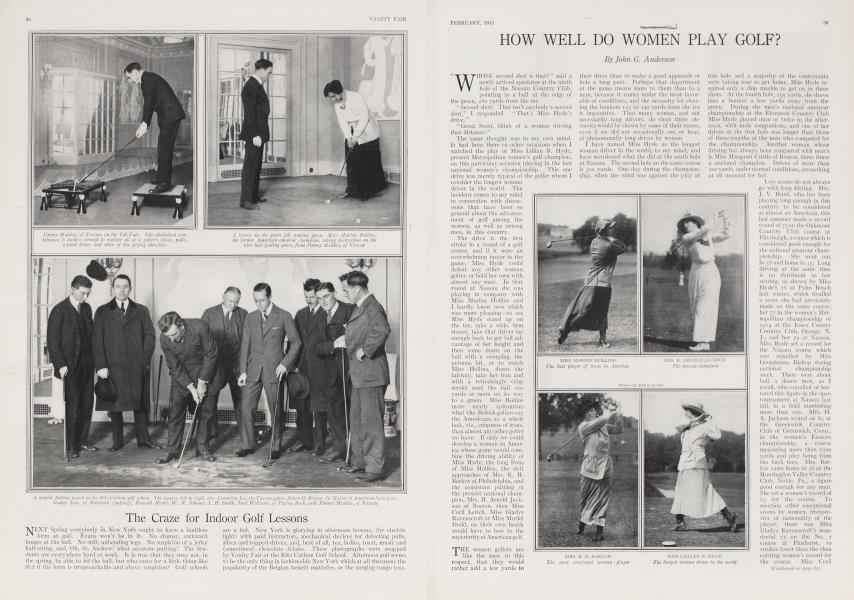
WHOSE second shot is that?" said a newly arrived spectator at the ninth hole of the Nassau Country Club, pointing to a ball at the edge of the green, 280 yards from the tee.
"Second shot! That isn't anybody's second shot," I responded. "That's Miss Hyde's drive."
"Great Scott, think of a woman driving that distance!"
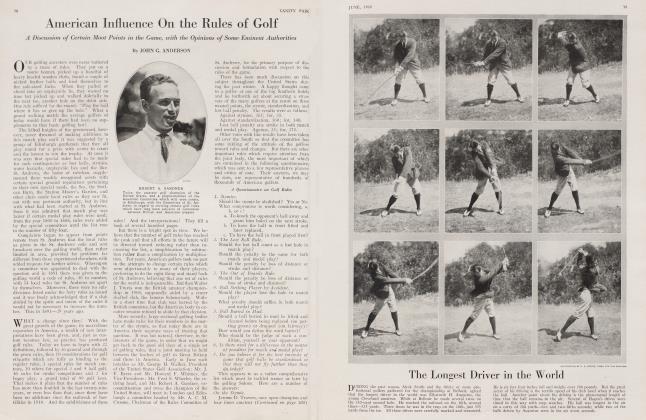
The same thought was in my own mind. It had been there on other occasions when I watched the play of Miss Lillian B. Hyde, present Metropolitan women's golf champion, on this particular occasion playing in the last national women's championship. This one drive was merely typical of the golfer whom I consider the longest woman driver in the world. The incident comes to my mind in connection with discussions that have been so general about the advancement of golf among the women, as well as among men, in this country.
The drive is the first stroke in a round of a golf course, and if it were an overwhelming factor in the game, Miss Hyde could defeat any other woman golfer, or hold her own with almost any man. In that round at Nassau she was playing in company with Miss Marion Hollins and I hardly know now which was more pleasing—to see Miss Hyde stand up on the tee, take a wide, firm stance, take that driver far enough back to get full advantage of her height and then come down on the ball with a sweeping, impetuous hit, or to watch Miss Hollins, down the fairway, take her iron and with a refreshingly crisp stroke send the ball 200 yards or more on its way to a green. Miss Hollins more nearly epitomizes what the British golfers say the Americans as a whole lack, viz., crispness of irons, than almost any other golfer we have. If only we could develop a woman in America whose game would combine the driving ability of Miss Hyde, the long irons of Miss Hollins, the deft approaches of Mrs. R. H. Barlow of Philadelphia, and the consistent putting of the present national champion, Mrs. H. Arnold Jackson of Boston, then Miss Cecil Leitch, Miss Gladys Ravenscroft or Miss Muriel Dodd, on their own heath would have to bow to the superiority of American golf.
THE women golfers are like the men in this respect, that they would rather add a few yards to their drive than to make a good approach or hole a long putt. Perhaps that department of the game means more to them than to a man, because it comes under the most favorable of conditions, and the necessity for clearing the bunkers 125 to 140 yards from the tee is imperative. That many women, and not necessarily long drivers, do clear these obstacles would be shown by some of their scores, even if we did not occasionally see, or hear, of phenomenally long drives by women
I have named Miss Hyde as the longest woman driver in the world, to my mind, and have mentioned what she did at the ninth hole at Nassau. The second hole on the same course is 500 yards. One day during the championship, when the wind was against the play at this hole and a majority of the contestants were taking four to get home, Miss Hyde required only a chip mashie to get on in three shots. At the fourth hole, 295 yards, she drove into a bunker a few yards away from the green. During the men's national amateur championship at the Ekwanok Country Club Miss Hyde played once or twice in the afternoon, with male companions, and one of her drives at the first hole was longer than those of three-fourths of the men who competed for the championship. Another woman whose driving has always been compared with men's is Miss Margaret Curtis of Boston, three times a national champion. Drives of more than 200 yards, under normal conditions, are nothing at all unusual for her.
Low scores do not always go with long hitting. Mrs. j. V. Hurd, who has been playing long enough in this country to be considered as almost an American, this last summer made a record round of 75 on the Oakmont Country Club course at Pittsburgh, a course which is considered good enough for t he national amateur championship. She went out in 38 and home in 37. Long driving at the same time is no detriment to low scoring, as shown by Miss Hyde's 76 at Palm Beach last winter, which rivalled a score she had previously made on the same course; her 77 in the women's Metropolitan championship of 1914 at the Essex County Country Club, Orange, N. J., and her 79 at Nassau. Miss Hyde set a record for the Nassau course which was equalled by Miss Georgianna Bishop during national championship week. There were about half a dozen men, as I recall, who equalled or bettered this figure in the open tournament at Nassau last fall, in a field numbering more than 200. Mrs. H. A. Jackson scored an 83 at the Greenwich Country Club of Greenwich, Conn., in the women's Eastern championship, a course measuring more than 6300 yards and play being from the back tees. Mrs. Barlow came home in 38 at the Huntingdon Valley Country Club, Noble, Pa., a figure good enough for any man. She set a women's record of 83 for the course. To mention other exceptional scores by women, irrespective of nationality of the player, there was Miss Gladys Ravenscroft's wonderful 75 on the No. 2 course at Pinehurst, 10 strokes lower than the then existing women's record for the course. Miss Cecil Leitch, the British champion, once did a 67 at Ranelagh.
(Continued on page 82)
(Continued from page 59)
THE question arises, could the leading eight male golfers of America play the leading eight women, concede them half a stroke and get the best of them?
Mrs. H. A. Jackson.......Mr. Francis Ouimet
Miss Lillian B. Hyde......Mr. C. E. Evans, Jr.
Miss Marion Hollins...........Mr. Jerome D. Travers
Miss Elaine Rosenthal.........Mr. W. C. Fownes
Mrs. R. H. Barlow.......Mr. Walter J. Travis
Miss Margaret Curtis.........Mr. Ray R. Gorton
Miss F. C. Osgood..........Mr. Oswald Kirkby
Miss Caroline Painter..........Mr. D. E. Sawyer
Here is a list of players of opposite sexes which could not be much improved upon. The pairings are not made up necessarily in order of ability, but rather because those who are bracketed have strikingly similar styles and dispositions, while, from other points of view, their golfing kinship is really amazing.
Mrs. Jackson and Mr. Ouimet have both won a national amateur championship. Mr. Ouimet has won the national open, which is all medal play, and Mrs. Jackson has won the Women's Eastern, which corresponds with the national open. Both play easily and are adept in all departments of the game. Miss Hyde has been styled the "Chick" Evans of women's golf. Both have been foiled from attaining their greatest golfing ambition because of temperament, expressed chiefly in putting. Miss Hollins, like Mr. Travers, puts her greatest faith in the irons. Miss Rosenthal and Mr. Fownes play thinking, cautious golf. Mrs. Barlow and Mr. Travis lack only distance, excel in all other branches and have been notably successful for years. Miss Osgood and Mr. Kirkby both perform feats of great golfing brilliancy, but lack steadiness in the "big" moments. Miss Painter and Mr. Sawyer are essentially medal scorers, and decidedly good ones.
What, again, would be the outcome of such a match if played, for example, at Ekwanok, the scene of last years' amateur championship? Having formed as my own opinion that one 18-hole match would result either in a tie, 4 to 4, or else that the men would win by 5 matches to 3, I submitted the list to an authority on play in this country of both men and women and, without either of us knowing the other's selections as winners, we discovered that we had chosen exactly the same. It would hardly be etiquette to name the selections. If these two sets of players were to compete in matches every day for a week I can imagine that there would be many extra-hole contests.
Subscribers have complete access to the archive.
Sign In Not a Subscriber?Join Now
