Sign In to Your Account
Subscribers have complete access to the archive.
Sign In Not a Subscriber?Join NowThe Sleepwalker and the State
Thoughts on the New Renascence and the Structure of the Future
G. K. CHESTERTON
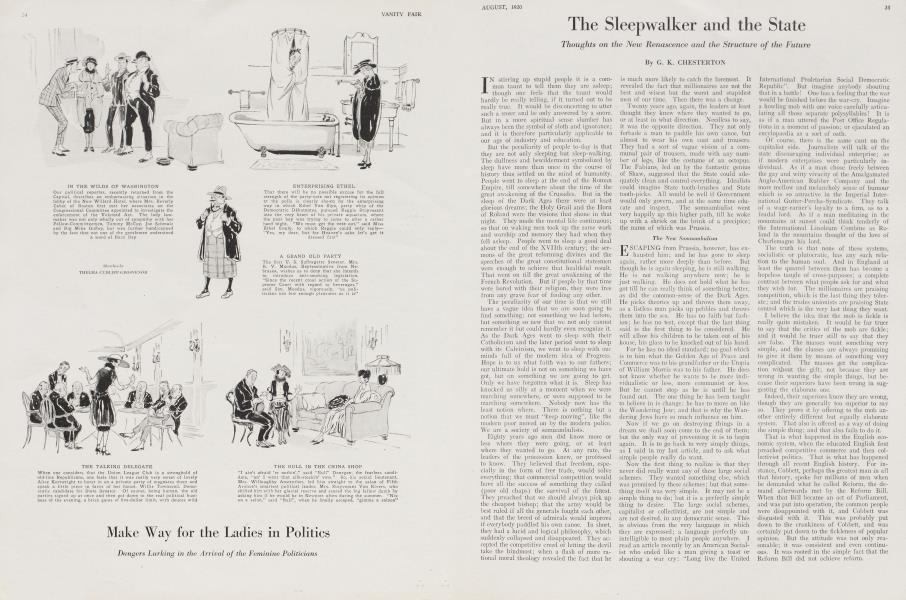
IN stirring up stupid people it is a common taunt to tell them they are asleep; though one feels that the taunt would hardly be really telling, if it turned out to be really true. It would be disconcerting to utter such a sneer and be only answered by a snore. But in a more spiritual sense slumber has always been the symbol of sloth and ignorance; and it is therefore particularly applicable to our age of industry and education.
But the peculiarity of people to-day is that they are not only sleeping but sleep-walking. The dullness and bewilderment symbolized by sleep have more than once in the course of history thus settled on the mind of humanity. People went to sleep at the end of the Roman Empire, till somewhere about the time of the great awakening of the Crusades. But in the sleep of the Dark Ages there were at least glorious dreams; the Holy Grail and the Horn of Roland were the visions that shone in that night. They made the mental life continuous; so that on waking men took up the same work and worship and memory they had when they fell asleep. People went to sleep a good deal about the end of the XVIIth century; the sermons of the great reforming divines and the speeches of the great constitutional statesmen were enough to achieve that healthful result. That went on till the great awakening of the French Revolution. But if people by that time were bored with their religion, they were free from any grave fear of finding any other.
The peculiarity of our time is that we still have a vague idea that we are soon going to find something; not something we had before, but something so new that we not only cannot remember it but could hardly even recognize it. As the Dark Ages went to sleep with their Catholicism and the later period went to sleep with its Calvinism, we went to sleep with our minds full of the modern idea of Progress. Hope is to us what faith was to our fathers; our ultimate hold is not on something we have got, but on something we are going to get. Only we have forgotten what it is. Sleep has knocked us silly at a moment when we were marching somewhere, or were supposed to be marching somewhere. Nobody now has the least notion where. There is nothing but a notion that we must "keep moving", like the modem poor moved on by the modern police. We are a society of somnambulists.
Eighty years ago men did know more or less where they were going, or at least where they wanted to go. At any rate, the leaders of the procession knew, or professed to know. They believed that freedom, especially in the form of free trade, would solve everything; that commercial competition would have all the success of something they called (poor old chaps) the survival of the fittest. They preached that we should always pick up the cheapest bishop; that the army would be best ruled if all the generals fought each other, and that the breed of admirals would improve if everybody paddled his own canoe. In short, they had a lucid and logical philosophy, which suddenly collapsed and disappeared. They accepted the competitive creed of letting the devil take the hindmost; when a flash of more rational moral theology revealed the fact that he is much more likely to catch the foremost. It revealed the fact that millionaires are not the best and wisest but the worst and stupidest men of our time. Then there was a change.
Twenty years ago, again, the leaders at least thought they knew where they wanted to go, or at least in what direction. Needless to say, it was the opposite direction. They not only forbade a man to paddle his own canoe, but almost to wear his own coat and trousers. They had a sort of vague vision of a communal pair of trousers, made with any number of legs, like the costume of an octopus. The Fabians, led on by the fantastic genius of Shaw, suggested that the State could adequately clean and control everything. Idealists could imagine State tooth-brushes and State tooth-picks. All would be well if Government would only govern, and at the same time educate and inspect. The somnambulist went very happily up this higher path, till he woke up with a shriek on the brink of a precipice; the name of which was Prussia.
The New Somnambulism
ESCAPING from Prussia, however, has exhausted him; and he has gone to sleep again, rather more deeply than before. But though he is again sleeping, he is still walking. He is not walking anywhere now; he is just walking. He does not hold what he has got till he can really think of something better, as did the common-sense of the Dark Ages. He picks theories up and throws them away, as a listless man picks up pebbles and throws them into the sea. He has no faith but fashion; he has no test, except that the last thing said is the first thing to be considered. He will allow his children to be taken out of his house, his glass to be knocked out of his hand.
For he has no ideal standard; no goal which is to him what the Golden Age of Peace and Commerce was to his grandfather or the Utopia of William Morris was to his father. He does not know whether he wants to be more individualistic or less, more communist or less. But he cannot stop as he is until he has found out. The one thing he has been taught to believe in is change; he has to move on like the Wandering Jew; and that is why the Wandering Jews have so much influence on him.
Now if we go on destroying things in a dream we shall soon come to the end of them; but the only way of preventing it is to begin again. It is to go back to very simply things, as I said in my last article, and to ask what simple people really do want.
Now the first thing to realize is that they never did reajly want any of these large social schemes. They wanted something else, which was promised by these schemes; but that something itself was very simple. It may not be a simple thing to do; but it is a perfectly simple thing to desire. The large social schemes, capitalist or collectivist, are not simple and are not desired, in any democratic sense. This is obvious from the very language in which they are expressed; a language perfectly unintelligible to most plain people anywhere. I read an article recently by an American Socialist who ended like a man giving a toast or shouting a war cry: "Long live the United International Proletarian Social Democratic Republic". But imagine anybody shouting that in a battle! One has a feeling that the war would be finished before the war-cry. Imagine a howling mob with one voice carefully articulating all those separate polysyllables! It is as if a man uttered the Post Office Regulations in a moment of passion; or ejaculated an encylopaedia as a sort of oath.
Of course, there is the same cant on the capitalist side. Journalists will talk of the state discouraging individual enterprise; as if modern enterprises were particularly individual. As if a man chose freely between the gay and witty vivacity of the Amalgamated Anglo-American Rubber Company and the more mellow and melancholy sense of humour which is so attractive in the Imperial International Gutter-Percha-Syndicate. They talk of a wage-earner's loyalty to a firm, as to a feudal lord. As if a man meditating in the mountains at sunset could think tenderly of the International Linoleum Combine as Roland in the mountains thought of the love of Charlemagne his lord.
The truth is that none of these systems, socialistic or plutocratic, has any such relation to the human soul. And in England at least the quarrel between them has become a hopeless tangle of cross-purposes; a complete contrast between what people ask for and what they wish for. The millionaires are praising competition, which is the last thing they tolerate; and the trades unionists are praising State control which is the very last thing they want.
I believe the idea that the mob is fickle is really quite mistaken. It would be far truer to say that the critics of the mob are fickle; and it would be truer still to say that they are false. The masses want something very simple, and the classes are always promising to give it them by means of something very complicated. The masses get the complication without the gift; not because they are wrong in wanting the simple things, but because their superiors have been wrong in suggesting the elaborate one.
Indeed, their superiors know they are wrong, though they are generally too superior to say so. They prove it by offering to the mob another entirely different but equally elaborate system. That also is offered as a way of doing the simple thing; and that also fails to do it.
That is what happened in the English economic system, when the educated English first preached competitive commerce and then collectivist politics. That is what has happened through all recent English history. For instance, Cobbett, perhaps the greatest man in all that history, spoke for millions of men when he demanded what he called Reform, the demand afterwards met by the Reform Bill. When that Bill became an act of Parliament, and was put into operation, the common people were disappointed with it, and Cobbett was disgusted with it. This was probably put down to the crankiness of Cobbett, and was certainly put down to the fickleness of popular opinion. But the attitude was not only reasonable; it was consistent and even continuous. It was rooted in the simple fact that the Reform Bill did not achieve reform.
Subscribers have complete access to the archive.
Sign In Not a Subscriber?Join Now