
Sign In to Your Account
Subscribers have complete access to the archive.
Sign In Not a Subscriber?Join NowThe Theatrical Callboard
Critical Notes before the Curtain Rises
KENNETH MACGOWAN
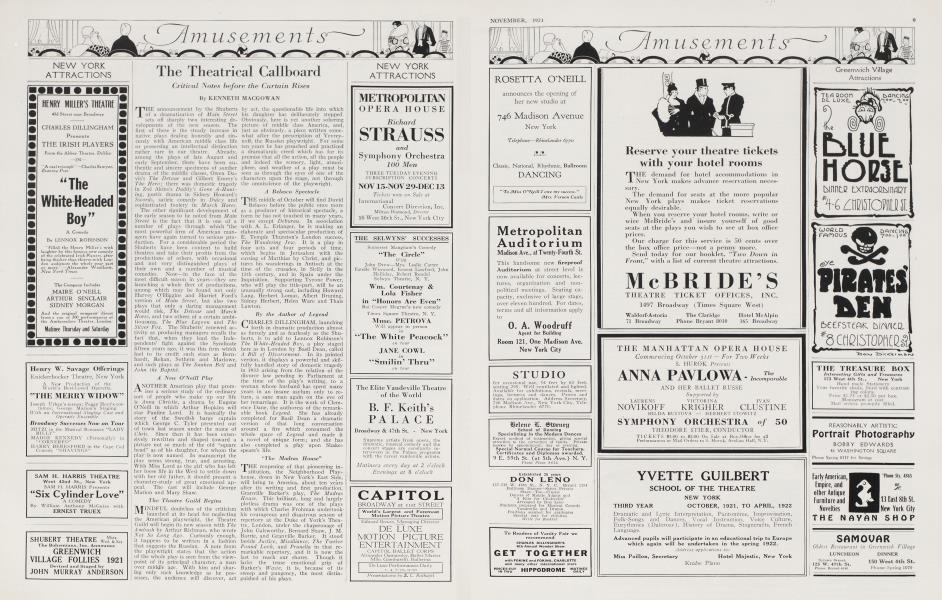
THE announcement by the Shuberts of a dramatization of Main Street sets off sharply two interesting developments of the new season. The first of these is the steady increase in native plays dealing honestly and sincerely with American middle class life or possessing an intellectual distinction rather rare in our theatre. Already, among the plays of late August and early September, there have been authentic and sincere specimens of somber drama of the middle classes, Owen Davis's The Detour and Gilbert Emery's The Hero; there was domestic tragedy in Zoö Akins's Daddy's Gone A-Hunting, poetic drama in Sidney Howard's Swords, satiric comedy in Dulcy and sophisticated foolery in March Hares.
The other significant development of the early season to be noted from Main Street is the fact that it is one of a number of plays through which 'the most powerful firm of American managers have again turned to serious production. For a considerable period the Shuberts have been content to build theatres and take their profits from the productions of others, with occasional and not very distinguished plays' of their own and a number of musical comedies. Now—in the face of the most difficult season in years—they are launching a whole fleet of productions, among which may be found not only Harvey O'Higgins and Harriet Ford's version of Main Street, but also two plays that only a daring management would risk, The Detour and March Hares, and two others of a certain ambitiousness, The Blue Lagoon and The Silver Fox. The Shuberts' renewed activity as producing managers recalls the fact that, when they lead the Independents' fight against the Syndicate fifteen years ago, it was this firm which had to its credit such stars as Bernhardt, Rehan, Sothern and Marlowe, and such plays as The Sunken Bell and John the Baptist.
A New O'Neill Play
A NOTHER American play that promises a serious study of the ordinary sort of people who make up our life is Anna Christie, a drama by Eugene O'Neill in which Arthur Hopkins will star Pauline Lord. It is basically the story of the Swedish barge captain which George C. Tyler presented out of town last season under the name of Chris. Since then it has been extensively rewritten and shaped toward a picture not so much of the old "square head" as of his daughter, for whom the play is now named. In manuscript the play seems strong, true, and arresting. With Miss Lord as the girl who has left her loose life in the West to settle down with her old father, it should present a character-study of great emotional appeal. The cast will include George Marion and Mary Shaw.
The Theatre Guild Begins
MINDFUL doubtless of the criticism launched at its head for neglecting the American playwright, the Theatre Guild will begin its new season with The Ambush by Arthur Richman, who wrote Not So Long Ago. Curiously enough, it happens to be written in a fashion that suggests the Russian. A note from the playwright states that the action of the whole play is seen from the viewpoint of its principal character, a man over middle age. With him and sharing only such knowledge as he possesses, the audience will discover, act by act, the questionable life into which his daughter has deliberately stepped. Obviously, here is yet another sobering picture of middle class America, and, just as obviously, a piece written somewhat after the prescription of Yevreynoff, the Russian playwright. For some ten years he has preached and practiced a dramaturgic creed which has for its premise that all the action, all the people and indeed the scenery, light, atmosphere, and weather of a play must be seen as through the eyes of one of the characters upon the stage, not through the, omniscience of the playwright.
A Belasco Spectacle
THE middle of October will find David Belasco before the public once more as a producer of historical spectacle, a form he has not touched in many years, if we except Deburau. In association with A. L. Erlanger, he is making an elaborate and spectacular production of E. Temple Thurston's London success, The Wandering Jew. It is a play in four acts and four periods of time, which begins in Jerusalem with the cursing of Matthias by Christ, and pictures his wanderings in Antioch at the time of the crusades, in Sicily in the 13th century, and in Spain under the Inquisition. Supporting Tyrone Power, who will play the title-part, will be an unusually strong cast, including Howard Lang, Herbert Lomas, Albert Bruning, Sidney Herbert, Helen Ware and Thais Lawton.
By the Author of Legend
CHARLES DILLINGHAM, launching forth in dramatic production almost as fiercely and as fearlessly as the Shuberts, is to add to Lennox Robinson's The White-Headed Boy, a play staged here as in London by Basil Dean, called A Bill of Divorcement. In its printed version, it displays a powerful and skilfully handled story of domestic tragedy in 1933 arising from the relation of the divorce law pending in Parliament at the time of the play's writing, to a woman whose husband has spent many years in an insane asylum only to return, a sane man again on the eve of her remarriage. It is the work of Clemence Dane, the authoress of the remarkable book Legend. She has already completed for Basil Dean a dramatic version of that long conversation around a fire which consumed the whole space of Legend and made it a novel of unique form; and she has also completed a play upon Shakespeare's life.
"The Madras House"
THE reopening of that pioneering institution, the Neighborhood Playhouse, down in New York's East Side, will bring to America, about ten years after its writing and first production, Granville Barker's play, The Madras House. This brilliant, long and largely plotless drama was one of the plays with which Charles Frohman undertookhis courageous and disastrous season of repertory at the Duke of York's Theatre, London, under the chaperonage of John Galsworthy, Bernard Shaw, J. M. Barrie, and Granville Barker. It stood beside Justice, Misalliance, The Twelve Pound Look, and Prunella in that remarkable repertory, and it is now the last to reach our shores. Though it lacks the tense emotional grip of Barker's Waste, it is, because of its sweep and pungency, the most distinguished of his plays.
Subscribers have complete access to the archive.
Sign In Not a Subscriber?Join Now