Sign In to Your Account
Subscribers have complete access to the archive.
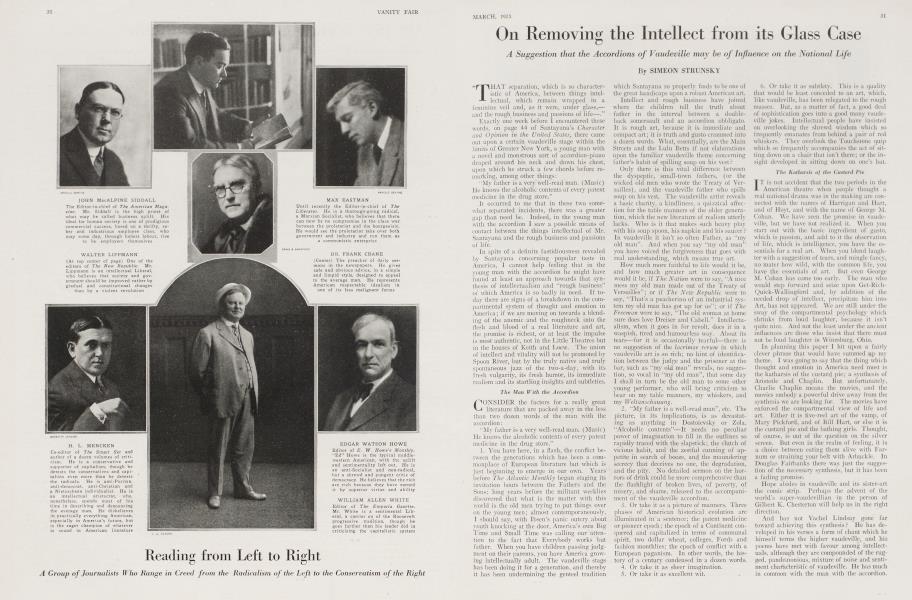
Sign In Not a Subscriber?Join NowOn Removing the Intellect from its Glass Case
SIMEON STRUNSKY
A Suggestion that the Accordions of Vaudeville may be of Influence on the National Life
THAT separation, which is so characteristic of America, between things intellectual, which remain wrapped in a feminine veil and, as it were, under glass,— and the rough business and passions of life—."
Exactly one week before I encountered these words, on page 44 of Santayana's Character and Opinion in the United States, there came out upon a certain vaudeville stage within the limits of Greater New York, a young man with a novel and monstrous sort of accordion-piano draped around his neck and down his chest, upon which he struck a few chords before remarking, among other things:
"My father is a very well-read man. (Music) He knows the alcoholic contents of every patent medicine in the drug store."
It occurred to me that in these two somewhat separated incidents, there was a greater gap than need be. Indeed, in the young man with the accordion I saw a possible means of contact between the things intellectual of Mr. Santayana and the rough business and passions of life.
In spite of a definite fastidiousness revealed by Santayana concerning popular taste in America, I cannot help feeling that in the young man with the accordion he might have found at least an approach towards that synthesis of intellectualism and "rough business" of which America is so badly in need. If today there are signs of a breakdown in the compartmental system of thought and emotion in America; if we are moving on towards a blending of the anemic and the roughneck into the flesh and blood of a real literature and art, the promise is richest, or at least the impulse is most authentic, not in the Little Theatres but in the houses of Keith and Loew. The union of intellect and vitality will not be promoted by Spoon River, but by the truly native and truly spontaneous jazz of the two-a-day, with its fresh vulgarity, its fresh humor, its immediate realism and its startling insights and subtleties.
The Man With the Accordion
CONSIDER the factors for a really great literature that are packed away in the less than two dozen words of the man with the accordion:
"My father is a very well-read man. (Music) He knows the alcoholic contents of every patent medicine in the drug store."
1.You have here, in a flash, the conflict between the generations which has been a commonplace of European literature but which is just beginning to emerge in our own. Years' before The Atlantic Monthly began staging its invitation bouts between the Fathers and the Sons; long years before the militant weeklies discovered that what is the matter with this world is the old men trying to put things, over on the young men; almost contemporaneously, I should say, with Ibsen's panic outcry about youth knocking at the door, America's own Big Time and Small Time was calling our attention to the fact that Everybody works but father. When you have children passing judgment on their parents, you have America growing intellectually adult. The vaudeville stage has been doing it for a generation, and thereby it has been undermining the genteel tradition which Santayana so properly finds to be one of the great handicaps upon a robust American art.
Intellect and rough business have joined where the children tell the truth about father in the interval between a doubleback somersault and an accordion obbligato. It is rough art, because it is immediate and compact art; it is truth and gusto crammed into a dozen words. What, essentially, are the Main Streets and the Lulu Betts if not elaborations upon the familiar vaudeville theme concerning father's habit of spilling soup on his vest?
Only there is this vital difference between the dyspeptic, small-town fathers, (or the wicked old men who wrote the Treaty of Versailles), and the vaudeville father who spills soup on his vest. The vaudeville artist reveals a basic charity, a kindliness, a quizzical affection for the table manners of the older generation, which the new literature of realism utterly lacks. Who is it that makes such heavy play with his soup spoon, his napkin and his saucer? In vaudeville it isn't so often Father, as "my old man". And when you say "my old man" you have voiced the forgiveness that goes with real understanding, which means true art.
How much more faithful to life would it be, and how much greater art in consequence would it be, if The Nation were to say, "A nice mess my old man made out of the Treaty of Versailles"; or if The New Republic were to say, "That's a peacherino of an industrial system my old man has got up for us"; or if The Freeman were to say, "The old woman at home sure does love Dreiser and Cabell." Intellectualism, when it goes in for revolt, does it in a waspish, tired and humourless way. About its tears—for it is occasionally tearful—there is no suggestion of the lacrimae rerum in which vaudeville art is .so rich; no hint of identification between the judge and the prisoner at the bar, such as "my old man" reveals, no suggestion, so vocal in "my old man", that some day I shall in turn be the old man to some other young performer, who will bring criticism to bear on my table manners, my whiskers, and my Weltanschauung.
2. "My father is a well-read man", etc. The picture, in its implications, is as devastatr ing as anything in Dostoievsky or Zola. "Alcoholic contents"—It needs no peculiar power of imagination to fill in the outlines so rapidly traced with the slapstick; the clutch of vicious habit, and the zestful cunning of appetite in search of booze, and the maundering secrecy that deceives no one, the degradation, and the pity. No detailed sermon on the horrors of drink could be more comprehensive than the flashlight of broken lives, of poverty, of misery, and shame, released to the accompaniment of the vaudeville accordion.
3. Or take it as a picture of manners. Three phases of American historical evolution are illuminated in a sentence; the patent medicine or pioneer epoch; the epoch of a Continent conquered and capitalized in terms of communal spirit, two dollar wheat, colleges, Fords and fashion monthlies; the epoch of conflict with a European paganism. In other words, the history of a century condensed in a dozen words.
4. Or take it as sheer imagination.
5. Or take it as excellent wit.
6.Or take it as subtlety. This is a quality that would be least conceded to an art, which, like vaudeville, has been relegated to the rough masses. But, as a matter of fact, a good deal of sophistication goes into a good many vaudeville jokes. Intellectual people have insisted on overlooking the shrewd wisdom which so frequently emanates from behind a pair of red whiskers. They overlook the Touchstone quip which so frequently accompanies the act of sitting down on a chair that isn't there; or the insight developed in sitting down on one's hat.
The Katharsis of the Custard Pie
IT is not accident that the two periods in the American theatre when people thought a real national drama was in the making are connected with the names of Harrigan and Hart, and of Hoyt, and with the name of George M. Cohan. We have seen the promise in vaudeville, but we have not realized it. When you start out with the basic ingredient of gusto, which is passion, and add to it the observation of life, which is intelligence, you have the essentials for a real art. When you blend laughter with a suggestion of tears, and mingle fancy, no mater how wild, with the common life, you have the essentials of art. But even George M. Cohan has come too early. The man who would step forward and seize upon Get-RichQuick-Wallingford and, by addition of the needed drop of intellect, precipitate him into Art, has not appeared. We are still under the sway of the compartmental psychology which shrinks from loud laughter, because it isn't quite nice. And not the least under the ancient influences are those who insist that there must not be loud laughter in Winesburg, Ohio.
In planning this paper I hit upon a fairly clever phrase that would have summed up my theme. I was going to say that the thing which thought and emotion in America need most is the katharsis of the custard pie; a synthesis of Aristotle and Chaplin. But unfortunately, Charlie Chaplin means the movies, and the movies embody a powerful drive away from the synthesis we are looking for. The movies have enforced the compartmental view of life and art. Either it is five-reel art of the vamp, of Mary Pickford, and of Bill Hart, or else it is the custard pie and the bathing girls. Thought, of course, is out of the question on the silver screen. But even in the realm of feeling, it is a choice between eating them alive with Farnum or straining your belt with Arbuckle. In Douglas Fairbanks there was just the suggestion of the necessary synthesis, but it has been a fading promise.
Hope abides in vaudeville and its sister-art the comic strip. Perhaps the advent of the world's super-vaudevillian in the person of Gilbert K. Chesterton will help us in the right direction.
And has not Vachel Lindsay gone far toward achieving this synthesis? He has developed in his verses a form of chant which he himself terms the higher vaudeville, and his poems have met with favour among intellectuals, although they are compounded of the rugged, pandemonious, mixture of noise and sentiment characteristic of vaudeville. He has much in common with the man with the accordion.
Subscribers have complete access to the archive.
Sign In Not a Subscriber?Join Now