Sign In to Your Account
Subscribers have complete access to the archive.
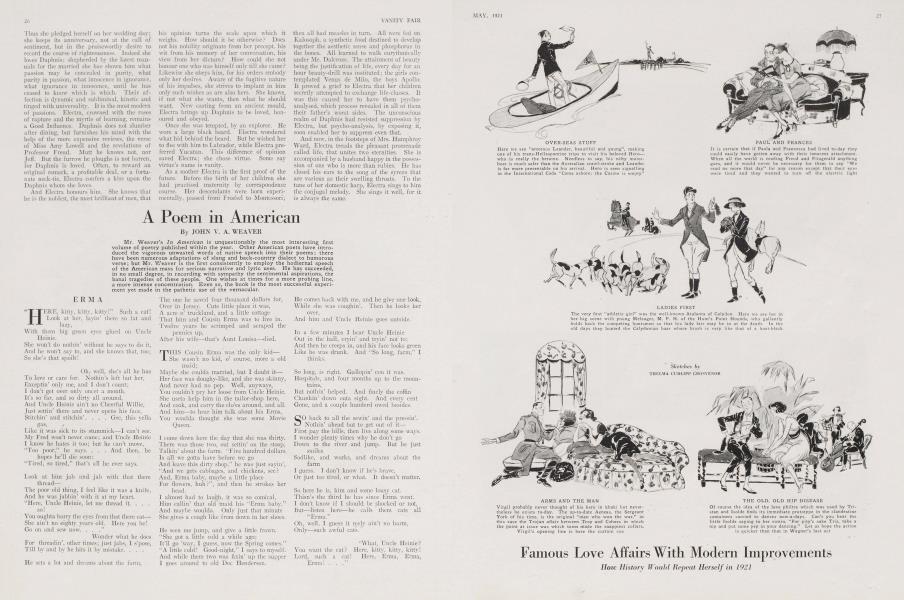
Sign In Not a Subscriber?Join NowA Poem in American
JOHN V. A. WEAVER
Mr. Weaver's In American is unquestionably the most interesting first volume of poetry published within the year. Other American poets have introduced the vigorous unwasted words of native speech into their poems; there have been numerous adaptations of slang and back-country dialect to humorous verse; but Mr. Weaver is the first consistently to employ the hodiernal speech of the American mass for serious narrative and lyric uses. He has succeeded, in no small degree, in recording with sympathy the sentimental aspirations, the banal tragedies of these people. One wishes at times for a more probing line, a more intense concentration. Even so, the book is the most successful experiment yet made in the pathetic use of the vernacular.
ERMA
"HERE, kitty, kitty, kitty!" Such a cat! Look at her, lavin' there so fat and lazy,
With them big green eyes glued on Uncle Heinie.
She won't do nothin' without he says to do it, And he won't say to, and she knows that, too; So she's that spoilt!
Oh, well, she's all he has To love or care for. Nothin's left but her, Exceptin' only me, and I don't count;
I don't get over only oncet a month,
It's so far, and so dirty all around,
And Uncle Heinie ain't no Cheerful Willie, Just settin' there and never opens his face, Stitchin' and stitchin'. . . . Gee, this yella gas, ,
Like it was sick to its stummick—I can't see. My Fred won't never come; and Uncle Heinie I know he hates it too; but he can't move, "Too poor," he says. . . . And then, he hopes he'll die soon:
"Tired, so tired," that's all he ever says.
Look at him jab and jab with that there thread—
The poor old thing, I feel like it was a knife, And he was jabbin' with it at my heart. "Here, Uncle Heinie, let me thread it. . . . so!
You oughta borry the eyes from that there cat— She ain't no eighty years old. Here you be! Go on and sew now. ..."
Wonder what he does For threadin', other times; just jabs, I s'pose, Till by and by he hits it by mistake. . . .
He sets a lot and dreams about the farm,
The one he saved four thousand dollars for, Over in Jersey. Cute little place it was,
A acre o' truckland, and a little cottage That him and Cousin Erma was to live in. Twelve years he scrimped and scraped the pennies up,
After his wife—that's Aunt Louisa—died.
THIS Cousin Erma was 'the only kid— She wasn't no kid, o' course, more a old maid;
Maybe she coulda married, but I doubt it— Her face was doughy-like, and she was skinny, And never had no pep. Well, anyways,
You couldn't pry her loose from Uncle Heinie. She useta help him in the tailor-shop here, And cook, and carry the clo'es around, and all. And him—to hear him talk about his Erma, You woulda thought she was some Movie Queen.
I come down here the day that she was thirty. There was those two, out settin' on the stoop, Talkin' about the farm. "Five hundred dollars Is all we gotta have before we go And leave this dirty shop," he was just sayin', "And we gets cabbages, and chickens, see? And, Erma baby, maybe a little place For flowers, huh?", and then he strokes her head.
I almost had to laugh, it was so comical, Him callin' that old maid his "Erma baby," And maybe woulda. Only just that minute She gives a cough like from down in her shoes.
He seen me jump, and give a little frown. "She got a little cold a while ago;
It'll go 'way, I guess, now the Spring comes." "A little cold! Good-night," I says to myself. And while them two was fixin' up the supper I goes around to old Doc Henderson.
He comes back with me, and he give one look, While she -was coughin'. Then he looks her over,
And him and Uncle Heinie goes outside.
In a few minutes I hear Uncle Heinie Out in the hall, cryin' and tryin' not to;
And then he creeps in, and his face looks green Like he was drunk. And "So long, farm," I thinks.
So long, is right. Gallopin' con it was. Hospitals, and four months up to the mountains,
But nothin' helped. And finely the coffin Chunkin' down outa sight. And every cent Gone, and a couple hunderd owed besides.
SO back to all the sewin' and the pressin'. Nothin' ahead but to get out of it—
First pay the bills, then live along some ways. I wonder plenty times why he don't go Down to the river and jump. But he just smiles
Sadlike, and works, and dreams about the farm
I guess. I don't know if he's brave,
Or just too tired, or what. It doesn't matter.
So here he is, him and some lousy cat.
Thisn's the third he has since Erma went.
I don't know if I should be shocked or not, But—listen here—he calls them cats all "Erma."
Oh, well, I guess it reely ain't no harm, Only'—such awful cats.
"What, Uncle Heinie? You want the cat? Here, kitty, kitty, kitty! Lord, such a cat! Here, Erma, Erma, Erma! . . ."
Subscribers have complete access to the archive.
Sign In Not a Subscriber?Join Now