
Sign In to Your Account
Subscribers have complete access to the archive.
Sign In Not a Subscriber?Join NowThe Financial Situation
The Harding Administration Studies the War Debt
MERRYLE STANLEY RUKEYSER
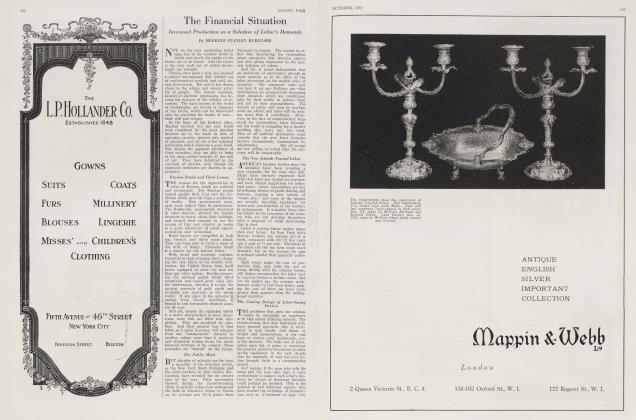
IN a sense, we have drifted, since the war, from super-dreadnaught to sail boat finance. The borrower who can get tens of millions from lenders in a single operation nowadays counts himself fortunate. Before the psychological deflation of the readjustment period, loans were made in billions. The ordinary Liberty Loan orator was unable to think in terms of less than ten figures. Under special authorization by Congress, the United States Treasury participated in the grandest loan of all times. Since man, emerging from the ape, first became upright—physically— no financial operation ever approached in magnitude the advances made by the government at Washington to the Allies. A sum, equivalent to the official estimate of the national wealth of Canada, was turned over to America's co-belligerents in the strife against the Teuton.
Engrossed in small affairs—the concomitants of recession in trade and industry—the layman has permitted the Allied debt of nearly $10,000,000,000 to. pass from the forefront of his consciousness. In taking inventory of the nation's affairs, the new Administration, however, has directed its attention to these debts, and, on the day of writing this article, a letter comes from Eliot Wadsworth, assistant Secretary of the Treasury, with this significant remark, "The whole question relating to the handling of the foreign obligations held by the United States is having the most careful consideration."
PRESIDENT HARDING has brought the question before meetings of his Cabinet, and a new policy is slowly emerging. Andrew W. Mellon, the Pittsburgh banker, who is now chief of the Treasury Department, is immediately responsible for formulating a plan, and Herbert Hoover, of the Commerce Department, is known to be more than normally interested in the problem and already to have contributed dynamic ideas.
The promises of the Allies to pay back the Treasury are still in temporary form, and early in 1920 the Treasury, free of the attributes of a Shylock, postponed for three years interest payments on the Allied debt. The new Administration therefore finds this whole matter of the world's huge financial transaction in the pigeonhole of "unfinished business."
And the adjustment of the matter is not simply an academic interest, of concern to professors of mathemathics who find their gayest amusement in romping through endless columns of figures. The Treasury, the giant creditor of the Allies, is also the debtor of millions of investors at home. It owes virtually a billion dollars a year in interest alone, and the one of the five war loans—the Victory issue—must be paid off (or refunded) in 1923 and may be retired in 1922 if the Treasury chooses.
There is a direct connection between Liberty bonds and the Treasury advances to the Allies, for—roughly—one half of all the funds raised by dramatizing investing during the fervent and sometimes Barnumized Liberty Loan campaigns was re-lent by the government at Washington to other countries associated with it during the war. The ten billion dollar fund was created under the first four Liberty Loans only.
Winning the conflict was the goal in those epic days, and procrastination was deemed intolerable. The traditional way of furnishing credit, or purchasing power, to the Allies would have been through the sale of foreign bonds directly to American investors through bankers, as was done in floating the Anglo-French loan. But as a practicable matter, it would have been impossible to get investors to exchange $10,000,000,000 for Allied obligations during the war. The United States itself was able to sell some $21,000,000,000 of securities only by combining high credit with noble sentiment.
The Allies needed the credit to buy the sinews of war, including foodstuffs. The quickest way was for the government at Washington itself to furnish it. The Treasury had enormous credit—borrowing capacity—but no surplus cash. Into no stores of golden treasure could it delve for the $10,000,000,000 for the Allies. It raised the funds by selling Liberty bonds and Victory notes to Americans. The government lent its credit, and the people furnished the cash.
Here is the situation to-day. The American public holds $21,43S,370^600 of Liberty bonds and Victory notes. As of June 6, 1921, the United States Treasury had advanced to the Allies $9,597 -518,741. Both of these figures represent par value. Liberty bonds, which are quoted in the open market place, are now selling at a discount, ranging as high as fifteen per cent. The Allied obligations, however, are locked up in Treasury vaults at Washington, and no free bidding has fixed their present realizable value. Technically, the United States government could insist upon payment of the aggregate of the advances to-morrow, as the obligations are demand obligations, payable at the option of the lender. Practically, the creditors could not make immediate payment. Some bankers doubt whether they can ever be expected to pay in full. Interest alone, amounting to nearly $500,000,000 a year, has been deferred, because of the inability of the foreign governments comfortably to meet their obligations until their recovery from, the ailments of war has gone further.
THE obvious need is that the Allied debts to the Treasury, which are in addition to those to private investors in this country, be funded. This means simply that the obligations payable on demand be converted into securities which mature at some future date, such as twenty years hence. Of all the large debtors to the Treasury, Great Britain seems the most anxious to reach an agreement which will put this indebtedness on a more permanent basis.
At Washington, it has been proposed at Cabinet meetings, and at a conference between President Harding and leading men of finance, that a goodly share of the Liberty bonds and Victory notes outstanding be retired by turning over Allied obligations to the Treasury to private investors here. The suggestion has been made that the Government strike off a large block of Allied promisesto-pay from the asset side of the national balance sheet and eliminate a corresponding amount of Liberty bonds from the liability side. When the loans were made to the Allies, the American public supplied the cash, and the government acted as an intermediary. The new idea is to eliminate the Government from the operation, and let Great Britain, France, Belgium, Czecho-Slovakia, Italy and the rest become instead the debtors of private citizens who acquire their bonds.
When out of bureaucratic Washington this fresh, energized, tentative program emerged recently, practitioners in the world of finance forthwith characterized it as an "ideal theoretical solution." But the bond salesmen, bank presidents, and private bankers urged caution, as is their wont, and wondered whether this delightful little scheme could be executed.
(Continued on page 8)
(Continued from page 6)
Will the American investor exchange Liberty bonds for European issues?
Under certain conditions and in limited amounts the answer to the foregoing question is an emphatic "yes." Since the armistice, $1,372,461,000 of Old World obligations were underwritten in this country, and sold directly to individuals in this country, many of whom undoubtedly sold Liberty bonds to get cash to take advantage of the higher yield offered by the foreign securities.
The American government sold its own Liberty bonds on no cold-blooded business basis. It enlisted dollars, paying moderate interest rates varying from 3 1/2 to 4 ¾ per cent. Many economists contend that it would have been cheaper in the long run to have paid higher interest rates on the bonds, which for patriotic motives were absorbed at a lower cost to the government than the going rate for money. Since then interest rates
have risen with great rapidity, and only now is there an indication of a check in the rising rental charge on money, The Allied obligations to the Treasury nominally bear 5 per cent interest. They could not be transferred to the public until the interest return was substantially raised.
It is a nice question how high the yield would have to be. It depends on many factors, and in the ordinary investment market bankers do not fix the rate of a new offering until a few hours before a public sale is started. Among the Treasury's debtors are countries of varying prestige at the frontier of capital. At this time, Great Britain is regarded as the best of America's debtors, in a financial sense, and Russia, the poorest.
ANY relinquishment of Liberty bonds for European securities by investors will have to be voluntary, for the Treasury has contracted to pay gold to the holders of their bonds. The moral obligation of the Treasury to Liberty bond holders, moreover, is far greater than the terms of the indenture. The American government cannot sponsor any plan of exchange which does not safeguard every holder of "the safest security in the world," even against his own lack of expert knowledge about the riddles of international finance. The ultimate in caution and safety could be attained if the Treasury guaranteed the principal and interest of the foreign obligations accepted in exchange of Liberty bonds. Such an indorsement has been considered by the authorities at the capital, and would theoretically render the new securities even safer than Liberty bonds, for to the promise of the United States it would also add that of one of the Allies. A Liberty bond holder would lose nothing in safety if he converted it into an Allied obligation guaranteed by the American government.
In limited amounts, the more choice of the refunded obligations would be saleable in the open market without a guarantee by the United States. British bonds would find a market without, indorsement, and international bankers, with British connections, are of the opinion that the British. Treasury would resent any suggestion of an American guarantee. Once a foreign government permitted the United States to guarantee its securities, bankers feel, it would become all the harder to borrow in the future solely on their own credit.
As of June 6, 1921, the advances made by the Secretary of the Treasury were as follows:
Belgium..$349,214,467
Cuba . 10,000,000
Czecho-Slovakia . 61,256,206
France.2,997,477,800
Great Britain .4,277,000,000
Greece . 15,000,000
Italy .1,648,034,050
Liberia . 26,000
Roumania . 25,000,000
Russia . 187,729,750
Serbia . 26,780,465
$9,597,'518,741
Of the foregoing obligations held by the Treasury, none would bring par if dumped into the market place. Provided a plan for transferring the securities from the Treasury to the publie were arranged, the yield to the investor could be worked out either by selling 5 per cent obligations to the public at a sufficient discount to yield 7 per cent or more or, on the other hand, the return to the investor could be heightened by raising the interest rate on the obligations through agreement with the Allies,
THE Government of the United States certainly wants to make no profit out of these advances to its comrades in arms. It will be unspeakably fortunate if it breaks even. If the obligations are to be made more attractive, the government at Washington should make sacrifices as well as the Allies, possibly by selling the securities at a discount. If the debt were transferred to investors on an acceptable basis, the Allies would benefit in diverse ways. First, their credit would be improved by cleaning up the present muddle; secondly, it is better to have many creditors than one, and much less likely to lead to political complications,
Before the United States could think of offering Allied securities to the public, it would have to resume negotiations with the Allies regarding a funding operation. The idea that the whole debt should be cancelled has not perished; it prevails in certain European quarters and to a lesser extent in the United States. The Treasury has never countenanced this theory. Only the securities of those nations able and willing to pay principal and interest, of course, should be transferred to the public,
From the practical standpoint, the main obstacle to shifting the Allied debt from the Treasury to investors is the magnitude of the advances. Investment bankers emphasize this difficulty. But why not offer the Allied securities piecemeal?
The psychology of markets would interfere with this procedure, unless modified. The investor would be disinclined to take the first block of Allied bonds offered, expecting that later the terms would be more attractive,
And yet this difficulty does not seem insuperable. The most feasible scheme, it seems, would be to offer as a first instalment the largest amount that the market would absorb of the best Allied securities available. Some masters of finance in the great Wall Street banks think that $500,000,000 of British bonds would be taken by investors over a period of about six months in exchange for designated Liberty bonds or Victory notes. The government could check the tendency to hold off for later offerings by making the conversion privilege on certain groups of Liberty bonds expire at given dates, such as in six months, If the conversion privilege was made alluring by inducements affecting either interest or maturity, investors would buy Liberty bonds in the open market for the purpose of exchanging them into Allied securities, and as a result this buying would be an effective means of bringing Liberty bonds closer to par.
Subscribers have complete access to the archive.
Sign In Not a Subscriber?Join Now
