
Sign In to Your Account
Subscribers have complete access to the archive.
Sign In Not a Subscriber?Join NowFour Complex Bridge Hands
Showing How the Famous Russian Expert Solved the Problems Outlined Last Month
R. F. FOSTER
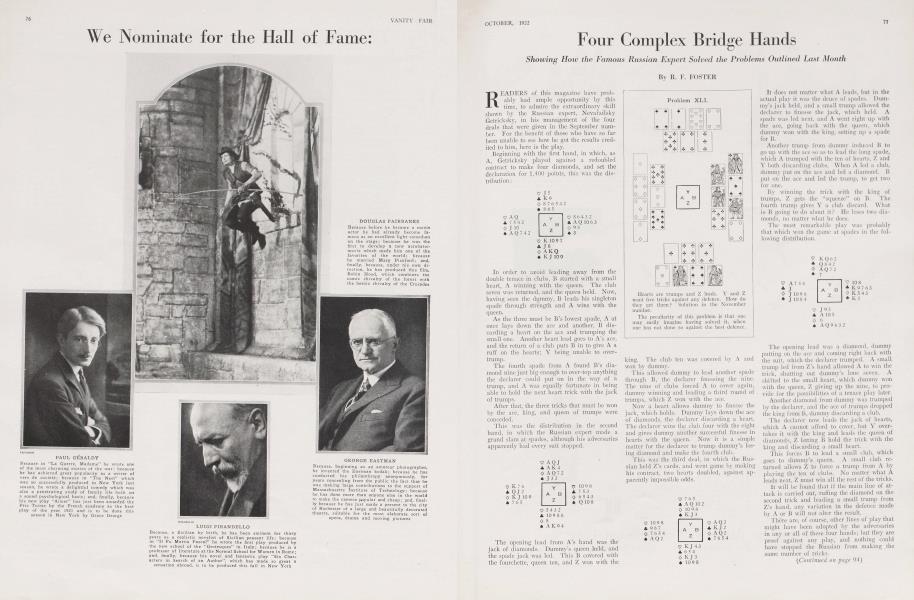
READERS of this magazine have probably had ample opportunity by this time, to admire the extraordinary skill shown by the Russian expert, Nevafailsky Getricksky, in his management of the four deals that were given in the September number. For the benefit of those who have so far been unable to see how he got the results credited to him, here is the play.
Beginning with the first hand, in which, as A, Getricksky played against a redoubled contract to make four diamonds, and set the declaration for 1,400 points, this was the distribution:
In order to avoid leading away from the double tenace in clubs, B started with a small heart, A winning with the queen: The club seven was returned, and the queen held. Now, having seen the dummy, B leads his singleton spade through strength and A wins with the queen.
As the three must be B's lowest spade, A at once lays down the ace and another, B discarding a heart on the ace and trumping the small one. Another heart lead goes to A's ace, and the return of a club puts B in to give A a ruff on the hearts; Y being unable to overtrump.
The fourth spade from A found B's diamond nine just big enough to over-top anything the declarer could put on in the way of a trump, and A was equally fortunate in being able to hold the next heart trick with the jack of trumps.
After that, the three tricks that must be won by the ace, king, and queen of trumps were conceded.
This was the distribution in the second hand, in which the Russian expert made a grand slam at spades, although his adversaries apparently had every suit stopped.
The opening lead from A's hand was the jack of diamonds. Dummy's queen held, and the spade jack was led. This B covered with the fourchette, queen ten, and Z won with the king. The club ten was covered by A and won by dummy.
Problem XLI.
Hearts are trumps and Z leads. Y and Z want five tricks against any defence. How do they get them? Solution in the November number.
The peculiarity of this problem is that one may easily imagine having solved it, when one has not done so against the best defence.
This allowed dummy to lead another spade through B, the declarer finessing the nine. The nine of clubs forced A to cover again, dummy winning and leading a third round of . trumps, which Z won with the ace.
Now a heart allows dummy to finesse the jack, which holds. Dummy lays down the ace of diamonds, the declarer discarding a heart. The declarer wins the club four with the eight and gives dummy another successful finesse in hearts with the queen. Now it is a simple matter for the declarer to trump dummy's losing diamond and make the fourth club.
This was the third deal, in which the Russian held Z's cards, and went game by making his contract, two hearts doubled, against apparently impossible odds.
It does not matter what A leads, but in the actual play it was the deuce of spades. Dummy's jack held, and a small trump allowed the declarer to finesse the jack, which held. A spade was led next, and A went right up with the ace, going back with the queen, which dummy won with the king, setting up a spade for B.
Another trump from dummy induced B to go up with the ace so as to lead the long spade, which A trumped with the ten of hearts, Z and Y both discarding clubs. When A led a club, dummy put on the ace and led a diamond. B put on the ace and led the trump, to get two for one.
By winning the trick with the king of trumps, Z gets the "squeeze" on B. The fourth trump gives Y a club discard. What is B going to do about it? He loses two diamonds, no matter what he does.
The most remarkable play was probably that which won the game at spades in the following distribution.
The opening lead was a diamond, dummy putting on the ace and coming right back with the suit, which the declarer trumped. A small trump led from Z's hand allowed A to win the trick, shutting out dummy's lone seven. A shifted to the small heart, which dummy won with the queen, Z giving up the nine, to provide for the possibilities of a tenace play later.
Another diamond from dummy was trumped by the declarer, and the ace of trumps dropped the king from B, dummy discarding a club.
The declarer now leads the jack of hearts, which A cannot afford to cover, but Y overtakes it with the king and leads the queen of diamonds, Z letting B hold the trick with the king and discarding a small heart.
This forces B to lead a small club, which goes to dummy's queen. A small club returned allows Z to force a trump from A by playing the ten of clubs. No matter what A leads next, Z must win all the rest of the tricks.
It will be found that if the main line of attack is carried out, ruffing the diamond on the second trick and leading a small trump from Z's hand, any variation in the defence made by A or B will not alter the result.
There are, of course, other lines of play that might have been adopted by the adversaries in any or all of these four hands; but they are proof against any play, and nothing could have stopped the Russian from making the same number of tricks.
(Continued on page 94)
(Continued from page 77)
Answer to the September Problem
THIS was the distribution in Problem XL, in which the chief difficulty was to meet the best defences.
Hearts are trumps and Z leads. Y and Z want six tricks. This is how they get them:
Z starts with the interior diamond, the six. Both A and B play high diamonds to the lead, so as to be able later to throw the lead into either hand. This defence is the great obstacle in solving this problem.
Y wins the diamond and returns the king of hearts, which Z must overtake with the ace. Before picking up the trumps, Z must lead the ace of diamonds, to see which of his adversaries is going to win the third round of diamonds, Y discarding a small club. Having ascertained where the command of the diamonds is to be left, Z leads the trump.
If A holds the top diamond, Y will discard the spade seven; but if the high diamond is with B, a club is the discard for Y. The losing diamond from Z, and Y arranges his play accordingly. If A wins the diamond, Y keeps all his clubs; but if B is about to win it, Y must keep both his spades. Of course, if A starts off with a high club after winning the diamond, Y will pass up the first club lead so as to lie tenace on the next club play.
The trap in this problem lies in the importance of providing for the one free discard that Y can get, and making it clear to him by showing him where the third round of diamonds will be won, and which adversary will then be in the lead.
Subscribers have complete access to the archive.
Sign In Not a Subscriber?Join Now
