Sign In to Your Account
Subscribers have complete access to the archive.
Sign In Not a Subscriber?Join NowExpressionism in the German Theatre
An Account of the Revolution Toward Reality as Opposed to Realism in European Drama
KENNETH MACGOWAN
THE real point and explanation of those recent developments in the theatre which the ordinary person is accustomed to regard as bizarre, and a little esoteric, is that—like the "modernistic" movements in painting—they represent an attempt on the part of art to escape from the literal realism of yesterday and by simplification and exaggeration to present the essence of reality rather than, as naturalism tried to do, merely the replica of its outer shell. It is a curious and interesting story. As a deliberate effort of the playwrights to see life in the terms of form instead of accidental actuality it goes back only half a dozen years through the works of the Germans who adopted the word Expressionism to describe their aim and technique. It has hung potential for ten or fifteen years in the work of the more advanced and philosophic designers and directors of the new stagecraft, a waiting stimulus to the playwrights. As an unconscious impulse to reach beyond the limits of realism its beginnings are to be traced back twenty, thirty, almost forty years in the work of some of Europe's ablest realists.
The two greatest figures in the modern theatre—which is the realistic theater—give the same demonstration of the limitations of realism, and turn in the same fashion away from actuality towards an intense spiritual vitality. Both Ibsen and Strindberg come out of romanticism into realism, and pass on to a symbolism that is far on the way towards expressionism. In Ibsen the new tendency is clearly marked in The Wild Duck (1884) and develops gradually through The Master Builder (1892) to completion in When We Dead Awaken (1899). Strindberg's Towards Damascus (1898) carries strong hints of the spiritual intensity which threatened the outer reality of so many of Strindberg's earlier plays; and by 1902, in Swanwhite and The Dream Play, he is well embarked on a type of nonrealistic drama which finds a bizarre culmination in The Spook Sonata in 1907.
Two other European playwrights of distinction—Tchekov and Wedekind—show a similar dissatisfaction with pure realism, though neither passes through the three stages of development to be traced in Ibsen and Strindberg. The work of Tchekov or the work of Wedekind is all pretty much of a piece. It is never wholly realistic in the narrowest sense. Each has a peculiar quality and method throughout. Tchekov beginning in 1896 with the Seagull, keeps to a realism of such intense spiritual truth that in a performance of his The Cherry Orchard by the Moscow Art Theatre, its extraordinary virtues are the virtues of expressionism. Wedekind's first play, the thesis-drama The Awakening of Spring, written in 1891, is stamped with his curious and violent intensity, and his sense of the spiritual overtones of life. In 1895 and 1903 he produced in the two parts of Lulu—Erdgeist and Pandora's Box— dramas horrifically actual in their pictures of sexual aberration and at the same time so intense psychologically and so sharply defined and apt in action that their Realism treads close on the boundaries which Expressionism has over-passed.
Ibsen and Expressionism
THERE is a curious distinction in end and means between such plays as these of Ibsen, Strindberg, Tchekov and Wedekind and the newer expressionist dramas of Germany and America. The earlier plays indulge in symbolic, fantastic^ deeply spiritual ideas, but their language is almost always highly realistic.They are still bound to the past of their authors and to the present of their theater..
The newer expressionist dramas, on the other hand, are as free in speech as they are in ideaIt is a freedom that often makes an harmonious wedding of end and means. Sometimes the language is so completely free from the bonds of actuality that it approaches the onomatapoetic verse of Mallarme, depending on sound for sense. In Eugene O'Neill's distinguished piece of expressionism, The Hairy Ape, the playwright strikes a happy medium through speech which is realistic and characteristic in idiom but which is developed in idea, intensity, and length of utterance clean past the possibilities of the people of the play.
Occasionally you find a pseudo-expressionist piece like Vatermord, by Arnold Bronner, whose action is naturalistic—grossly naturalistic—but whose language is often far from natural. This piece was first produced in Berlin in the summer of 1922, when the mind of the German capital could safely be described as neurotic. Its subject matter—the incest and patricide of the CEdipus complex circling about a boy in his 'teens—produced a stormy session between adherents and opponents, a session finally ended by the Schutzpolizei with rifles and the command: "Sei ruhig, meine Herrschaften!"
The run which followed at one of the theaters formerly directed by Max Reinhardt may be explained by the notorious subject matter, but there were critics to assert that Bronnen had a style of considerable power as well as novelty. The boy's final speech as he staggers on to the stage from an inner room, where he has killed his father, and rebuffs the passionate entreaties of his mother, is translated from the printed version, retaining the one form of punctuation used, the slanting dash which ordinarily indicates the end of a line:
I'm through with you/ I'm through with everything / Go bury your husband you are old / I am young / I don't know you / I am free / Nobody in front of me nobody next to me nobody over me father's dead/ Heaven I spring up to you I fly/ It pounds shakes groans complains must rise swells wells up springs up flies must rise.
Continued on page 116
Continued from page 53
I
I bloom
Before such an arrangement of words The Spook Sonata seems almost midVictorian. The Student talks to the ghostly Milkmaid in the most matter of fact fashion. Even the old Mummy, the mad woman who always sits in a closet, talks like a most realistic parrot when she is not talking like a most realistic woman. Here it is the ideas that stagger and afright you, the mouldering minds, the walking Dead, the cook who draws all the nourishment out of the food before she serves it, the terrible relations of young and old. All of them are things having faint patterns in actuality and raised by Strindberg to a horrible clarity.
To follow the banner of Expressionism in playwriting—I say nothing of stage setting, for that is, happily, another matter—requires all three Graces and a strong stomach. The bizarre morbidity, the nauseating sexuality, the lack of any trace of joy or beauty which characterizes the work of most of those who labeled themselves expressionists in Germany during the past few years, match Strindberg at his unhappiest, while the vigor with which they drive their ideas forth in speech far outdoes him.
Expressionism, in the narrow sense in which such plays define it, is a violent storm of emotion beating up from the unconscious mind. It is no more than the waves which shatter themselves on the shore of our conscious existence, only a distorted hint of the deep and mysterious sea of unconsciousness. Expressionism, as we have so far known it, is a meeting of the fringes of the conscious and the unconscious, and the meeting is startling indeed.
Germany's reception of the expressionist plays was openminded, as is Germany's reception of almost all new effort. The dramas of the best of the expressionists—George Kaiser and Walter Hasenclever—were produced in leading theatres, in the State and city theatres of Dresden and Frankfort and in Reinhardt's playhouses, for example. But this summer they had disappeared from the very catholic and long-suffering repertoires of these houses, and while Wedekind and Strindberg were to be seen from Stockholm to Vienna, the simon-pure expressionists, the playrights of what I think it is fair to call the lesser expressionism, were hardly to be seen. Only the oneact opera, Morder, Hoffnung der Frauen, a composition by Paul Hindemith on a playlet by the artist-author, Oskar Kokoschka, was being played.
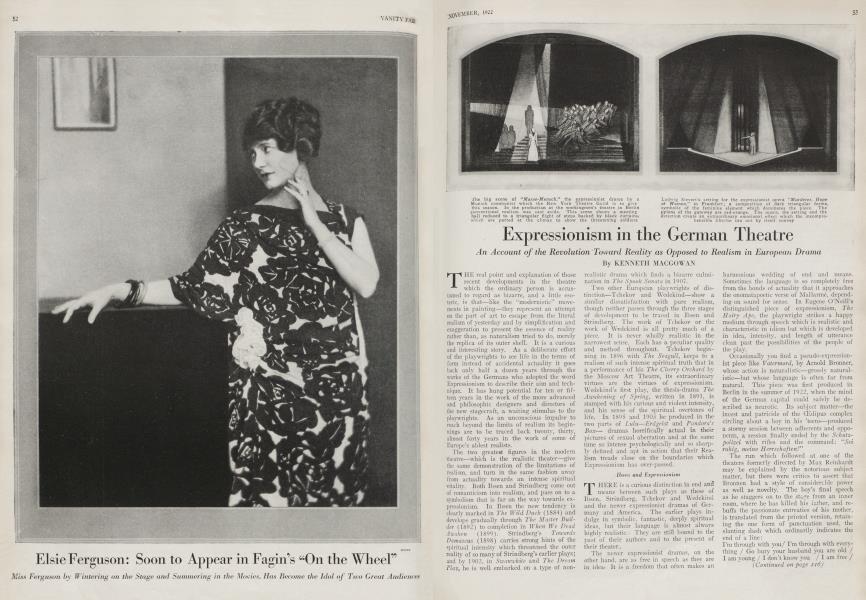
This piece, produced at the Opera House in Frankfort, points an interesting union and parallel between at least one sort of expressionism and music. The action, passing in some indefinite olden time, is symbolically very difficult—quite as difficult as its title, Murderer, Hope of Women. The emotions of the words, on the other hand, are clear enough, and they receive from the music a background of color, a tonal reinforcement, that are most welcome; at the same time the composer finds in the vigorous, if somewhat arbitrary, feeling of the playwright a provocative challenge.
Though the most celebrated plays of the expressionist pioneers have failed to
make a place for themselves in the German repertory, they have had this effect. Playwrights who might have written in the conventional mode have been turned towards a freer technique, and they have succeeded in accomplishing much that is interesting. Sometimes, of course, they have used their freedom for the old, sentimental ends; there is Die Wunderlichen Geschichtten des Kappelmeisier Kreisles for example, a conventional enough story told in forty-two scenes with mechanical tricks devised to make a motion picture technique possible in the theatre. In the plays of the Czech Capek, there is far more seriousness, their success in German has undoubt edly been made easier by the propaganda of the expressionist movement. but none of them is a true example of that new sort of drama now strugglinz for life.
We find this at its best—and popu. larly most successful—in MasseMensch,, a philosophic and yet highly exciting drama of social revolution written by Ernst Toller, one of the Munich communists, now in jail for his share in the red rebellion of 1919 This piece, which will be produced in New York by the Theatre Guild in a translation by Louis Untermeyer is written in a strange sort of free verse, often beautiful, generally effective, and sometimes almost incomprehensible. Every other scene is a dream scene and those that pass in real life are written and staged in a strongly conventionalized and arbitrary manner.
Expressionism and Music
IN the artists who give expressionism a physical form and a pictorial atmosphere upon the stage we find still more of hope. They have gone more quickly and more securely towards their goal. They have had a disciplinary practice upon the plays of an earlier time, a time before realism. They are freed from the moral problems of the writer; and where their work is distempered with the morbidity, the unhealthiness, of so much of our time, the result is less obvious in color or design than it would be if it took the form of words. And they have had behind them the history and the example of the movement in art which we once called postimpressionism, but which follows logically, into expressionism, the movement of Cezanne, Van Gogh, Picasso.
The problem of the expressionist play is the problem of music. And yet not its problem; for music, being so markedly apart from actuality in its materials, has made few and not very successful attempts at the realism which has swamped our stage. Music has been by very nature expressionistic It has failed whenever, as program music, it approached the suggestion of the actual. For the rest, it has soared easily, surely, towards direct expression of spiritual reality. Expressionism in the theater has to seek the way of music, the way towards beauty and ecstasy. The difficulty of the playwright is that he must always feel the pull of the actual life about him; he must make his drama out of human beings and not out of pure vision or emotional response. The world about him is corrupt and corrupting outwardly, as well as beautiful and wonderful within. He cannot, like the musician, leap away from its entanglements by putting his hands to an instrument of abstract art. But he car gain a certain release by foreswearing as much as possible the reproduction of the actual.
Subscribers have complete access to the archive.
Sign In Not a Subscriber?Join Now
