Sign In to Your Account
Subscribers have complete access to the archive.
Sign In Not a Subscriber?Join NowFashions and Pleasures of New York
JOHN McMULLIN
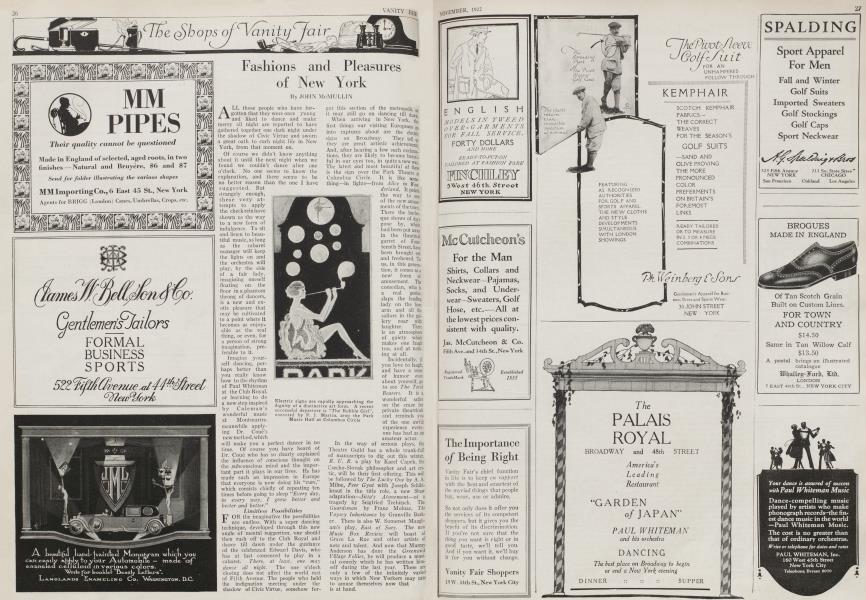
ALL those people who have forgotten that they were once young and liked to dance and make merry all night are reported to have gathered together one dark night under the shadow of Civic Virtue and sworn a great oath to curb night life in New York, from that moment on.
Of course we didn't know anything about it until the next night when we found we couldn't dance after one o'clock. No one seems to know the explanation, and there seems to be no better reason than the one I have suggested. But strangely enough, these very attempts to apply the check rein have shown us the way to a new form of indulgence. To sit and listen to beautiful music, as long as the cabaret manager will keep the lights on and the orchestra will play, by the side of a fair lady, imagining oneself floating on the floor in a phantom throng of dancers, is a new and exotic pleasure that may be cultivated to a point where it becomes as enjoyable as the real thing, or even, for a person of strong imagination, preferable to it.
Imagine yourself dancing, perhaps better than you really know how to the rhythm of Paul Whiteman at the Club Royal, or learning to do a new step inspired by Coleman's wonderful music at Montmartre, meanwhile applying Dr. Coue's new method, which will make you a perfect dancer in no time. Of course you have heard of Dr. Coue who has so clearly explained the influence of conscious thought on the subconscious mind and the important part it plays in our lives. He has made such an impression in Europe that everyone is now doing his "cure," which consists chiefly of repeating ten times before going to sleep "Every day, in every way, I grow better and better and better
Limitless Possibilities
FOR the imaginative the possibilities are endless. With a super dancing technique, developed through this new aftgle of 'me'ntal Suggestion', one should then rush off to the Club Royal and dance till dawn under the guidance of the celebrated Edward Davis, who has at last consented to play in a cabaret. There, at least, one may dance all night. The one o'clock closing does not affect the world east of Fifth Avenue. The people who held the indignation meeting under the shadow of Civic Virtue, somehow for got this section of the metropolis, it may still go on dancing till daw When arriving in New York, first things our visiting Europeans go into raptures about are the electric signs on Broadway. They tell they are great artistic achievemesh And, after hearing a few such exclamations, they are likely to become beautiful in our eyes too, in quite a new way. The latest and most beautiful of these is the sign over the Park Theatxe at Columbus Circle. It is like thing-in lights-from Alice in Won. derland. It points the way to one of the new amusements of the town. There the buries! que shows of days gone by, which had been put away in the theatrical garret of Fourteenth Street, have been brought out and freshened. To us, in this generation, it comes as a new form of amusement. The comedian, who is a real genius, slaps the leading lady on the bare arm and all the sailors in the gallery roar with laughter. There is an atmosphere of gaiety which makes one laugh too, and at nothing at all.
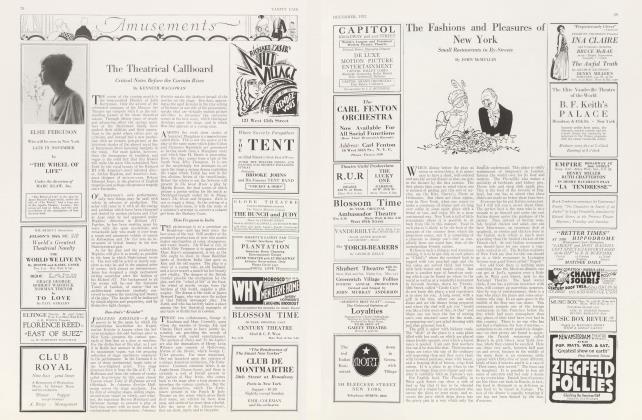
Incidentally, if you love to laugh, and have a sense of humor even about yourself, go to see The Torch Bearers. It is a wonderful satire on the craze for private theatricals and reminds you of the one awful experience everyone has had as an amateur actor. In the way of serious plays, the Theatre Guild has a whole trunk-full of manuscripts to dig out this winter. R. U. R. a play by Karel Capek, the Czecho-Slovak philosopher and art critic, will be their first offering. This will be followed by The Lucky One by A. A. Milne, Peer Gynt with Joseph Schildkraut in the title role, a new Shaw adaptation—Jitta's Atonement—of a tragedy by Seigfried Trebitsch. The Guardsman by Franz Molnar, The Voysey Inheritance by Granville Barker. There is also W. Somerset Maugham's play, East of Suez. The new Music Box Review will boast of Grace La Rue and other artists of note and talent. And now that Murray Anderson has done the Greenwich Village Follies, he will produce a musical comedy which he has written himself during the last year. These are only a few of the infinitely varied ways in which New Yorkers may care to amuse themselves now that is at hand.

Subscribers have complete access to the archive.
Sign In Not a Subscriber?Join Now