Sign In to Your Account
Subscribers have complete access to the archive.
Sign In Not a Subscriber?Join NowThe Fashions and Pleasures of New York
JOHN McMULLIN
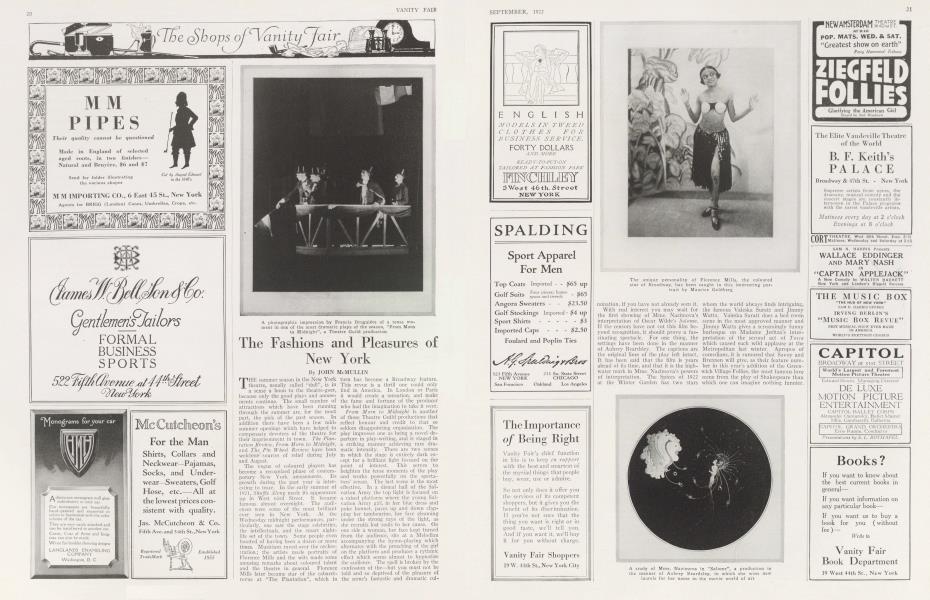
THE summer season in the New York theatre, usually called "dull", is in a sense a boon to the theatre-goer, because only the good plays and amusements continue. The small number of attractions which have been running through the summer are, for the most part, the pick of the past season. In addition there have been a few midsummer openings which have helped to compensate devotees of the theatre for their imprisonment in town. The Plantation Review, From Morn to Midnight, and The Pin Wheel Review have been welcome sources of relief during July and August.
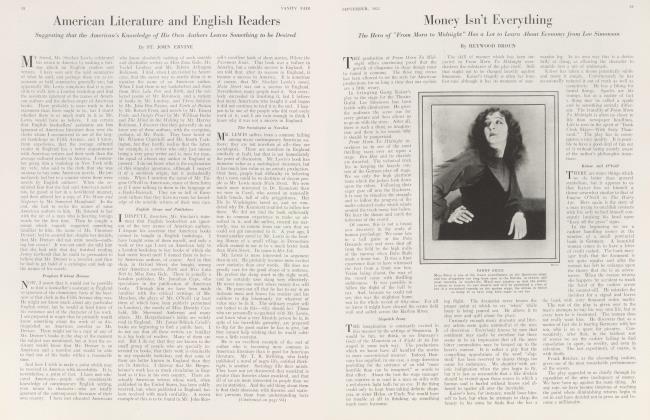
The vogue of coloured players has become a recognized phase of contemporary New York amusements. Its growth during the past year is interesting to trace. In the early summer of 1021, Shuffle Along made its appearance up in West 63rd Street. It became famous almost overnight. The audiences were some of the most brilliant ever seen in New York. At the Wednesday midnight performances, particularly, one saw the stage celebrities, the intellectuals, and the smart nightlife set of the town. Some people even boasted of having been a dozen or more times. Musicians raved over the orchestration; the artists made portraits of Florence Mills and the wits made some amusing remarks about coloured talent and the theatre in general. Florence Mills later became star of the cabaretrevue at "The Plantation", which in turn has become a Broadway feature, This revue is a thrill one could only find in America. In London or Paris it would create a sensation, and make the fame and fortune of the producer who had the imagination to take it over,
From Morn to Midnight is another of those Theatre Guild productions that reflect honour and credit to that so seldom disappointing organization. The play impresses one as being a novel departure in play-writing, and is staged in a striking manner achieving rare dramatic intensity. There are two scenes in which the stage is entirely dark except for a brilliant light focused on the point of interest. This serves to heighten the tense moments of the play and works powerfully on the spectators' senses. The last scene is the most effective. In a dismal hall of the Salvation Army the top light is focused on a raised platform where the young Salvation Army girl, in her blue dress and poke bonnet, paces up and down clapping her tambourine, her face gleaming under the strong rays of the light, as she recruits lost souls to her cause. On one side a woman, her face kept turned from the audience, sits at a Melodian accompanying the hymn-playing which alternates with the preaching of the girl on the platform and produces a rythmic effect which seems almost to hypnotize the audience. The spell is broken by the confession of the—but you must not be told and so deprived of the pleasure of the scene's fantastic and dramatic culmination, if you have not already seen it.
With real interest you may wait for the first showing of Mme. Nazimova's interpretation of Oscar Wilde's Salome. If the censors have not cut this film beyond recognition, it should prove a fascinating spectacle. For one thing, the settings have been done in the manner of Aubrey Beardsley. The captions are the original lines of the play left intact, It has been said that the film is years ahead of its time, and that it is the highwater mark in Mme. Nazimova's powers of interpretation. The Spices of 1922 at the Winter Garden has two stars whom the world always finds intriguing, the famous Valeska Suratt and Jimmy Watts. Valeska Suratt does a bed room scene in the most approved manner and Jimmy Watts gives a screamingly funny burlesque on Madame Jeritza's interpretation of the second act of Tosca which caused such wild applause at the Metropolitan last winter. Apropos of comedians, it is rumored that Savoy and Brennen will give, as their feature number in this year's addition of the Greenwich Village Follies, the most famous love scene from the play of Shakespeare than which one can imagine nothing funnier.
Subscribers have complete access to the archive.
Sign In Not a Subscriber?Join Now
