Sign In to Your Account
Subscribers have complete access to the archive.
Sign In Not a Subscriber?Join NowHow to Select a Colour Scheme
Some Combinations to Avoid in the Painting and Trimming of Automobiles
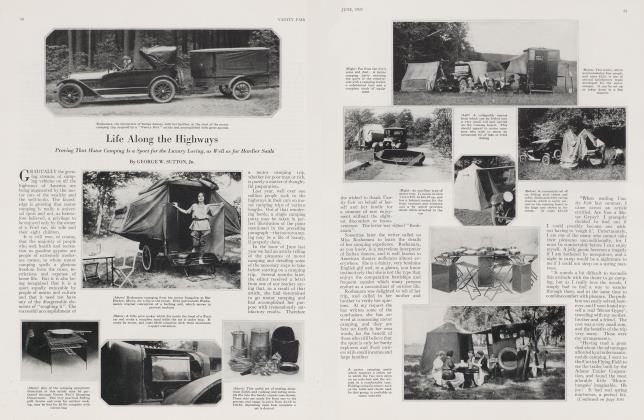
GEORGE W. SUTTON, Jr.
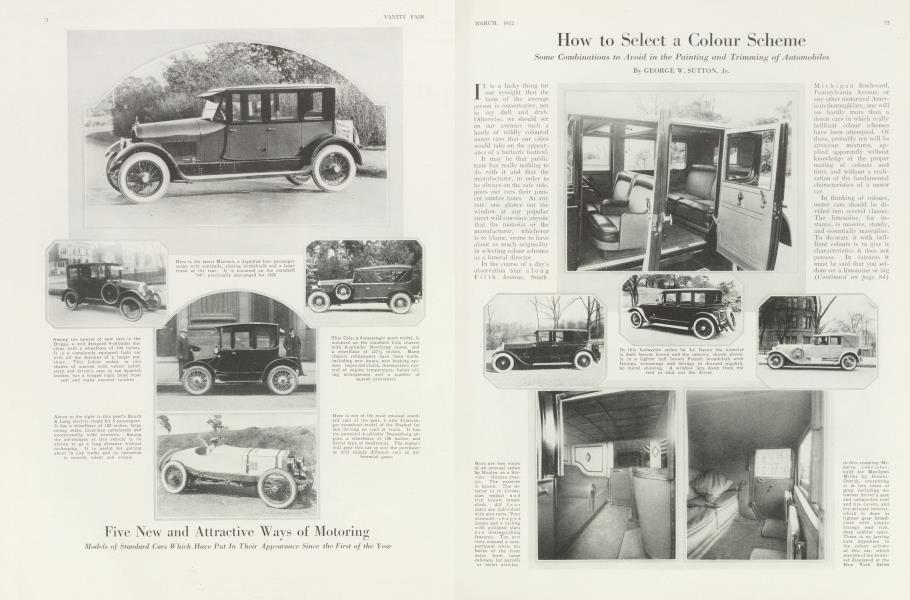
IT is a lucky thing for our eyesight that the taste of the average person is conservative, not to say dull and drab. Otherwise, we should see on our avenues such a horde of wildly coloured motor cars that our cities would take on the appearance of a barbaric festival.
It may be that public taste has really nothing to do with it and that the manufacturer, in order to be always on the safe side, gives our cars their present sombre tones. At any rate, one glance out the window at any popular street will convince anyone that the motorist or the manufacturer, whichever is to blame, seems to have about as much originality in selecting colour schemes as a funeral director.
In the course of a day's observation tour along Fifth Avenue, South Michigan Boulevard, Pennsylvania Avenue, or any other motorized American thoroughfare, one will see hardly more than a dozen cars in which really brilliant colour schemes have been attempted. Of these, probably ten will be atrocious mixtures, applied apparently without knowledge of the proper mating of colours and tints, and without a realization of the fundamental characteristics of a motor car.
In thinking of colours, motor cars should be divided into several classes. The limousine, for instance, is massive, stately, and essentially masculine. To decorate it with brilliant colours is to give it characteristics it does not possess. In fairness it must be said that you seldom see a limousine or big sedan decorated in bad taste. It should be and usually is done on the outside in subdued shades of red, green, blue, brown, or black, and the interior, while allowably more delicate, generally is upholstered in sober greys, tans, blue, green, or red, to harmonize with the exterior. To paint a limousine in pastel shades is to place it on a par with the gentleman who shows up at a formal dance in mouse grey evening clothes.
(Continued on page 84)
(Continued from page 75)
THE average touring car is a machine of utility and its appearance should mark it as such. Olive drab, grey, dark green, blue, red, and brown, are suitable because they are not only "in character" but are more likely to retain a respectable amount of luster after a hard trip in a rain storm.
The roadster and four-passenger sport car have a different psychology. Their dress may correspond to that of their passengers, with their brilliant sweaters, scarfs, and hats in the liveliest colours. Roadsters and sport cars represent youth, "pep", action, and their colours, so long as they do not violate the set rules of blending, may be done in the most vivid shades. Slightly softened primary or secondary colours are probably the best to use for the effective decoration of roadsters and sport cars.
On the other hand, the dainty feminine car, the landaulet, brougham, or cabriolet, may be treated with considerably more latitude, especially in the matter of interior fittings. If the car is to be used for formal purposes, it would naturally reflect delicacy and culture and, by the same token, simplicity, in both exterior and interior. If, however, the owner is a young lady who uses the car for shopping, for running out to the country club, and other informal activities, the colours may be in brighter tones and express more liveliness of feminine spirit.
THERE are several things to be avoided. One of these is the use of vertical lines. This applies also to the aluminum hood. The motor car has two main characteristics—power and speed. Neither of these can be properly expressed in a car by vertical lines. To paint a hood one colour and the body another is bound to produce the impression of squattiness. The manufacturers have realized this, as a general rule, and have given their cars long sweeping lines which create the impression of speed even when the machines are not in motion.
There is no reason why motor cars should not be more colourful than they are. In fact, when Miss A. H. Fish, an English sketch artist, was in this country six months ago, she remarked on the dulness and lack of variety in our car colours. It is easily possible, through a study of paints, to arrive at some brilliant combinations which will not clash nor disagree. There are three primary colours, red, yellow, and blue, from which all of the others are obtained. None of these should be used by itself but should be blended to guard against a garish effect. Shades of any two of them will blend properly, but all three cannot be used at once. White and black are not colours, but have an important place in automobile painting. White is supposed to be the presence of all colours and black the absence of them. A good rule to follow, and one which cannot produce an inharmonious effect, is to take any two primary or secondary colours which make a pleasing combination, mix them, and use the blend for the body and the two colours themselves for striping wheels, fenders, and other trim.
If you are not a student of art it would be a good idea to consult some friendly artist when contemplating a change in your car colour scheme. He will show you the relations of primary and secondary colours and their complements and show you how to create combinations which will be striking and original but which will always be in good taste. Many of these thoughts on colour combinations are the result of a chat on the subject with C. Coles Phillips, the expert illustrator and artist.
THE seeker after information concerning the tendency in car colouring should visit the Annual Automobile Salon at New York and Chicago. However, in the expositions just closed, one would need more than the ancient and inefficient lantern of Diogenes to detect any consistent trend in colour schemes. It has been said that the custom body builders, who, after all, are the arbiters of motor car styles, are getting away from the deep greens, blues and blacks. This may be so, yet all the cars displayed by Locke were in these conservative colours with interiors done, for the most part, in quiet grey or tan-striped upholstery and fittings of bone or other inconspicuous material. All the Locomobiles, likewise, were in the darker shades of green, blue and maroon, while Healey, displaying Stevens-Duryea, Lancia, Cadillac, Pierce-Arrow and Falcon cars, clung to deep browns, greens, blues, and blacks for exterior finish.
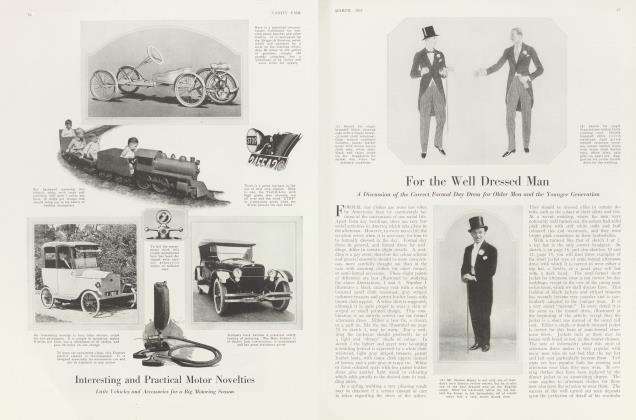
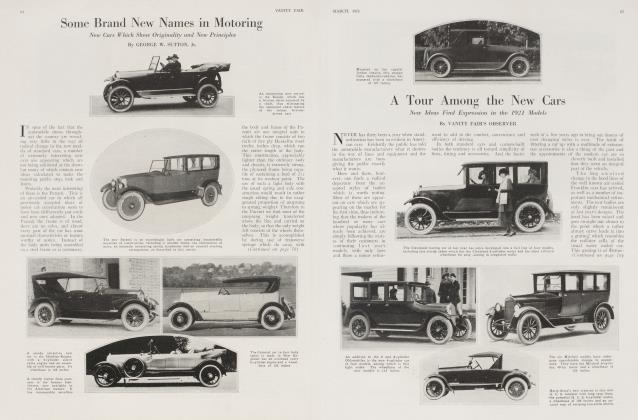
On the other hand, Rolls Royce, noted for its conservatism, displayed a variety of cars in vivid shades of grey, maroon and ivory white. Among the BrooksOstruk Minervas there was a wide choice of brilliant colours. One sedan was in bright blue with black trim. A brougham, built for Miss Billie Burke, had a bright aluminum hood and cowl, a green body with upper moulding, rear panel and roof in soft grey leather and an interior in deep tan. Next to this was a big Minerva sporting four-passenger touring car, called the Corsair, which was a study in canary yellow, while in the corner was the gem of the exhibit, the exquisite little gray cabriolet of Miss Marilynn Miller, shown on the first page of this article.
(Continued, on page 100)
(Continued from page 84)
The Cunningham greys and greens and blues were enhanced considerably by clever striping in harmonizing shades. A number of unusual colour treatments were revealed on Daniels cars, one of which was a blue limousine with the driver's seat in light grey leather and the interior seats in grey leather and the walls and ceiling in deep blue upholstery. Another Daniels was entirely black on the exterior with salmon colour interior. This was a collapsible cabriolet. A number of spectacular colour combinations were introduced by the Murphy Body Company on Lincoln chassis. In this display peculiar shades of red were used with great effect.
AT the National Automobile Shows there was very little in the way of vivid colouring, except in sport models. This will always be true, for the manufacturer of standard cars has a problem which differs materially from that of the custom builder. Whereas the latter has only one customer at a time to please in the selection of a colour scheme, the maker of stock cars must plan on meeting the artistic tastes of many hundreds or thousands of buyers of the same model, and as the taste of any considerable block of average citizens is confined within extremely narrow limits, the standard manufacturer must watch his step. Considering also that he is restricted by considerations of economy and durability in the choice of upholstery materials and interior and exterior colours, the exhibitors at the big shows did mighty well.
If there is any discernible current in motor car colour styles, it is toward the employment of new and brighter shades of blue, green, claret, brown, and yeL low with an increase in the popularity of grey. The striping of cars is, as a rule, more prevalent but smaller and less noticeable than in former years, while practically all monograms are small and not complicated.
In the matter of interior finish most of the custom-made cars are upholstered in rather subdued cloth or cord and worsted, in various tones of grey, tan, blue, green, maroon, and brown. The severe plainness, which marked last year's cars, is beginning to give way a little and we see more broadlace and a touch of colour here and there in the fittings. There is a noticeable decrease in the use of tapestry, flower vases and enamel furniture, as door handles, dome lights, dictaphones, window regulators, vanity cases and smoking sets are called. The use of brightly coloured leather has received a great impetus from the appearance of many twoand four-passenger sport cars. Striped upholstery, employing two shades of .one colour, is used extensively and there is a considerable increase in arm rests, large door pockets for tools, and trunks for carrying clothes on tours.
SUMMING up, it may be said that among standardized cars colour schemes are more or less conservative through psychological and commercial necessity. In custom-built cars the desire of the purchaser to make the car reflect his own personality appears not only in the type of machine he selects, but in the exterior and interior decoration as well. There is a tendency to relieve the austere backgrounds of a year ago and to select colour schemes and fittings which are livelier but still in good taste.
Subscribers have complete access to the archive.
Sign In Not a Subscriber?Join Now

