
Sign In to Your Account
Subscribers have complete access to the archive.
Sign In Not a Subscriber?Join NowAdvertising Etiquette
GEORGE S. CHAPPELL
How to Get Over that Guilty Feeling When You Throw Them Away
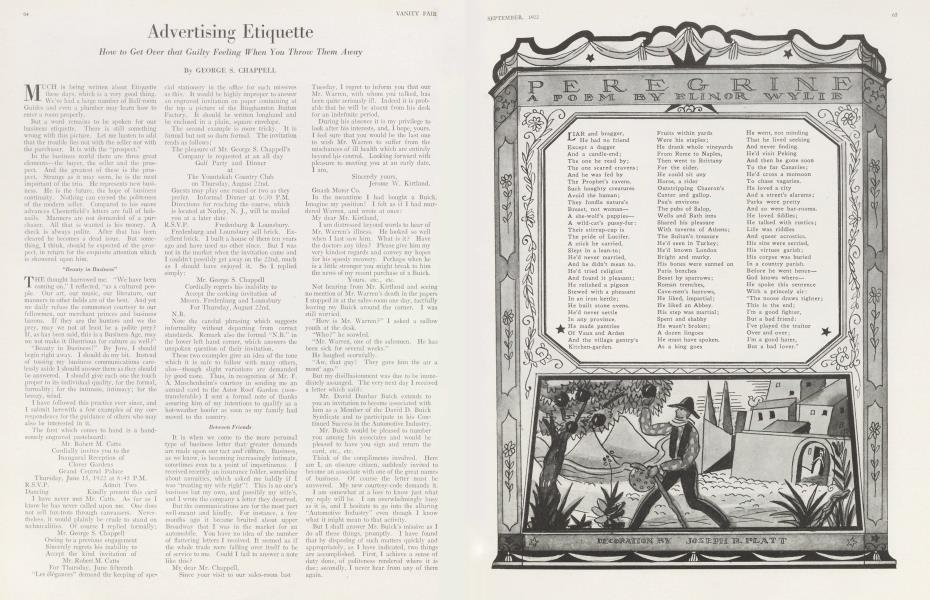
MUCH is being written about Etiquette these days, which is a very good thing. We've had a large number of Ball-room Guides and even a plumber may learn how to enter a room properly.
But a word remains to be spoken for our business etiquette. There is still something wrong with this picture. Let me hasten to add that the trouble lies not with the seller nor with the purchaser. It is with the "prospect."
In the business world there are three great elements—the buyer, the seller and the prospect. And the greatest of these is the prospect. Strange as it may seem, he is the most important of the trio. He represents new business. He is the future, the hope of business continuity. Nothing can exceed the politeness of the modern seller. Compared to his suave advances Chesterfield's letters are full of hobnails. Manners are not demanded of a purchaser. All that is wanted is his money. A check is always polite. After that has been cleared he becomes a dead issue. But something, I think, should be expected of the prospect, in return for the exquisite attention which is showered upon him.
"Beauty in Business"
THE thought harrowed me. "We have been coming on," I reflected, "as a cultured people. Our art, our music, our literature, our manners in other fields are of the best. And yet we daily refuse the commonest courtesy to our fellowmen, our merchant princes and business barons. If they are the hunters and we the prey, may we not at least be a polite prey? If, as has been said, this is a Business Age, may we not make it illustrious for culture as well?"
"Beauty in Business!" By Jove, I should begin right away. I should do my bit. Instead of tossing my business communications carelessly aside I should answer them as they should be answered. I should give each one the touch proper to its individual quality, for the formal, formality; for the intimate, intimacy; for the breezy, wind.
I have followed this practice ever since, and I submit herewith a few examples of my correspondence for the guidance of others who may also be interested in it.
The first which comes to hand is a handsomely engraved pasteboard:
Mr. Robert M. Catts
Cordially invites you to the
Inaugural Reception of
Clover Gardens
Grand Central Palace
Thursday, June 15, 1922 at 8:45 P.M.
R.S.V.P.
Admit Two
Dancing
Kindly present this card
I have never met Mr. Catts. As far as I know he has never called upon me. One does not sell fox-trots through canvassers. Nevertheless, it would plainly be crude to stand on technicalities. Of course I replied formally:
Mr. George S. Chappell
Owing to a previous engagement
Sincerely regrets his inability to
Accept the kind invitation of
Mr. Robert M. Catts
For Thursday, June fifteenth
"Les elegances" demand the keeping of spe-
cial stationery in the office for such missives as this. It would be highly improper to answer an engraved invitation on paper containing at the top a picture of the Binghamton Button Factory. It should be written longhand and be enclosed in a plain, square envelope.
The second example is more tricky. It is formal but not so darn formal. The invitation reads as follows:
The pleasure of Mr. George S. Chappell's Company is requested at an all day Golf Party and Dinner at
The Yountakah Country Club on Thursday, August 22nd.
Guests may play one round or two as they prefer. Informal Dinner at 6:30 P.M. Directions for reaching the course, which is located at Nutley, N. J., will be mailed you at a later date.
R.S.V.P.
Fredenburg & Lounsbury.
Fredenburg and Lounsbury sell brick. Excellent brick. I built a house of them ten years ago and have used no other since. But I was not in the market when the invitation came and I couldn't possibly get away on the 22nd, much as I should have enjoyed it. So I replied simply:
Mr. George S. Chappell Cordially regrets his inability to Accept the corking invitation of Messrs. Fredenburg and Lounsbury For Thursday, August 22nd.
N.B.
Note the careful phrasing which suggests informality without departing from correct standards. Remark also the formal "N.B." in the lower left hand corner, which answers the unspoken question of their invitation.
These two examples give an idea of the tone which it is safe to follow with many others, also—though slight variations are demanded by good taste. Thus, in recognition of Mr. F. A. Muschenheim's courtesy in sending me an annual card to the Astor Roof Garden (nontransferable) I sent a formal note of thanks assuring him of my intentions to qualify as a hot-weather hoofer as soon as my family had moved to the country.
Between Friends
It is when we come to the more personal type of business letter that* greater demands are made upon our tact and culture. Business, as we know, is becoming increasingly intimate, sometimes even to a point of impertinence. I received recently an insurance folder, something about annuities, which asked me baldly if I was "treating my wife right"! This is no one's business but my own, and possibly my wife's, and I wrote the company a letter they deserved.
But the communications are for the most part well-meant and kindly. For instance, a few months ago it became bruited about upper Broadway that I was in the market for an automobile. You have no idea of the number of flattering letters I received. It seemed as if the whole trade were falling over itself to be of service to me. Could I fail to answer a note like this?
My, dear Mr. Chappell,
Since your visit to our sales-room last
Tuesday, I regret to inform you that our Mr. Warren, with whom you talked, has been quite seriously ill. Indeed it is probable that he will be absent from his desk for an indefinite period.
During his absence it is my privilege to look after his interests, and, I hope, yours. I feel sure that you would be the last one to wish Mr. Warren to suffer from the mischances of ill health which are entirely beyond his control. Looking forward with pleasure to meeting you at an early date, I am,
Sincerely yours,
Jerome W. Kirtland.
Gnash Motor Co.
In the meantime I had bought a Buick. Imagine my position! I felt as if I had murdered Warren, and wrote at once:
My dear Mr. Kirtland,
I am distressed beyond words to hear of Mr. Warren's illness. He looked so well when I last saw him. What is it? Have the doctors any idea ? Please give him my very kindest regards and convey my hopes for his speedy recovery. Perhaps when he is a little stronger you might break to him the news of my recent purchase of a Buick.
Yours, etc., etc.
Not hearing from Mr. Kirtland and seeing no mention of Mr. Warren's death in the papers I stopped in at the sales-room one day, tactfully leaving my Buick around the comer. I was still worried.
"How is Mr. Warren?" I asked a sallow youth at the desk.
"Who?" he scowled.
"Mr. Warren, one of the salesmen. He has been sick for several weeks."
He laughed scornfully.
"Aw, that guy! They gave him the air a mont' ago."
But my disillusionment was due to be immediately assuaged. The very next day I received a letter which said:
Mr. David Dunbar Buick extends to you an invitation to become associated with him as a Member of the David D. Buick Syndicate and to participate in his Continued Success in the Automotive Industry.
Mr. Buick would be pleased to number you among his associates and would be pleased to have you sign and return the card, etc., etc.
Think of the compliments involved. Here am I, an obscure citizen, suddenly invited to become an associate with one of the great names of business. Of course the letter must be answered. My new courtesy-code demands it.
I am somewhat at a loss to know just what my reply will be. I am overwhelmingly busy as it is, and I hesitate to go into the alluring "Automotive Industry" even though I know what it might mean to that activity.
But I shall answer Mr„ Buick's missive as I do all these things, promptly. I have found that by disposing of such matters quickly and appropriately, as I have indicated, two things are accomplished. First, I achieve a sense of duty done, of politeness rendered where it is due; secondly, I never hear from any of them again.
Subscribers have complete access to the archive.
Sign In Not a Subscriber?Join Now