Sign In to Your Account
Subscribers have complete access to the archive.
Sign In Not a Subscriber?Join NowGeorge M. Cohan: The Song-and-Dance Man
A Tribute to the Not-Quite-Undiscovered Genius of the American Stage
GILBERT SELDES
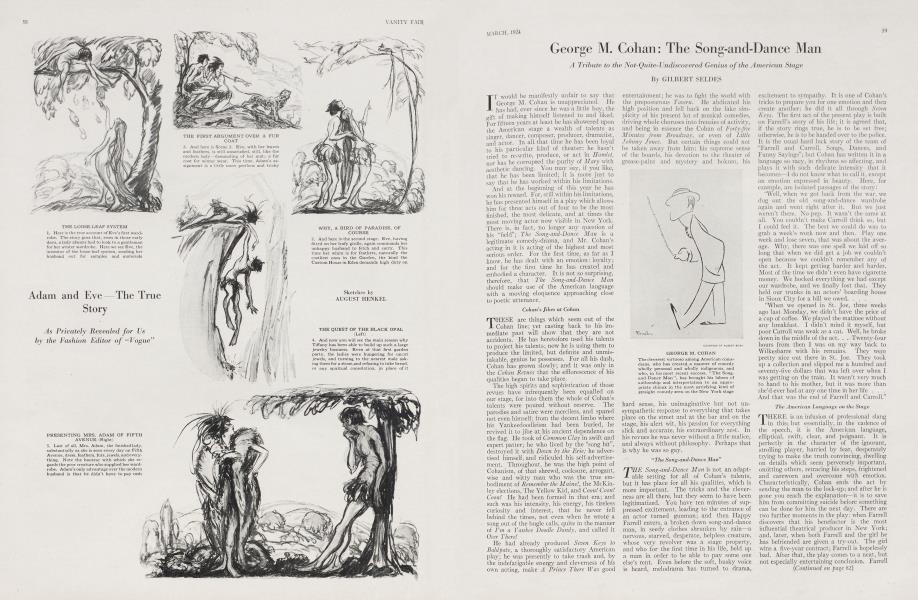
IT would be manifestly unfair to say that George M. Cohan is unappreciated. He has had, ever since he was a little boy, the gift of making himself listened to and liked. For fifteen years at least he has showered upon the American stage a wealth of talents as singer, dancer, composer, producer, dramatist, and actor. In allthat time he has been loyal to his particular kind of theater: he hasn't tried to re-write, produce, or act in Hamlet, nor has he corrupted the purity of Mary with aesthetic dancing. You may say, if you like, that he has been limited; it is more just to say that he has worked within his limitations.
And at the beginning of this year he has won his reward. For, still within his limitations, he has presented himself in a play which allows him for three acts out of four to be the most finished, the most delicate, and at times the most moving actor now visible in New York. There is, in fact, no longer any question of his "field"; The Song-and-Dance Man is a legitimate comedy-drama, and Mr. Cohan's acting in it is acting of the highest and most serious order. For the first time, as far as I know, he has dealt with an emotion: loyalty; and for the first time he has created and embodied a character. It is not so surprising, therefore, that The Song-and-Dance Man should make use of the American language with a moving eloquence approaching close to poetic utterance.
Cohan's Jibes at Cohan
THESE are things which seem out of the Cohan line; yet casting back to his immediate past will show that they are not accidents. He has heretofore used his talents to project his talents; now he is using them to produce the limited, but definite and unmistakable, genius he possesses. For all his dash, Cohan has grown slowly; and it was only in the Cohan Revues that the efflorescence of his qualities began to take place.
The high spirits and sophistication of those revues have infrequently been equalled on our stage, for into them the whole of Cohan's talents were poured without reserve. The parodies and satire were merciless, and spared not even himself; from the decent limbo where his Yankeedoodleism had been buried, he revived it to jibe at his ancient dependence on the flag. He took of Common Clay in swift and expert patter; he who lived by the "song hit", destroyed it with Down by the Erie; he advertised himself, and ridiculed his self-advertisement. Throughout, he was the high point of Cohanism, of that shrewd, cocksure, arrogant, wise and witty man who was the true embodiment of Remember the Mainel, the McKinley elections, The Yellow Kid, and Coonl Coonl Coonl He had been formed in that era; and such was his intensity, his energy, his tireless curiosity and interest, that he never fell behind the times, not even when he wrote a song out of the bugle calls, quite in the manner of I'm a Yankee Doodle Dandy, and called it Over There!
He had already produced Seven Keys to Baldpate, a thoroughly satisfactory American play; he was presently to take trash and, by the indefatigable energy and cleverness of his own acting, make A Prince There Was good entertainment; he was to fight the world with the preposterous Tavern. He abdicated his high position arid fell back on the fake sim plicity of his present lot of musical comedies, driving whole choruses into frenzies of activity, and being in essence the Cohan of Forty-five Minutes from Broadway, or even of Little Johnny Jones. But certain things could not be taken away from him: his supreme sense of the boards, his devotion to the theater of grease-paint and mystery and bokum, his hard sense, his unimaginative but not unsympathetic response to everything that takes place on the street and at the bar and on the stage, his alert wit, his passion for everything slick and accurate, his extraordinary zest. In his revues he was never without a little malice, and always without philosophy. Perhaps that is why he was so gay.
"The Song-and-Dance Man"
THE Song-and-Dance Man is not an adaptable setting for ail of Cohan's talents, but it has place for all his qualities, which is more important. The tricks and the cleverness are all there, but they seem to have been legitimatized. You have ten minutes of suppressed excitement, leading to the entrance of an actor turned gunman; and then Happy Farrell enters, a broken down song-and-dance man, in seedy clothes shrunken by rain—a nervous, starved, desperate, helpless creature, whose very revolver was a stage property, and who for the first time in his-life, held up a man in order to be able to pay some one else's rent. Even before the soft, husky voice is heard, melodrama has turned to drama, excitement to sympathy. It is one of Cohan's tricks to prepare you for one emotion and then create another: he did it all through Seven Keys. The first act of the present play is built on Farrell's story of his life; it is agreed that, if the story rings true, he is to be set free; otherwise, he is to be handed over to the police. It is the usual hard luck story of the team of "Farrell and Carroll, Songs, Dances, and Funny Sayings"; but Cohan has written it in a language so racy, in rhythms so affecting, and plays it with such delicate intensity that it becomes—I do not know what to call it, except an emotion expressed in beauty. Here, for example, are isolated passages of the story:
"Well, when we got back from the war, we dug out the old song-and-dance wardrobe again and went right after it. But we just weren't there. No pep. It wasn't the same at all. You couldn't make Carroll think so, but I could feel it. The best we could do was to grab a week's work now and then. Play one week and lose seven, that was about the average. Why, there was one spell we laid off so long that when we did get a job we couldn't open because we couldn't remember any of the act. It kept getting harder and harder. Most of the time we didn't even have cigarette money. We hocked everything we had except our wardrobe, and we finally lost that. They held our trunks in an actors' boarding house in Sioux City for a bill we owed. . . .
"When we opened in St. Joe, three weeks ago last Monday, we didn't have the price of a cup of coffee. We played the matinee without any breakfast. I didn't mind it myself, but poor Carroll was weak as a cat. Well, he broke down in the middle of the act. . . Twenty-four hours from then I was on my way back to Wilkesbarre with his remains. They were pretty nice out there in St. Joe. They took up a collection and slipped me a hundred and seventy-five dollars that was left over when I was getting on the train. It wasn't very much to hand to his mother, but it was more than she'd ever had at any one time in her life . . . And that was the end of Farrell and Carroll."
The American Language on the Stage
THERE is an infusion of professional slang in this; but essentially, in the cadence of the speech, it is the American language, elliptical, swift, clear, and poignant. It is perfectly in the character of the ignorant, strolling player, harried by fear, desperately trying to make the truth convincing, dwelling on details which seem perversely important, omitting others, retracing his steps, frightened and careworn and overcome with emotion. Characteristically, Cohan ends the act by sending the man to the lock-up; and after he is gone you reach the explanation—it is to save him from committing suicide before something can be done for him the next day. There are two further moments in the play: when Farrell discovers that his benefactor is the most influential theatrical producer in New York; and, later, when both Farrell and the girl he has befriended are given a try-out. The girl wins a five-year contract; Farrell is hopelessly bad. After that, the play comes to a neat, but not especially entertaining conclusion. Farrell goes into business, makes a small fortune, and promptly forsakes business for his old profession, because he has a true song.-anddance man's heart.
Continued on page 82
Continued from page 59
The play is obviously Mr. Cohan's gesture of devotion to the theater; instinctively, he has projected the emotion through another one, the devoted loyalty of one player to his partner. The emotion is very real, and Cohan has given it dignity, as well as delicacy. If the feeling is his own, the character is not himself; and in that prime qualification for good acting he has surpassed nearly every American actor I know, for he has not for a moment intruded the personality of the actor into the character created by him. I have seen Mr. Cohan at least five times playing himself, and I know the difference. Instead of a curtain speech Mr. Cohan does Farrell's song and dance, as he is supposed to have done it at the try-out; it is extremely deft parody; it is funny, and it is Cohan. For the rest of the play, he is the failure Farrell, the misguided, infatuated fellow who never really had the root of the matter in him.
There is a further point about Cohan's acting. I would like to fill the theater, when he plays, with all the enthusiasts for restraint, with all those who worship the drama, with Miss Eva Le Gallienne and Mr. Arthur Hopkins and the Theatre Guild. For here they could see restraint which rises from strength and which makes no sacrifice of intensity or of passion. They would see gestures of an instinctive refinement, movements of breathless precision, a voice which hardly rises above a murmur, yet seems to have every tone and every timbre, to express every necessary emotion. They would see the indirect method at its best, for virtually none of Cohan's effects are won by direct attack on the audience—he seems to work through the other players. They would see a triumphant virtuosity, put to its proper use.
So far, an unerring instinct has made it possible for Cohan to exist without the aid of a constructive and disciplining intelligence. The content of his plays is insignificant or conventional. He is not a thinker, nor a poet; he is, in short, not a great artist. He has never pretended to be. Out of simple and common things, he has created first entertainment and then beauty; and in the second order of the world's desirable citizens, he has a valid claim to the foremost rank.
Subscribers have complete access to the archive.
Sign In Not a Subscriber?Join Now
