
Sign In to Your Account
Subscribers have complete access to the archive.
Sign In Not a Subscriber?Join Now"Desire Under the Ellums"
ALEXANDER WOOLLCOTT
Being Some Footnotes to the Running Story of Eugene O'Neill
EPHRAIM CABOT, Jr.
I was the son of the Abbie Putnam That married Ephraim Cabot for his farm. When I had been two weeks upon the earth
My mother shoved a pillow in my face. Abbie had needed a son to clinch her hold On all that mean New England land The Cabots tilled for more than fifty years,
But there was no sap in Ephraim for her scheme.
Behind his back she used instead The salty Eben whom an earlier wife Had left to grow up strong and sweaty Working the stubborn acres of the farm. It was good strategy; but in the midst of it She fell in love with this lusty stepson of hers.
All at once, when I came into the world, She knew she had created something that might cheat
Her sulking lover of his legacy.
And while the neighbors, leering round the kitchen stove,
Were swilling Cabot cider in my honour She stole upstairs and choked me in my cradle.
One of the neighbors, Gene O'Neill it was, Picked up my story for a tragedy.
It was acted in the Village by some players Who wore a studied Down East dialect Saying "stun", with care, for "stone"
And "hum" for "home."
But my own sufferings were over.
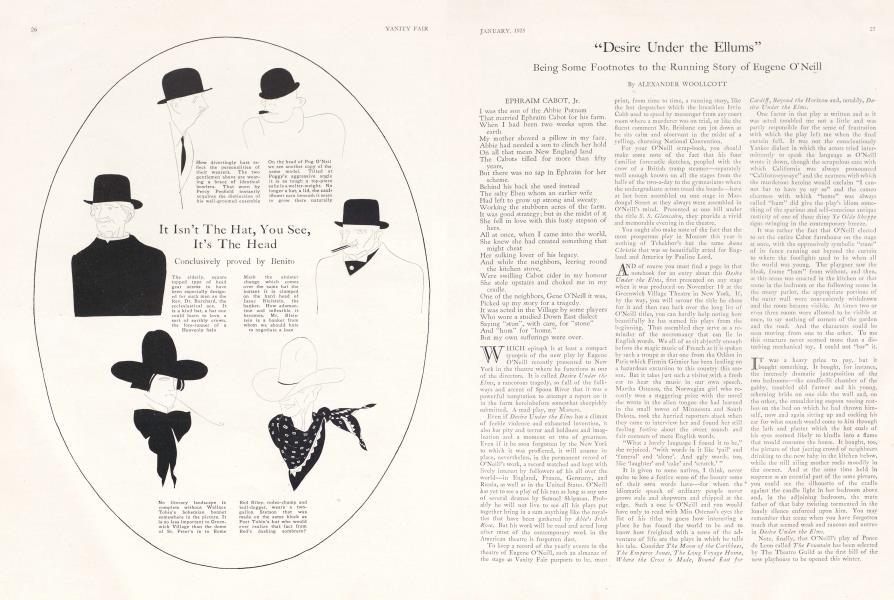
WHICH epitaph is at least a compact synopsis the new play by Eugene O'Neill recently presented to New York in the theatre where he functions as one of the directors. It is called Desire Under the Elms, a rancorous tragedy, so full of the folkways and accent of Spoon River that it was a powerful temptation to attempt a report on it in the form hereinbefore somewhat sheepishly submitted. A mad play, my Masters.
Even if Desire Under the Elms has a climax of feeble violence and exhausted invention, it also has pity and terror and boldness and imagination and a moment or two of greatness. Even if it be soon forgotten by the New York to which it was proffered, it will assume its place, nevertheless, in the permanent record of O'Neill's work, a record watched and kept with lively interest by followers of his all over the world—in England, France, Germany, and Russia, as well as in the United States. O'Neill has yet to sec a play of his run as long as any one of several dramas by Samuel Shipman. Probably he will not live to see all his plays put together bring in a sum anything like the royalties that have been gathered by Abie's Irish Rose. But his work will be read and acted long after most of the contemporarv work in the American theatre is forgotten dust.
To keep a record of the yearly events in the theatre of Eugene O'Neill, such an almanac of the stage as Vanity Fair purports to be, must print, from time to time, a running story, like the hot despatches which the breathless Irvin Cobb used to speed by messenger from any court room where a murderer was on trial, or like the fluent comment Mr. Brisbane can jot down as he sits calm and observant in the midst of a yelling, churning National Convention.
For your O'Neill scrap-book, you should make some note of the fact that his four familiar forecastle sketches, peopled with the crew of a British tramp steamer—separately well enough known on all the stages from the halls of the two-a-day to the gymnasiums where the undergraduate actors tread the boards—have at last been assembled on one stage in Macdougal Street as they always were assembled in O'Neill's mind. Presented as one bill under the title S. S. Gleucairn, they provide a vivid and memorable evening in the theatre.
You ought also make note of the fact that the most prosperous play in Moscow this year is nothing of Tchekhov's but the same Anna Christie that was so beautifully acted for England and America by Pauline Lord.
AND of course you must find a page in that notebook for an entry about this Desire Under the Elms, first presented on any stage when it was produced on November 10 at the Greenwich Village Theatre in New York. If, by the way, you will savour the title he chose for it and then run back over the long list of O'Neill titles, you can hardly help noting how beautifully he has named his plays from the beginning. Thus assembled they serve as a reminder of the necromancy that can lie in English words. We all of us sit abjectly enough before the magic music of French as it is spoken by such a troupe as that one from the Odeon in Paris which Firmin Gemier has been leading on a hazardous excursion to this country this season. But it takes just such a visitor with a fresh ear to hear the music in our own speech. Martha Ostcnso, the Norwegian girl who recently won a staggering prize with the novel she wrote in the alien tongue she had learned in the small towns of Minnesota and South Dakota, took the hurried reporters aback when they came to interview her and found her still feeling festive about the sweet sounds and fair contours of mere English words.
"What a lovely language I found it to be," she rejoiced, "with words in it like 'pail' and 'funeral' and 'alone'. And ugly words, too, like 'laughter' and 'cake' and 'scratch.' "
It is given to some natives, I think, never quite to Jose a festive sense of the beauty some of their own words have—for whom the idiomatic speech of ordinary people never grows stale and shopworn and chipped at the edge. Such a one is O'Neill and you would have only to read with Miss Ostenso's eyes the list of his titles to guess how interesting a place he has found the world to be and to know how freighted with a sense of the adventure of life are the plays in which he tells his talc. Consider The Moon of the Caribhees, The Emperor Jones, The Long Voyage Home, Where the Cross is Made, Bound East for Cardiff, Beyond the Horizon and, notably, Desire Under the El JUS.
One factor in that play as written and as it was acted troubled me not a little and was partly responsible for the sense of frustration with which the play left me when the final curtain fell. It was not the conscientiously Yankee dialect in which the actors tried intermittently to speak the language as O'Neill wrote it down, though the scrupulous care with which California was always pronounced "Californ-cyc-aye" and the neatness with which the murderous heroine would exclaim "I cannot bar to have ye say so" and the cameo clearness with which "home" was always called "hum" did give the play's idiom something of the spurious and self-conscious antique rusticity of one of those shiny Ye Olde Shoppe signs swinging in the contemporary breeze.
It was rather the fact that O'Neill elected to set the entire Cabot farmhouse on the stage at once, with the oppressively symbolic "stuns" of its fence running out beyond the curtain to where the footlights used to be when all the world was young. The playgoer saw the bleak, frame "hum" from without, and then, as this scene was enacted in the kitchen or that scene in the bedroom or the following scene in the musty parlor, the appropriate portions of the outer wall were conveniently withdrawn and the room became visible. At times two or even three rooms were allowed to be visible at once, to say nothing of corners of the garden and the road. And the characters could be seen moving from one to the other. To me this structure never seemed more than a disturbing mechanical toy. I could not "bar" it.
IT was a heavy price to pay, but it bought something. It bought, for instance, the intensely dramatic juxtaposition of the two bedrooms—the candle-lit chamber of the gabby, troubled old farmer and his young, scheming bride on one side the wall and, on the other, the smouldering stepson tossing restless on the bed on which he had thrown himself, now and again sitting up and cocking his ear for what sounds would come to him through the lath and plaster which the hot coals of his eyes seemed likely to kindle into a flame that would consume the house. It bought, too, the picture of that jeering crowd of neighbours drinking to the new baby in the kitchen below, while the still ailing mother rocks moodily in the corner. And at the same time held in suspense as an essential part of the same picture, you could sec the silhouette of the cradle against the candle light in her bedroom above and, in the adjoining bedroom, the mute father of that baby twisting tormented in the lonely silence enforced upon him. You may remember that scene when you have forgotten much that seemed weak and raucous and untrue in Desire Under the Elms.
Note, finally, that O'Neill's play of Ponce de Leon called The Fountain has been selected by The Theatre Guild as the first bill of the new playhouse to be opened this winter.
Subscribers have complete access to the archive.
Sign In Not a Subscriber?Join Now