Sign In to Your Account
Subscribers have complete access to the archive.
Sign In Not a Subscriber?Join NowThe Varying Shaw
Notes Marking the Milestones in the Making of Some Classics
ALEXANDER WOOLLCOTT
THE walls of the Garrick Theatre, which stands in Thirty-fifth Street just east of Herald Square, are witnessing as pretty a revenge as ever the whirligig of time brought in.
This playhouse had been built as a home for the art of the late Ned Harrigan; but thirty years ago this month it was taken over by Richard Mansfield, who redecorated it from cellar to garret, inscribed the mosaic of its lobby with a gigantic monogram of his own initials, named it the Garrick and dreamed great dreams of its future. On March 22— that, as gifted mathematicians already know, was in 1895—he wrote some account of those dreams to the watchful William Winter, whom he regarded not only as a friend at court but, inevitably, as a potential biographer. A new play from a new playwright in London was due on his desk the following Monday and if it proved to be clean—Mansfield's very words, addressed, no doubt, to Mr. Winter's celebrated susceptibilities,—he would inaugurate his tenancy of the Garrick with it.
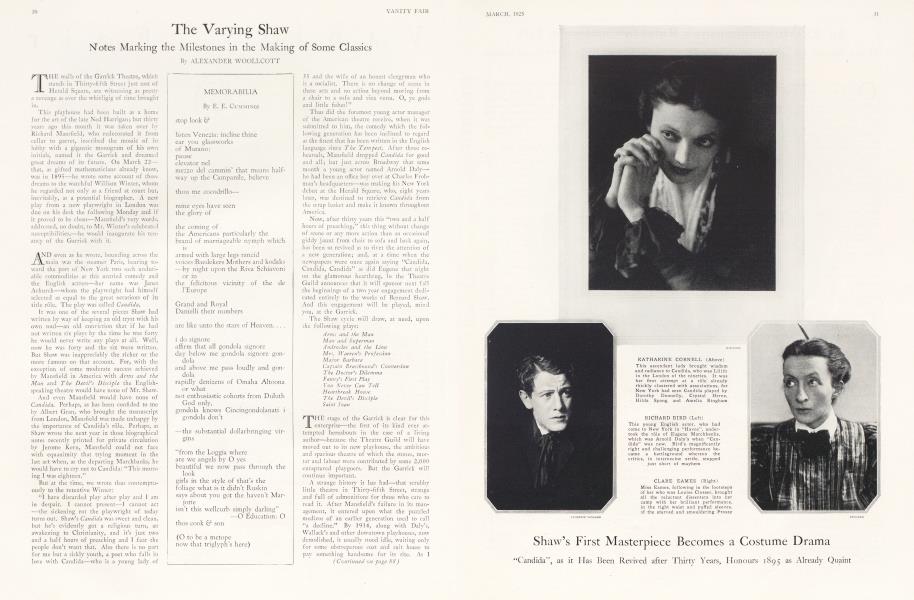
AND even as he wrote, bounding across the main was the steamer Paris, bearing toward the port of New York two such undutiable commodities as this untried comedy and the English actress—her name was Janet Achurch—whom the playwright had himself selected as equal to the great occasions of its title role. The play was called Candida.
It was one of the several pieces Shaw had written by way of keeping an old tryst with his own soul—an old conviction that if he had not written six plays by the time he was forty he would never write any plays at all. Well, now he was forty and the six were written. But Shaw was inappreciably the richer or the more famous on that account. For, with the exception of some moderate success achieved bv Mansfield in America with Arms and the Man and The Devil's Disciple the Englishspeaking theatre would have none of Mr. Shaw.
And even Mansfield would have none of Candida. Perhaps, as has been confided to me by Albert Gran, who brought the manuscript from London, Mansfield was made unhappy by the importance of Candida's role. Perhaps, as Shaw wrote the next year in those biographical notes recently printed for private circulation by Jerome Kern, Mansfield could not face with equanimity that trying moment in the last act when, as the departing Marchbanks, he would have to cry out to Candida: "This morning I was eighteen."
But at the time, we wrote thus contemptuously to the retentive Winter:
"I have discarded play after play and I am in despair. I cannot present—I cannot act —the sickening rot the playwright of today turns out. Shaw's Candida was sweet and clean, but he's evidently got a religious turn, an awakening to Christianity, and it's just two and a half hours of preaching and I fear the people don't want that. Also there is no part for me but a sickly youth, a poet who falls in love with Candida—who is a young lady of 35 and the wife of an honest clergyman who is a socialist. There is no change of scene in these acts and no action beyond moving from a chair to a sofa and vice versa. O, ye gods and little fishes!"
Thus did the foremost young actor manager of the American theatre receive, when it was submitted to him, the comedy which the following generation has been inclined to regard as the finest that has been written in the English language since The Tempest. After three rehearsals, Mansfield dropped Candida for good and all; but just across Broadway that same month a young actor named Arnold Daly— he had been an office boy over at Charles Frohman's headquarters—was making his New York debut at the Herald Square, who, eight years later, was destined to retrieve Candida from the scrap basket and make it known throughout America.
Now, after thirty years this "two and a half hours of preaching," this thing without change of scene or any more action than an occasional giddy jaunt from chair to sofa and back again, has been so revived as to rivet the attention of a new generation; and, at a time when the newspapers were once again saying "Candida, Candida, Candida" as did Eugene that night on the glamorous hearthrug, lo the Theatre Guild announces that it will sponsor next fall the beginnings of a two year engagement dedicated entirely to the works of Bernard Shaw. And this engagement will be played, mind you, at the Garrick.
The Shaw cycle will draw, at need, upon the following plays:
Arms and the Man Man and Superman Androcles and the Lion Mrs. Warren's Profession Major Barbara Captain Brassbound's Conversion The Doctor's Dilemma Fanny's First Play You Never Can Tell Heartbreak House The Devil's Disciple Saint Joan
THE stage of the Garrick is clear for this enterprise—the first of its kind ever attempted hereabouts in the case of a living author—because the Theatre Guild will have moved out to its new playhouse, the ambitious and spacious theatre of which the stones, mortar and labour were contributed by some 2,000 enraptured playgoers. But the Garrick will continue important.
A strange history it has had—that scrubby little theatre in Thirty-fifth Street, strange and full of admonitions for those who care to read it. After Mansfield's failure in its management, it entered upon what the puzzled medicos of an earlier generation used to call "a decline." By 1914, along with Daly's, Wallack's and other downtown playhouses, now demolished, it usually stood idle, waiting only for some obstreperous coat and suit house to pay something handsome for its site. As I recall my infrequent visits within its musty walls in those days, only desperate ventures made use of it.
Continued on page 88
Continued from page 30
I shall not soon forget, for instance, the fearful drama entitled My Lady's Boudoir, in which an effulgent lady named Adele Blood clamoured briefly for attention. I shall never forget the revival of Hauptmann's Elga in which the thunderous Hedwig Reichcr pressed upon the face of the unfortunate John Blair a salutation of such fervour that when she relaxed her fond embrace it was noted by an embarrassed audience that his moustache once decorously and conventionally moored on his upper lip, was now reposing rakishly on his left temple.
By 1919 it was a matter of common knowledge on Broadway that Thirty-fifth Street was off the theatrical map. "They", said the managers, "will not go to the Garrick any more." Wherefore its annual rental became the smallest of all the theatres in New York and that is one of the reasons why the founders of the Guild, who had only $500 in the bank any way, began their enterprise at the Garrick. During the last two seasons it has been rather harder to get a seat there than at any other playhouse in New York. As someone has said— was it Lovelace?—stone walls do not a theatre make, nor real estate a stage.
The Guild's access to the Shaw manuscripts has been richly and painfully earned. The Guild had given the first production to such plays of his as Heartbreak House, Saint Joan and, which was positively heroic, Back to Methuselah. The last named was produced in the full expectation of losing $30,000, being a difficult drama which required three evenings to play. The actual loss was $20,000—a good investment in the affections of the conscientious Shaw, who has given the Guild first call on all his manuscripts and declined all traffic with such other New York managers as had been cold to them in earlier days.
The Guild's octopus grip on the Shaw scripts became known when the success of the Candida revival emboldened the Actors' Theatre to undertake a revival of The Doctors' Dilemma or You Never Can Tell. It was then discovered that permission had first to be sought not from the offish Shawr but from the inscrutable Guild, the directors of which were finally compelled to announce their own intended use of these plays at the Garrick.
The present Candida revival marks the first recognition of an early Shaw play as a costume drama. Just as the playgoers of 1895 smiled reminiscently at the hoop skirts which billowed romantically on the stage of Shenandoah so now the 1925 playgoers have been chuckling over the puffed sleeve, circular petticoats and pinched waists of Candida. Doddering New Yorkers in their forties have been recognizing with a start and something of a pang that the youngsters of today regard the goings on of 1895 as quaint and historical.
Candida then is so costumed as to measure the water which has flowed under the bridge since the play was written. You can measure that span even better by watching how completely the vision and the thought of the play are now accepted as a matter of course by a .civilization which, somewhat out of breath to be sure, has caught up with its major prophet. And if Shaw, smiling through the benign white of his Santa Claus beard, will have his seventieth birthday celebrated by the establishment of a theatre in New York devoted entirely to his works, it probably occurs to so softened an antagonist of the human race that such recognition usually comes to. a man not on his seventieth birthday but long after his death.
Subscribers have complete access to the archive.
Sign In Not a Subscriber?Join Now
