Sign In to Your Account
Subscribers have complete access to the archive.
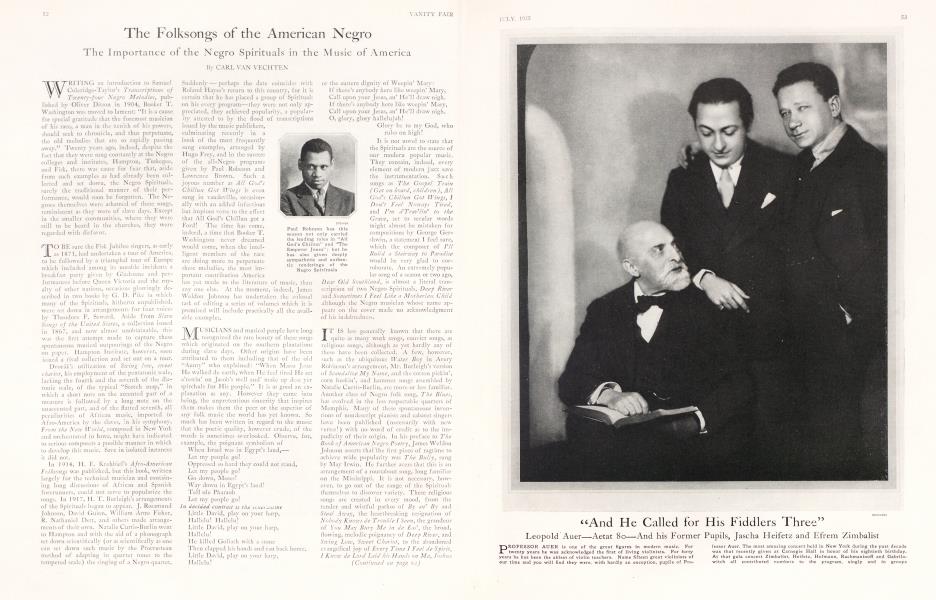
Sign In Not a Subscriber?Join NowThe Folksongs of the American Negro
The Importance of the Negro Spirituals in the Music of America
CARL VAN VECHTEN
WRITING an introduction to Samuel Coleridge-Taylor's Transcriptions of Twenty-four Negro Melodies, published by Oliver Ditson in 1904, Booker T. Washington was moved to lament: "It is a cause for special gratitude that the foremost musician of his race, a man in the zenith of his powers, should seek to chronicle, and thus perpetuate, the old melodies that arc so rapidly passing away." Twenty years ago, indeed, despite the fact that they were sung constantly at the Negro colleges and institutes, Hampton, Tuskegee, and Fisk, there was cause for fear that, aside from such examples as had already been collected and set down, the Negro Spirituals, surely the traditional manner of their performance, would soon be forgotten. The Negroes themselves were ashamed of these songs, reminiscent as they were of slave days. Except in the smaller communities, where they were still to be heard in the churches, they were regarded with disfavor.
TO BE sure the Fisk Jubilee singers, as early as 1871, had undertaken a tour of America, to be followed by a triumphal tour of Europe which included among its notable incidents a breakfast party given by Gladstone and performances before Queen Victoria and the royalty of other nations, occasions glowingly described in two books by G. D. Pike in which many of the Spirituals, hitherto unpublished, were set down in arrangements for four voices by Theodore F. Seward. Aside from Slave Songs of the United States, a collection issued in 1867, and now almost unobtainable, this was the first attempt made to capture these spontaneous musical outpourings of the Negro on paper. Hampton Institute, however, soon issued a rival collection and set out on a tour.
Dvorak's utilization of Swing low, sweet chariot, his employment of the pentatonic scale, lacking the fourth and the seventh of the diatonic scale, of the typical "Scotch snap, in which a short note on the accented part of a measure is followed by a long note on the unaccented part, and of the flatted seventh, all peculiarities of Airican music, imported to Afro-America by the slaves, in his symphony, From the New World, composed in New York and orchestrated in Iowa, might have indicated to serious composers a possible manner in which to develop this music. Save in isolated instances it did not.
In 1914, H. E. Krehbicl's Afro-American Folksongs was published, but this book, written largely for the technical musician and containing long discussions of African and Spanish forerunners, could not serve to popularize the songs. In 1917, H. T. Burleigh's arrangements of the Spirituals began to appear. J. Rosamund Johnson, David Guion, William Arms Fisher, R. Nathaniel Dett, and others made arrangements of their own. Natalie Curtis-Burlin went to Hampton and with the aid of a phonograph set down scientifically (or as scientifically as one can set down such music by the Procrustean method of adapting its quarter tones to the tempered scale) the singing of a Negro quartet. Suddenly — perhaps the date coincides with Roland Hayes's return to this country, for it is certain that he has placed a group of Spirituals on his every program—they were not only appreciated, they achieved popularity, a popularity attested to by the flood of transcriptions issued by the music publishers, culminating recently in a book of the most frequently sung examples, arranged by Hugo Frey, and in the success of the all-Negro programs given by Paul Robeson and Lawrence Brown. Such a joyous number as All God's Chillun Got Wings is even sung in vaudeville, occasionally with an added infectious but impious verse to the effect that All God's Chillun got a Ford! The time has come, indeed, a time that Booker T. Washington never dreamed would come, when the intelligent members of the race are doing more to perpetuate these melodics, the most important contribution America has yet made to the literature of music, than any one else. At the moment, indeed, James Weldon Johnson has undertaken the colossal task of editing a series of volumes which it is promised will include practically all the available examples.
MUSICIANS and musical people have long recognized the rare beauty of these songs which originated on the southern plantations during slave days. Other origins have been attributed to them including that of the old "Aunty" who explained: "When Massa Jesus He walked de earth, when He feel tired He set a'restin' on Jacob's well and' make up dese yer spirchuls for His people." It is as good an explanation as any. However they came into being, the unpretentious sincerity that inspires them makes them the peer or the superior of any folk music the world has yet known. So much has been written in regard to the music that the poetic quality, however crude, of the words is sometimes overlooked. Observe, for, example, the poignant symbolism of When Israel was in Egypt's land,—
Let my people go!
Oppressed so hard they could not stand,
Let my people go!
Go down, Moses!
Way down in Egypt's land!
Tell ole Pharaoh
Let my people go!
In decided contrast is the senerzouke Little David, play on your harp,
Hallclu! Hallelu!
Little David, plav on vour harp,
Hallclu!
He killed Goliath with a stone
Then clapped his hands and ran back home.
Little David, plav on vour harp,
Hallelu!
or the austere dignity of Wecpin' Mary:
If there's anybody here like weepin' Mary,
Call upon your Jesus, an' He'll draw nigh.
If there's anybody here like wecpin' Mary,
Call upon your Jesus, an' He'll draw nigh.
O, glory, glory hallelujah!
Glory be to my God, who rules on high!
It is not novel to state that the Spirituals are the source of our modern popular music. They contain, indeed, every element of modern jazz save the instrumentation. Such songs as The Gospel Train (Get on board, children), All God's Chillun Got Wings, I Don't Feel Noways Tired, and I'm a'Trav'lin' to the Grave, set to secular words might almost be mistaken for compositions by George Gershwin, a statement I feel sure, which the composer of I'll Build a Stairway to Paradise would be very glad to corroborate. An extremely popular song of a season or two ago, Dear Old Southland, is almost a literal transcription of two Negro Spirituals, Deep River and Sometimes I Feel Like a Motherless Child although the Negro musician whose name appears on the cover made no acknowledgment of his indebtedness.
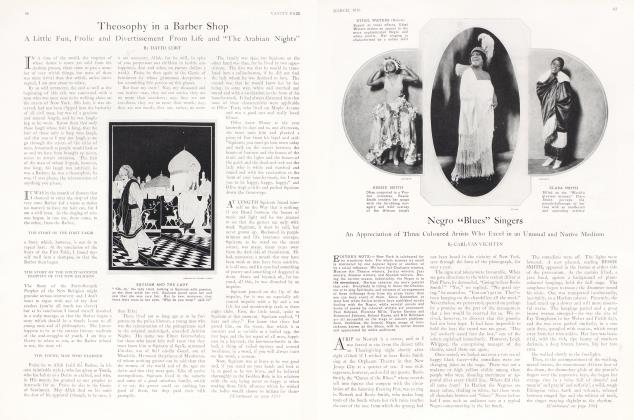
IT IS less generally known that there are quite as many work songs, convict songs, as religious songs, although as yet hardly any of these have been collected. A few, however, such as the ubiquitous Water Boy in Avery Robinson's arrangement, Mr. Burleigh's version of Scandalize My Name, and the cotton pickin', corn huskin', and hammer songs assembled by Natalie Curtis-Burlin, are more or less familiar. Another class of Negro folk song, The Blues, has evolved in the less respectable quarters of Memphis. Many of these spontaneous inventions of nondescript pianists and cabaret singers have been published (necessarily with new verses!) with no word of credit as to the impudicity of their origin. In his preface to The Book of American Negro Poetry, James Weldon Johnson asserts that the first piece of ragtime to achieve wide popularity was The Bully, sung by May Irwin. He further avers that this is an arrangement of a roustabout song, long familiar on the Mississippi. It is not necessary, however, to go out of the range of the Spirituals themselves to discover variety. These religious songs are created in every mood, from the tender and wistful pathos of By an' By and Steal Away, the heartbreaking resignation of Nobody Knows de Trouble I Seen, the grandeur of You May Bury Me in de Eas', the broad, flowing, melodic poignancy of Deep River, and Swing Low', Sweet Chariot, to the abandoned evangelical joy of Every Time I Feel de Spirit, I Know de Lord Laid his Hands on Me, Joshua Fit de Rattle ob Jericho, and I'll be a Witness for My Lord.
(Continued on page 92)
(Continued from page 52)
Negro folksongs differ from the folksongs of most other races through the fact that they are swung in harmony, and as Negroes harmonize instinctively, each performance differs in some particular from every other performance, although the melody retains its general integrity. It is the custom, indeed, for Negro singers in choruses to sing tenor or bass at will, according to their mood. It is, therefore, not a work of supererogation to harmonize these songs for piano and voice, as the piano, to a certain extent, fills in the harmony properly supplied by the other singers, although, as its scale lacks quarter tones, occasionally a flat seventh is substituted for the more esoteric note.
The progress of these Spirituals into the repertory of most public singers is due, perhaps, more than to any other one man, to the indefatigable efforts of H. T. Burleigh. For nearly a decade, Mr. Burleigh, who is still occupied with the task, has been issuing his concert arrangements of these masterpieces of homely music. Nevertheless, I cannot look upon all of Mr. Burleigh's arrangements with favor, principally because they have been instrumental in bringing these songs to the attention of white singers and I do not think white singers can sing Spirituals. Women, with few exceptions, should not attempt to sing them at all. White singers have been attracted to Mr. Burleigh's arrangements, because they include many of the "tricks" which make any song successful, while the accompaniments are often highly sophisticated. This is not true of all of Mr. Burleigh's arrangements and I think it may safely be stated that it is only true of any of them insofar as he failed to express the real love for this music that he indubitably feels.
In his foreword to his transcriptions, however, Mr. Burleigh has warned performers against making an attempt "to imitate the manner of the Negro in singing them, by swaying the body, clapping the hands, or striving to make the peculiar inflections of voice that are natural with the colored people." As a piece of advice directed to white singers this may be all very well, but I have already stated my conviction that white singers had better leave them alone. The trouble with this advice is that it is being heeded by too many colored singers, who not only avoid the natural Negro inflections, but are inclined to avoid the dialect as well. That is the reason that many people will prefer the traditional, evangelical renderings of Paul Robeson, to the more refined performances of Roland Hayes. It is to be remembered that when Caruso sang Neapolitan folksongs he sang them in dialect, as much as possible in the manner of the authentic interpretation. The fact that the Spirituals are religious in their nature does not alter my point of view. I am merely arguing for a maintenance of the original manner in which they were sung.
To date, too many of the concert arrangements—and I do not refer alone to Mr. Burleigh's—have apparently been made from the fourpart versions to be found in the Fisk and Hampton collections. What is needed at present is more original research. A trained Negro musician— to no other than a Negro would the material be available—should scour the South, not only for new songs, but to make accurate records of harmonized performances of the old ones before it is too late. Any such seeker, it is evident, will find a mine of hitherto unearthed material in the work and convict songs, and in the underworld of the Southern cities.
Subscribers have complete access to the archive.
Sign In Not a Subscriber?Join Now
