Sign In to Your Account
Subscribers have complete access to the archive.
Sign In Not a Subscriber?Join NowA Republic in False-Face
Republican Germany Is Precipitating Itself Anew into the Disaster of Monarchism
MAXIMILIAN HARDEN
IN 1806 Prussia was humbled in the dust by Napoleon. Stung by the defeat, a new Germany carried its standards to victory in 1813 and in 1814, on the field of Waterloo, in 1815, and, finally to an extraordinary triumph in the Franco-Prussian War in 1870. Even during the World War, the early chapters were a record of victories that were acclaimed in every city and village of the Fatherland.
How, then, could such military prestige, backed by such great courage and devotion, suddenly meet with the most crushing military defeat in history? The disaster was incomprehensible, not merely to the deluded masses in Germany, but also to the inner circle: the official and military classes; even to the supreme army command itself; for everybody in Germany had somehow come to believe in the delusions and lies of the moment. And then, suddenly, they stood dismayed in the graveyard of their history as a dominant nation in the world's affairs.
THE FIRST REACTION
THEN the Junker von Hcydebrand, most Prussian of the Prussians, suddenly broke through the discipline of office and, in the first panic, cried aloud, for all men to hear, "We have been lied to and betrayed!" In Munich the writer of the present article heard almost the identical words from the mouth of an officer belonging to the nobility and holding one of the most important posts in the Bavarian Ministry of War. This was the general reaction. No one had a good word to say for the princes of Germany—from the greatest down to the least—who had succeeded in saving their own skins and sheltering their own sons, while the nation at large had suffered every calamity of starvation, wounds, and death. No one raised his voice in defense of the Emperor and the Crown Prince, both of whom had by that time lied to Holland. The thrones of the reigning houses of Germany toppled as if their supports had been secretly sawed away by demons working in the earth. This was the mood of the first hour of terror.
But soon business awakened from its lethargy and the utilitarian optimism of a commercial and acquisitive civilization yawned and stretched, and rubbed its eyes. After all, was this complete capitulation to Fate necessary? Why admit that the nation had been lied to and betrayed, the prestige of the German ruling houses destroyed, and their administrative achievements proved worthless? Of course, no one could hope, for decades to come, to sec the old order return in its "undisciplined impudence of dynasty," and with its old hierarchy of caste. But a new set of dogmas was speedily concocted and a new plan of action mapped out. Its propaganda ran about as follows: Germany was completely guiltless of a war fought by her in self-defense. She had fought a victorious fight, but was robbed of complete and final triumph by a thrust in the back from Jews, Socialists, aliens, and other stay-at-homes and traitors, who were betrayed by the glitter of Wilson's fourteen points into making a treacherous Carthaginian peace. Neither Germany's princes nor officials nor generals were ever in the wrong. Their honor was as unsmirched as that of Lohengrin when he first stepped out of the barge conveyed by the swan.
If this balderdash could only get itself accepted, the road would eventually be cleared for a new nationalistic and monarchistic regime.
That it was believed can be explained only by the peculiar credulity of the German masses, who during the four years of the war had allowed themselves to be fed on the most impossible fables, and had remained in complete ignorance of every detail, from the first disaster of the Marne to the growing war strength of America, cherishing their fatuous certainty of victory until the very last second.
POST-WAR PROPAGANDA
THE most important bit of propaganda, and that most frequently employed, was the yarn about America's falling out of step with the Allies. This story was cleverly exploited by the Nationalists. "The greatest world power," so they said, "has turned with disgust from the dastardly Treaty of Versailles. She has unmasked the pretensions of the Allies, especially France, and has transferred her sympathy to us." Finally Von Hindenburg made a public statement to the effect that he had learned from many correspondents in the United States that America regretted deeply having been lured into the war against Germany, which country she now realized had been not only entirely guiltless, but also the most able of the warring nations.
Such dangerous rumors gained credence the more easily, as Lloyd George, appalled by the growing menace of France on the continent, suddenly turned against his former ally (No one paid any attention to the fact that, at the time, Lloyd George was a political bankrupt and could not in any sense be identified with the British Empire). Then the slogan was, "Russia, America, England, have broken away from the alliance!" After a while it ran, "The whole world, with the exception of France and her satellites, is now convinced of the righteousness of our cause." Other influences contributed to the growing strength of the Nationalists; fear of the Bolsheviki, who had tried to establish themselves in Berlin and in Munich; then the fact that in Moscow, Turkey, Hungary, Italy, Bulgaria, and Spain, flourishing dictatorships had been established seemed to cast an imputation of weakness on democracy as a whole and to prove that it was nothing but a will o' the wisp to lead a disappointed people into the bog. Added to this, the first Republican government was feeble and blundering. Corruption was widespread. Above all, the legend of world domination was still rife.
THE MONARCHIST LEANING
THE aging and the old prefer any kind of old régime, simply because it is old and because they were young under it, too young to remember its failings—"the good old times," are they not a thousand times better than any kind of today, no matter how prettily the present may be furbished and embellished? Furthermore, to mobilize the men of the older generation for nationalism and monarchy was bound to be far from difficult, since, under the new regime, they had really lost all the luxuries of life and existed in many cases in dire need. Social rank, privilege, power, fortune, they had lost them all. It is clear enough that a man who has been accustomed to being respectfully saluted as Colonel, who has ruled with all but unlimited power over three thousand men, who has had two orderlies, two service horses, and a bright-colored coat with gold braid and various decorations, and who now plods up and down the street on foot, wears a twice-turned tweed suit, and earns a paltry commission by selling insurance, will not hesitate to proclaim that the new republic, any republic, in fact, is an accursed institution, that the statesmen who arc responsible for it arc a band of thieves, and that only a speedy return to a military monarchy can restore peace and prosperity to the nation.
And it must be remembered that multitudes of officials and military leaders were thus stripped, and plunged, almost overnight, into the humdrum existence of the proletarian.
GERMAN YOUTH TODAY
TO WIN the youth of the land was far more difficult. It was to be expected that the young, as a natural protest to the nationalistic megalomania, with its train of misery and selfdeception, should have framed for themselves some sort of humane and international ideals of world politics. As a matter of fact, the son of many a conservative and pious parson became a veritable stormy petrel of the revolution, while the son of many a hard-headed atheist plunged into the depths of mysticism. The German youth of today shows in many ways a noble seriousness and a fine zeal. In some districts, particularly the Catholic ones, the widespread "youth" movement has brought about a renaissance of humanism and internationalism. Nevertheless, by an overwhelming majority, the younger generation is anti-republican and antidemocratic. Not to have made the Kaiser eat the broth which he started to brew and sign a humiliating treaty before his abdication, has proved to be an irretrievable and costly error; for, to German youths, the Kaiser has become a veritable symbol of the "victorious maintenance of German thought against a world of enemies"—whereas, in reality, he is merely the svinbol of the unforgivable wasting of what was best in German life and thought and tradition. Since every parson, teacher, and professor is a staunch nationalist, and since most of them distinguished themselves during the war by evolving the intellectual sophistries which were calculated to arouse enthusiasm for the Hohenzollern regime, it has been comparatively easy for them to lure youths onto the side of the nationalists, with their poisoned baits of casuistry.
THE BENT TWIG
DAY after day, the rising generation has heard in churches, in schools, and from their parents' lips that they had been so wisely ruled by the Hohenzollerns that the entire world had enviously risen to destroy them.
The student was taught that not until the Hohenzollerns came from Frankenland, from their castle and country of Nuremberg, was the foundation laid for the power and prestige of, first, the Kingdom of Prussia and finally of the united German Kmpire. The strong army, the clean-cut, strict administration, the inflexible objective adjustment of every legal difference, the flourishing economic state, the social reforms, from the creation and maintenance of hospitals and orphan asylums to the insurance of workers against old age, accident and sickness, all these things, together with the furthering of art and science, were the achievements of the Hohenzollerns and for these the nation owed them unlimited gratitude.
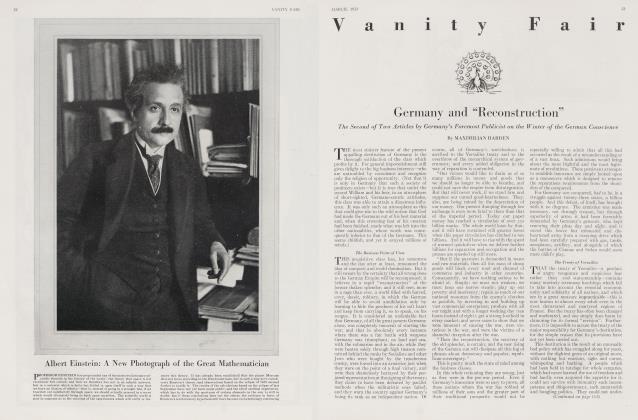
The duty of the young was to prepare themselves to reinstate this noble dynasty and, with it, restore to the Fatherland its former power and prestige. They must begin by crushing all profiteers, pacifists, internationalists, and revolutionists. Since Jews are usually internationalists, naturally the muddy stream of anti-Semitism swelled the popular current. The Jewish problem in Germany is quite different from that in other countries. The Jewish population of Germany does not amount to even one per cent of the whole, and is altogether out of proportion to the number of Jews dominating finance, the press, commerce, the bar, science (particularly medicine), the theatre, the moving picture, and other branches of industry and art. In the new Germany, it happens that certain Jews arc the most notable personalities. Such men as Professor Ehrlich (Salvarsan—"606"), Haber (artificial fertilizer and poison gas), Einstein (relativity), Borchardt (the surgeon who was called by Lenin and who saved the present writer's life by an operation on the head after an attempted assassination), Washerman (syphilis tests), Gundolf (the historian of world literature), Bonn (sociologist; adjutant of Count Yon Bcrnstorff in Washington), Rathenau (General Electric Company), Fuerstenberg (Commerce Corporation of Berlin), Ballin (Hamburg American Line), the bankers Warburg, Schwabach, Salomonsohn (Disconto Company), Liebcrmann (painter), Reinhardt (unparalleled genius of the theatre), Lubitsch (film director), the socialist leaders Eisner, Hauser, Levine, Muehsam, Toller; and that almost genial rebel, Rosa Luxemburg, are only a few among the best known of them. Through the stupidity of the Simili revolution, a great many important posts were filled with Jews who were not particularly brilliant or accomplished; so that a springtide of anti-Semitism resulted which overflowed all barriers of decency and stirred up a mad and murderous hatred.
So it came about, from these various causes, that the young men of Germany permitted themselves to be secretly trained by military officers of the old regime. Any number of "Vaterlaendische Verbande" (patriotic societies) were formed. Their names were mostly borrowed from Germany's romantic age, they were called the Siegfried, the Roland, the Yiking, the Wotan, the Steel Helmet, and so forth. Their aim—the purification of Germany in preparation for a nationalistic and monarchists revival. Their methods were largely the ignoble ones of expediency. They showed but little willingness to undergo again the sacrifices which had proved so futile during the war.
The republic failed utterly to oppose this movement. It took no stand, it did nothing to point out the monstrous mistakes of Kaiserism and to show up the Hohenzollerns in their true light (although the much-referred to "family morals" would provide ample material for an essay on decay). It did-not give birth to a single new thought; it did not proclaim a single new ideal. It did not awaken enthusiasm anywhere. It contented itself with whining about the cruelty of the enemy and urged obedience to "law and order" without stopping to consider that for wailing and exhorting, a military monarchy is far more effective than a republic.
Meanwhile, the Emperor leads the comfortable life of a country gentleman in Holland and receives constant tributes of esteem from the Fatherland. The Crown Prince has been allowed to return. Wherever he exhibits himself in public, he is loudly acclaimed. Anyone who attempts to impugn Kaiserism is boycotted by the press. Should anyone venture to talk against it in parliament, he would be drowned out. And the man who was Field Marshal of the Imperial Army is now President of the German Republic.
There is not the slightest probability that the Workers, in spite of their socialistic leanings, will put up any strong fight against the restoration of the monarchy, for they have been deceived by their leaders; and the republic has proved a bitter disillusionment. And the standing army of the republic is officered by men of the old regime,—the burglar in the role of policeman.
THE POSSIBILITIES
THE situation as it stands, then, is this: Germany has a republic in name only, completely under the domination of the old, nationalistic and monarchistic party. To Field Marshal von Hindenburg, president of the so-called republic, they look to lift the splendor of the German Empire out of the mud. If this old militarist, bowed down to as if he were a graven image, should be unable to work the miracle expected of him, what would happen? An attempt to restore the Hohenzollerns, in the teeth of the opposition of the Allies? Hardly likely. A proletarian revolution? The German temperament is fundamentally too conservative for that. The only real remedy, of course, would be a right-about-face, a renunciation of the old disastrous militarist conceptions of the function of the state in general, and the German state in particular, and an honest trial of a true, not a sham, republic, a republic which will realize that the days of war and aggression arc over. The German naturally loves constructive work. The only struggle today that will yield him great and certain returns is the struggle to bring about as quickly as possible a democratic united states of Germany.
Subscribers have complete access to the archive.
Sign In Not a Subscriber?Join Now
