Sign In to Your Account
Subscribers have complete access to the archive.
Sign In Not a Subscriber?Join NowThe Developing Art
The Sad State of American Films—With a Note on "Variety" and the Censors
DONALD FREEMAN
THE battle for, or against, the motion picture is endless. Since that baffling device, the motion camera, was first dedicated to the pictorial regurgitation of fiction, charges of imbecility have been hurled against the craftsmen of the new industry in America. The critics of motion pictures (not the goodly film reviewers who, with a fewcommendable exceptions, are subsidized pressagents or mental defectives) perennially allege that American motion pictures have sunk to an aesthetic level so low as actually to threaten the public taste of the nation; that, inasmuch as the foreign markets are flooded with miles of our celluloid bilge, we, as a people, are made ridiculous in the eyes of other races. The producers, of course, make a gallant defense, recalling a first principle of economics, the Law of Supply and Demand. Having supplied a digestible quota of seduced (but later regenerate) heroines, murder mysteries, and rhapsodies on maternal devotion without visible protest, the producers consider (as who would not?) that they have satisfied both the greater public and the stockholders and they accordingly plan for the future on the optimistic theory that the present formula is good for another year.
IT is, despite these noble protestations, impossible for the film-makers to evade the responsibility. After all, the banalities which are distributed into a year's output, emanate from their own studios, under an elaborate monogram, supposed, I take it, to attest to the firm's approval. And it is certainly true that, in foreign countries, America is regarded by the film-going public as a startling but thoroughly impossible nation. In England, the curious manners of our film-folk are looked upon as an index to our national taste. There, the narrow escapes from disaster and the extravagant rescues of American heroines are regarded tolerantly, while the pathetic attempts, in our so-called "society pictures", to portray snobbishness evoke a ripple of derision bordering on contempt. In Vienna, which gorgeous city is the receptacle of all the bad films which are frankly unsaleable elsewhere, there is even an expression' deriving from the films "in the American manner" to describe dramatic insanities of various sorts. Thus, in the Viennese journals, the phrase is used to report any stupendous and highly improbable occurrence,—i.s., a triple suicide.
The distribution of American films in foreign countries is so very well organized that unfavourable reactions to them become really dangerous. In Hollywood, the one thought is to meet the demands of a domestic market. That done, the far-reaching effect of a falsely psychologized extract from American life is never considered. French films, for instance, are so incompetently devised, and so infantile in every respect, that few of them ever reach an American screen,—fortunately for France. If we, as a people, were provided with a steady diet of photoplays of French manufacture, it is much to be feared that our opinion of that eminent nation would suffer a severe decline. English films are little better, and I have seen—one might believe representative— motion pictures in Russia brimful of tortures and excruciating human torments such as would make Torqueinada seem a novice. In almost every country, sporadic attempts have been made to compete with American film-producers with the most abortive results imaginable. Seldom do such efforts transcend the borders of the country of origin, and, in the majority of instances, result cither in a small gain or a financial loss. America's position is so formidable, so unapproachable, in the world's motion picture market, that it well behooves our film entrepreneurs to take steps to correct the erroneous impressions of American life which they have been instrumental in fostering.
Of no consequence, you say!
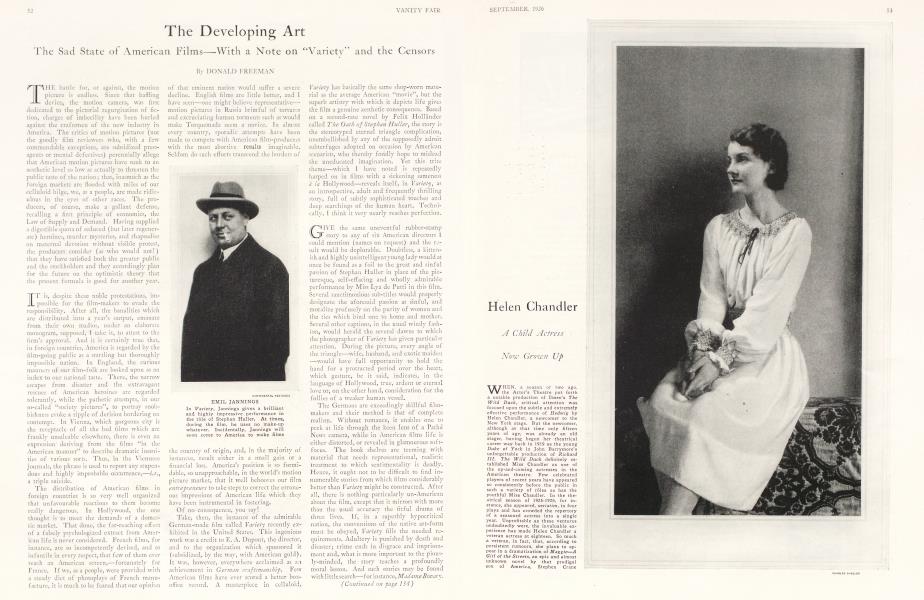
Take, then, the instance of the admirable German-made film called Variety recently exhibited in the United States. This ingenious work was a credit to E. A. Dupont, the director, and to the organization which sponsored it (subsidized, by the way, with American gold). It was, however, everywhere acclaimed as an achievement in German craftsmanship. Few American films have ever scored a better boxoffice record. A masterpiece in celluloid, Variety has basically the same shop-worn material as the average American "movie", but the superb artistry with which it depicts life gives the film a genuine aesthetic consequence. Based on a second-rate novel by Felix Hollander called The Oath of Stepha?i Huller, the story is the stereotyped eternal triangle complication, unembcllishcd by any of the supposedly adroit subterfuges adopted on occasion by American scenarists, who thereby fondly hope to mislead the uneducated imagination. Yet this trite theme—which I have noted is repeatedly harped on in films with a sickening sameness a la Hollywood—reveals itself, in Variety, as an introspective, adult and frequently thrilling story, full of subtly sophisticated touches and deep searchings of the human heart. Technically, I think it very nearly reaches perfection.
GIVE the same uneventful rubber-stamp story to any of six American directors i could mention (names on request) and the result would be deplorable. Doubtless, a kittenish and highly unintelligentyoung lady would at once be found as a foil to the great and sinful passion of Stephan Huller in place of the picturesque, self-effacing and wholly admirable performance by Miss Lya de Putti in this film. Several sanctimonious sub-titles would properly designate the aforesaid passion as sinful, and moralize profusely on the purity of women and the ties which bind one to home and mother. Several other captions, in the usual windy fashion, would herald the several dawns to which the photographer of Variety has given particu'nr attention. During the picture, every angle of the triangle—wife, husband, and exotic maiden —would have full opportunity to hold the hand for a protracted period over the heart, which gesture, be it said, indicates, in the language of Hollywood, true, ardent or eternal love or, on the other hand, consideration for the follies of a weaker human vessel.
The Germans arc exceedingly skillful filmmakers and their method is that of complete realism. Without romance, it enables one to peek at life through the keen lens of a Pathe News camera, while in American films life is cither distorted, or revealed in glamourous softfocus. The book shelves are teeming with material that needs representational, realistic treatment to which sentimentality is deadly. Hence, it ought not to be difficult to find innumerable stories from which films considerably better than Variety might be constructed. After all, there is nothing particularly un-American about the film, except that it mirrors with more than the usual accuracy the fitful drama of three lives. If, in a superbly hypocritical nation, the conventions of the native art-form must be obeyed, Variety fills the needed requirements. Adultery is punished by death and disaster; crime ends in disgrace and imprisonment and, what is more important to the piously-minded, the story teaches a profoundly moral lesson. And such stories may be found with little search—for instance, Madame Bovary.
(Continued on page 134)
(Continued from page 52)
If not exactly what the public wants, Variety is what the public will accept. It establishes a standard in filmmaking from which the American producers, if so minded, could begin in a direction which would eventually provide the public with less sentimental and, pray God, slightly more intelligent pictures. Devotees of the films claim that such a program is impossible, because "the censors are against it". That is, the censors (I surmise the efficacious Mr. Hays is unofficially included in this category) are presumed to exercise such control over the manufacture of American films as to enable them almost to dictate a producing program. Any proposed film, the script of which hinted that an unmarried mother might possibly enjoy her condition, or that tended to expose the fact that in most films the villain is a well-bred gentleman, and the hero an over-dressed imbecile, would be held detrimental to public morals, regardless of artistic intent. This is more than idle rumour, for only recently I came across a ukase out of the archives of a large producing organization apparently originating with the censors, which makes it fairly obvious that American films are hung first and tried afterwards. This elaborate edict decrees that no films are to be made which reveal "gambling scenes, especially showing money", and it is forbidden for one gentleman to hit another over the head "with a blunt instrument"—presumably a piece of lead pipe—in front of the camera, at any rate. Held, also, as "tending to corrupt morals", and hence to be eliminated is any scene showing "locking the door of a room with criminal intent when man and woman are in the room", while night-dresses (not pyjamas) are claimed unduly to expose the body, hence, indecent.
I cannot subscribe to the opinion that such restrictions as these, however childish, seriously threaten the progress of the art of the motion picture and prevent the faithful transfer of a work of literature to the screen. It would, perhaps, be wiser for our moral advisors to see a film first, and then to suggest the removal of any night-dresses that chanced to be unduly provocative. It might be a help in vindicating the now negligible reputation of the motion picture as it is evolved in America.
Subscribers have complete access to the archive.
Sign In Not a Subscriber?Join Now
