Sign In to Your Account
Subscribers have complete access to the archive.
Sign In Not a Subscriber?Join NowNo Disputing About Reasons
Why It Is Absolutely Impossible to Reconcile the Opinions of Mankind
ALDOUS HUXLEY
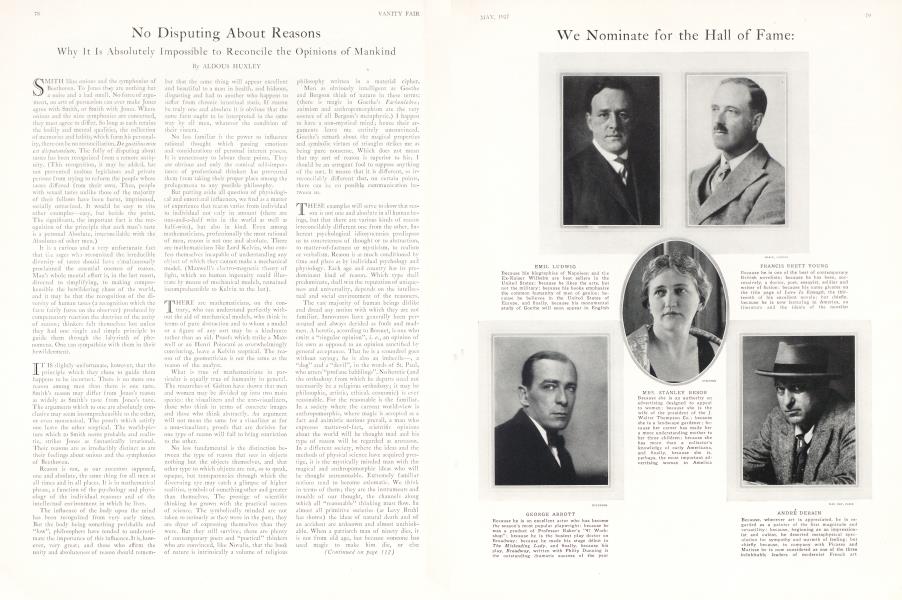
SMITH likes onions and the symphonies of Beethoven. To Jones th«y are nothing but a noise and a bad smell. No force of argument, no arts of persuasion can ever make Jones agree with Smith, or Smith with Jones. Where onions and the nine symphonies arc concerned, they must agree to differ. So long as each retains the bodily and mental qualities, the collection of memories and habits, which form his personality, there can be no reconciliation. De gustibus non est disputandum. The folly of disputing about tastes has been recognized from a remote antiquity. (This recognition, it may be added, has not prevented zealous legislators and private persons from trying to reform the people whose tastes differed from their own. Thus, people with sexual tastes unlike those of the majority of their fellows have been burnt, imprisoned, socially ostracized. It would be easy to cite other examples—easy, but beside the point. The significant, the important fact is the recognition of the principle that each man's taste is a personal Absolute, irreconcilable with the Absolutes of other men.)
It is a curious and a very unfortunate fact that the sages who recognized the irreducible diversity of tastes should have simultaneously proclaimed the essential oneness of reason. Man's whole mental effort is, in the last resort, directed to simplifying, to making comprehensible the bewildering chaos of the world, and it may be that the recognition of the diversity of human tastes (a recognition which the facts fairly force on the observer) produced by compensatory reaction the doctrine of the unity of reason; thinkers felt themselves lost unless they had one single and simple principle to guide them through the labyrinth of phenomena. One can sympathize with them in their bewilderment.
"IT IS slightly unfortunate, however, that the principle which they chose to guide them happens to be incorrect. There is no more one reason among men than there is one taste. Smith's reason may differ from Jones's reason as widely as Smith's taste from Jones's taste. The arguments which to one are absolutely conclusive may seem incomprehensible to the other, or even nonsensical. The proofs which satisfy one leave the other sceptical. The world-picture which to Smith seems probable and realistic, strikes Jones as fantastically irrational. Their reasons are as irreducibly distinct as are their feelings about onions and the symphonies of Beethoven.
Reason is not, as our ancestors supposed, one and absolute, the same thing for all men at all times and in all places. It is in mathematical phrase, a function of the psychology and physiology of the individual reasoner and of the intellectual environment in which he lives.
The influence of the body upon the mind has been recognized from very early times. But the body being something perishable and "low", philosophers have tended to underestimate the importance of this influence. It is, however, very great; and those who affirm the unity and absoluteness of reason should remember that the same thing will appear excellent and beautiful to a man in health, and hideous, disgusting and bad to another who happens to suffer from chronic intestinal stasis. If reason be truly one and absolute it is obvious that the same facts ought to be interpreted in the same way by all men, whatever the condition of their viscera.
No less familiar is the power to influence rational thought which passing emotions and considerations of personal interest possess. It is unnecessary to labour these points. They are obvious and only the comical self-importance of professional thinkers has prevented them from taking their proper place among the prolegomena to any possible philosophy.
But putting aside all question of physiological and emotional influences, we find as a matter of experience that reason varies from individual to individual not only in amount (there are one-and-a-half wits in the world as well as half-wits), but also in kind. Even among mathematicians, professionally the most rational of men, reason is not one and absolute. There are mathematicians like Lord Kelvin, who confess themselves incapable of understanding any object of which they cannot make a mechanical model. (Maxwell's electro-magnetic theory of light, which no human ingenuity could illustrate by means of mechanical models, remained incomprehensible to Kelvin to the last).
THERE are mathematicians, on the contrary, who can understand perfectly without the aid of mechanical models, who think in terms of pure abstraction and to whom a model or a figure of any sort may be a hindrance rather than an aid. Proofs which strike a Maxwell or an Henri Poincaré as overwhelmingly convincing, leave a Kelvin sceptical. The reason of the geometrician is not the same as the reason of the analyst.
What is true of mathematicians in particular is equally true of humanity in general. The researches of Galton have shown that men and women may be divided up into two main species: the visualizers and the non-visualizers, those who think in terms of concrete images and those who think abstractly. An argument will not mean the same for a visualizer as for a non-visual izer; proofs that arc decisive for one type of reason will fail to bring conviction to the other.
No less fundamental is the distinction between the type of reason that sees in objects nothing but the objects themselves, and that other type to which objects are not, so to speak, opaque, but transparencies through which the discerning eye may catch a glimpse of higher realities, symbols of something other and greater than themselves. The prestige of scientific thinking has grown with the practical success of science. The symbolically minded are not taken so seriously as they were in the past; they are shyer of expressing themselves than they were. But they still survive; there arc plenty of contemporary poets and "poetical" thinkers who arc convinced, like Novalis, that the book of nature is intrinsically a volume of religious philosophy written in a material cipher.
Men as obviously intelligent as Goethe and Bergson think of nature in these terms: (there is magic in Goethe's Farbenlehre; animism and anthropomorphism are the very essence of all Bergson's metaphysic.) I happen to have a non-mystical mind; hence their arguments leave me entirely unconvinced. Goethe's remark about the magical properties and symbolic virtues of triangles strikes me as being pure nonsense. Which docs not mean that my sort of reason is superior to his; I should be an arrogant fool to suppose anything of the sort. It means that it is different, so irreconcilably different that, on certain points, there can be no possible communication between us.
THESE examples will serve to show that reason is not one and absolute in all human beings, but that there arc various kinds of reason irreconcilably different one from the other. Inherent psychological idiosyncrasies predispose us to concreteness of thought or to abstraction, to matter-of-factness or mysticism, to realism or verbalism. Reason is as much conditioned by time and place as by individual psychology and physiology. Each age and country has its predominant kind of reason. Which type shall predominate, shall win the reputation of uniqueness and universality, depends on the intellectual and social environment of the reasoners.
The vast majority of human beings dislike and dread any notion with which they arc not familiar. Innovators have generally been persecuted and always derided as fools and madmen. A heretic, according to Bossuet, is one who emits a "singular opinion", i. e., an opinion of his own as opposed to an opinion sanctified by general acceptance. That he is a scoundrel goes without saying; he is also an imbecile—, a "dog" and a "devil", in the words of St. Paul, who utters'"profanc babblings". No heretic (and the orthodoxy from which he departs need not necessarily be a religious orthodoxy; it may be philosophic, artistic, ethical, economic) is ever reasonable. For the reasonable is the familiar. In a society where the current world-view is anthropomorphic, where magic is accepted as a fact and animistic notions prevail, a man who expresses matter-of-fact, scientific opinions about the world will be thought mad and his type of reason will be regarded as unreason. In a different society, where the ideas and the methods of physical science have acquired prestige, it is the mystically minded man with the magical and anthropomorphic ideas who will be thought unreasonable. Extremely familiar notions tend to become axiomatic. We think in terms of them; they are the instruments and moulds of our thought, the channels along which all "reasonable" thinking must flow. In almost all primitive societies (as Levy Bruhl has shown) the ideas of natural death and of an accident arc unknown and almost unthinkable. When a patriarch man of ninety dies, it is not from old age, but because someone has used magic to make him die, or else desired that he should die or else because the man himself has done something unlucky or failed to do something lucky. Similarly, if a child falls into a pond and is drowned, the event is in no circumstances accidental ; it has been willed, perhaps by a human being, perhaps by a spirit. The death is always a murder. To people among whom such notions are axiomatic, are what the old-fashioned rationalists and logicians would call "necessities of thought" our western ideas of accident and death from natural, impersonal causes seem crazy and utterly unreasonable. And let it be noted that there is no possible method of proving that we are right and the savages wrong. If we do not believe in magic and the action of invisible beings, is it because we have devised other hypotheses to account for the phenomena of nature which seem simpler and which are to a great extent susceptible of quantitative expression and of experimental test. The action of magic cannot be expressed mathematically; spirits cannot be isolated by chemical analysis; but that is no proof that they do not exist. The savage might admit our natural laws, while insisting that we had forgotten to take account of the magic and the devils lurking behind the superficially impersonal phenomena. We reject the devils not because we can demonstrate their non-existence, but because they do not fit in with our contemporary world-view, which seems to us true mainly on pragmatic grounds—because it enables us to control natural forces. Magic and devils offend our sense of probabilities and a certain aesthetic feeling for what is, intellectually, "good form". For most of us the notion of an impersonal nature is a "necessity of thought", is the channel along which all "reasonable" thinking must flow. For most—but by no means for all. For there are as many different species of reason to-day as there ever were. The prestige of matter-of-factness imposes on many who are not by nature matter-of-fact. But there are still plenty of nature's animists and mystics, who have the courage to stand out against the popular and, to them, profoundly unreasonable notions of their matter-of-fact contemporaries.
Continued on Page 112
Continued from Page 78
The way in which familiar and early-acquired notions condition our idea of the reasonable is very clearly shown in the attitude of contemporary Europeans and Americans towards the problems of sociology, ethics, religion and economics. With regard to all that concerns "nature", by which I mean everything in the universe that is not human, our western education is purely matter-of-fact. The Bestiaries of classical and mediaeval times have given place to sober and nonmoral Natural Histories; children are no longer taught that comets portend the death of kings or that thunder is the enraged bellowing of the divinity. We are made familiar with matter-of-fact views about nature from childhood, and only those who are congenitally very mystical ever think of regarding them as unreasonable. But where humanity is concerned education is of an entirely different kind. The child is brought up from the cradle with strange metaphysical entities such as Absolute Good, Absolutely Right Political and Economic Systems, Pure Reason, Natural Rights and many other supernatural monsters of the same kind. He is endowed with an Immortal Soul entirely distinct from his body, he is given a Personal God who, though banished by matter-of-factness from the external world, is still the ruler of that Humanity, which the child is taught to regard as totally distinct from the rest of the universe. The result of these extraordinary teachings is only too painfully apparent to anyone who observes our modern world. Men and women who, when dealing with some portion of inanimate nature—their garden, for example—will behave in a matter-of-fact and scientific way, become entirely different beings where-ever humanity is concerned. As gardeners, they are ready to make experiments, to try new and promising methods, to admit that they may have been wrong in the past and that their procedure in the future might be improved. But in their capacity as citizens, patriots, church-goers, members of a certain economic class, subjects of a certain kind of government they absolutely refuse to make experiments, to try new methods or consider new ideas, to admit that they may have been wrong. Towards nature and towards humanity they employ two quite dissimilar types of reason. They are matter-of-fact towards the first, towards the second they are mystical. This is entirely due to their upbringing. A stock of scientific, matter-offact notions conditions all their thinking about nature. No new idea about nature is regarded as reasonable which does not fit in harmoniously with these familiar and therefore axiomatic, necessary notions. Similarly, no new idea about humanity is regarded as reasonable which does not harmonize with the mystical pre-scientific notions regarding man and society which are drummed into all of us from the earliest years and which have consequently come to seem necessary, innate and beyond all dispute. Modern life is full of the most paradoxical inconsistencies. If a man were to tell us that it was immoral to travel by train, on the ground that trains are not mentioned in the Bible, we should send for the nearest brain specialist. But there are large areas of America where the men who say that it is immoral to believe that human beings evolved from a lower type of animal, on the ground that this theory is not propounded in the Bible, are elected by their fellow citizens to be their rulers and law givers. When the subject at issue is non-human, appeal to the magically authoritative book is now regarded as lunacy. When the subject is man, it is regarded as piety and good citizenship.
Subscribers have complete access to the archive.
Sign In Not a Subscriber?Join Now
