Sign In to Your Account
Subscribers have complete access to the archive.
Sign In Not a Subscriber?Join NowSOME AMERICAN CONTRADICTIONS
ALDOUS HUXLEY
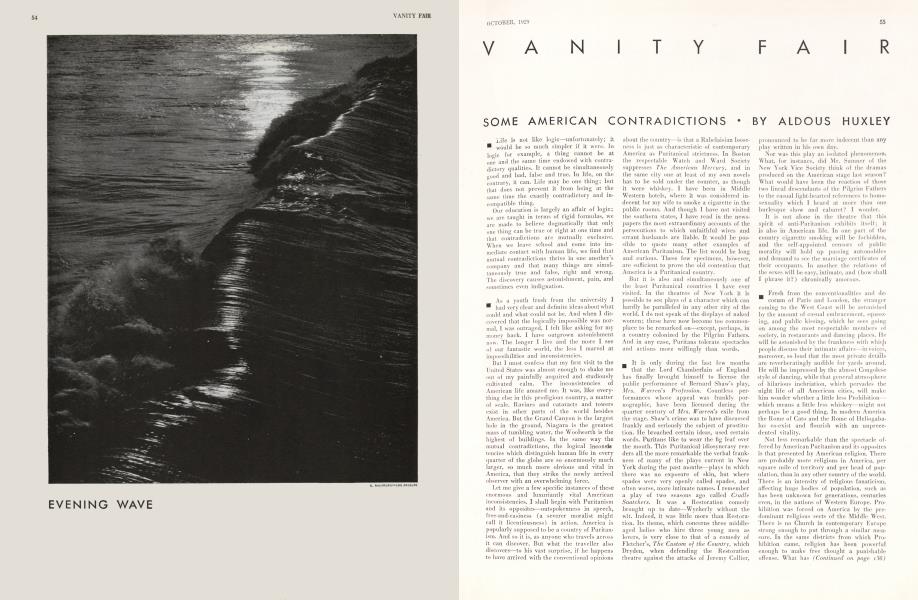
Life is not like logic—unfortunately; it would be so much simpler if it were. In logic for example, a thing cannot be at one and the same time endowed with contradictory qualities. It cannot be simultaneously good and bad, false and true. In life, on the contrary, it can. Life may be one thing; but that does not prevent it from being at the same time the exactly contradictory and incompatible thing.
Our education is largely an affair of logic; we are taught in terms of rigid formulas, we are made to believe dogmatically that only one thing can be true or right at one time and that contradictions are mutually exclusive. When we leave school and come into immediate contact with human life, we find that mutual contradictions thrive in one another's company and that many things are simultaneously true and false, right and wrong. The discovery causes astonishment, pain, and sometimes even indignation.
As a youth fresh from the university I had very clear and definite ideas about what could and what could not be. And when I discovered that the logically impossible was normal, I was outraged, I felt like asking for my money back. I have outgrown astonishment now. The longer I live and the more I see of our fantastic world, the less I marvel at impossibilities and inconsistencies.
But I must confess that my first visit to the United States was almost enough to shake me out of my painfully acquired and studiously cultivated calm. The inconsistencies of American life amazed me. It was, like everything else in this prodigious country, a matter of scale. Ravines and cataracts and towers exist in other parts of the world besides America. But the Grand Canyon is the largest hole in the ground, Niagara is the greatest mass of tumbling water, the Woolworth is the highest of buildings. In the same way the mutual contradictions, the logical inconsra tencies which distinguish human life in every quarter of the globe are so enormously much larger, so much more obvious and vital in America, that they strike the newly arrived observer with an overwhelming force.
Let me give a few specific instances of these enormous and luxuriantly vital American inconsistencies. I shall begin with Puritanism and its opposites—outspokenness in speech, free-and-easiness (a severer moralist might call it licentiousness) in action. America is popularly supposed to be a country of Puritanism. And so it is, as anyone who travels across it can discover. But what the traveller also discovers—to his vast surprise, if he happens to have arrived with the conventional opinions about the country—is that a Rabelaisian looseness is just as characteristic of contemporary America as Puritanical strictness. In Boston the respectable Watch and Ward Society suppresses The American Mercury, and in the same city one at least of my own novels has to be sold under the counter, as though it were whiskey. I have been in Middle Western hotels, where it was considered indecent for my wife to smoke a cigarette in the public rooms. And though I have not visited the southern states, I have read in the newspapers the most extraordinary accounts of the persecutions to which unfaithful wives and errant husbands are liable. It would be possible to quote many other examples of American Puritanism. The list would be long and curious. These few specimens, however, are sufficient to prove the old contention that America is a Puritanical country.
But it is also and simultaneously one of the least Puritanical countries I have ever visited. In the theatres of New York it is possible to see plays of a character which can hardly be paralleled in any other city of the world. I do not speak of the displays of naked women; these have now become too commonplace to be remarked on—except, perhaps, in a country colonized by the Pilgrim Fathers. And in any case, Puritans tolerate spectacles and actions more willingly than words.
It is only during the last few months that the Lord Chamberlain of England has finally brought himself to license the public performance of Bernard Shaw's play, Mrs. Warren's Profession. Countless performances whose appeal was frankly pornographic, have been licensed during the quarter century of Mrs. Warren's exile from the stage. Shaw's crime was to have discussed frankly and seriously the subject of prostitution. He broached certain ideas, used certain words. Puritans like to wear the fig leaf over the mouth. This Puritanical idiosyncrasy renders all the more remarkable the verbal frankness of many of the plays current in New York during the past months—plays in which there was no exposure of skin, but where spades were very openly called spades, and often worse, more intimate names. I remember a play of two seasons ago called Cradle Snatchers. It was a Restoration comedy brought up to date—Wycherly without the wit. Indeed, it was little more than Restoration. Its theme, which concerns three middleaged ladies who hire three young men as lovers, is very close to that of a comedy of Fletcher's, The Custom of the Country, which Dryden, when defending the Restoration theatre against the attacks of Jeremy Collier, pronounced to be far more indecent than any play written in his own day.
Nor was this play an isolated phenomenon. What, for instance, did Mr. Sumner of the New York Vice Society think of the dramas produced on the American stage last season? What would have been the reaction of those two lineal descendants of the Pilgrim Fathers to the casual light-hearted references to homosexuality which I heard at more than one burlesque show and cabaret? I wonder.
It is not alone in the theatre that this spirit of anti-Puritanism exhibits itself; it is also in American life. In one part of the country cigarette smoking will be forbidden, and the self-appointed censors of public morality will hold up passing automobiles and demand to see the marriage certificates of their occupants. In another the relations of the sexes will be easy, intimate, and (how shall I phrase it?) chronically amorous.
Fresh from the conventionalities and decorum of Paris and London, the stranger coming to the West Coast will be astonished by the amount of casual embracement, squeezing, and public kissing, which he sees going on among the most respectable members of society, in restaurants and dancing places. He will be astonished by the frankness with whicfi people discuss their intimate affairs—in voices, moreover, so loud that the most private details are reverberatingly audible for yards around. He will be impressed by the almost Congolese style of dancing, while that general atmosphere of hilarious inebriation, which pervades the night life of all American cities, will make him wonder whether a little less Prohibition— which means a little less whiskey—might not perhaps be a good thing. In modern America the Rome of Cato and the Rome of Heliogabalus co-exist and flourish with an unprecedented vitality.
Not less remarkable than the spectacle offered by American Puritanism and its opposites is that presented by American religion. There are probably more religions in America, per square mile of territory and per head of population, than in any other country of the world. There is an intensity of religious fanaticism, affecting huge bodies of population, such as has been unknown for generations, centuries even, in the nations of Western Europe. Prohibition was forced on America by the predominant religious sects of the Middle West. There is no Church in contemporary Europe strong enough to put through a similar measure. In the same districts from which Prohibition came, religion has been powerful enough to make free thought a punishable offense. What has happened in Tennessee could not happen in the Old World. Even in Spain— even in Turkey—Mr. Bryan and the Scopes trial would be impossibilities. There is hardly a sect of religion, old or new, which is unrepresented in modern America. Every known brand of Christianity has its followers, and dilute versions of other oriental faiths are achieving wide popularity.
Continued on page 136
Continued from page 55
And yet in this religious country the frankly anti-Christian writings of H. L. Mencken have an enormous circulation. Significant of the ordinary lowbrow public's attitude in regard to these matters are the plays which recur on the American stage concerning the close connection which exists between religion and sex. Such plays when good are applauded by large and appreciative audiences, mostly of middle class women. They would never, I am sure, attract such an audience in England or on the continent of Europe.
Another of the remarkable inconsistencies of American life is the coexistence of democratic manners and an intense snobbery.
When they have got over the first shock of being called "Folks" by the attendants on the Pullman car, visitors from older and more feudal countries soon find these manners refreshingly sensible. Impressed by these superficial symptoms of liberty, equality and fraternity, they are all unprepared for the intense and passionate snobbishness, which manifests itself especially in the older cities of the Union. The amount of space devoted by the press to the doings of "Society" is a fair indication of a country's social snobbery. In America it is considerable. The Society columns in the American dailies are as long as they are in the papers of avowedly aristocratic countries, the periodicals devoted to the social, the smart and the correct are as numerous. Meanwhile the Old World comedy of social snobs and climbers is played by a new aristocracy of money. The sentiments one may hear expressed in New York society, the expressions one may see on the faces of the smart Elect would do credit to a duchess of the ancien regime.
These contradictions puzzle us. Our intellectual training has been in the school of logic, not of life. We demand explanations, we want to know why life does not conform to the rules we have invented to simplify our thinking. Perhaps the best explanation of such vital inconsistencies as I have described is to be found in the fact that, in life, if not in logic or syntax, every "in spite of" is really a "because." Thus we may say that "in spite of its Puritanism, America is Rabelaisian"; that is the same as saying, "America is Rabelaisian, because it is Puritanical."
If we require further explanations, we must look for them, I suppose, in the mere physical vastness of America, in the variety of occupations and environment with which it provides its inhabitants, and in the variety of grace and background among the inhabitants themselves. Thus, one cannot expect a town dweller and a farmer to have the same habits of mind and the same manners. They have never seen eye to eye in the past and, in spite of many urbanizations in American country life, in spite of a more or less standardized, nation-wide system of education, they do not see eye to eye at the present, even in the United States. Town mouse remains town mouse; the country mouse (if we may judge by his legislative and intellectual exploits in what Mr. Mencken calls the "Cow States") is as profoundly countrified as ever he was in Mediaeval Europe. And possessing as he does political power—which is more than the European peasant ever possessed— fortunately, as I like to think, for civilization, he is at liberty to display his countrification in thought and action before an astonished world. Made vocal and politically strong, the American peasant has emphasized the everlasting difference which separates his kind from the inhabitants of cities. Here, then, is one great and fertile source of contradiction in American life.
Another is to be found in the differences in prosperity and rate of material progress existing between different parts of the country. The philosophy of life, the mortality current in the brand new, opulent and rapidly expanding cities of southern California cannot in the nature of things be the same as those which hold good in old and stagnant communities where conventions have had time to crystallize, where material conditions are hard, where the present is gloomy and the future is not necessarily tinged with rose. Nor can we expect a huge cosmopolitan city like New York in constant touch with all the civilizations of the world, to resemble in any way the purely American communities of the remote interior. No capital is ever characteristic of the country it represents. In this matter, as in all others, America has done things more emphatically, on a grander scale and with a greater vigour than any other country. New York is perhaps the least typical metropolis of any. Its own inherent life and energy have carried it further from its hinterland than London has moved from the rest of England, Paris from France, Berlin from Prussia and the whole of Germany. The social, moral and intellectual tendencies of New York are likely, in the nature of things, to be in contradiction with the tendencies of the rest of the country.
But why should I go on trying to explain these contradictions in American life? They exist, as they exist everywhere, but with a peculiar and typically American luxuriance. Let us accept them and be thankful. For how dull life would be, if it were logical and entirely consistent! Contradictions give it variety and interest. The magnitude and obviousness of its inconsistencies are what renders America the most richly various and, to a student of human affairs, the most fascinating country in the entire modern world.
Subscribers have complete access to the archive.
Sign In Not a Subscriber?Join Now
