Sign In to Your Account
Subscribers have complete access to the archive.
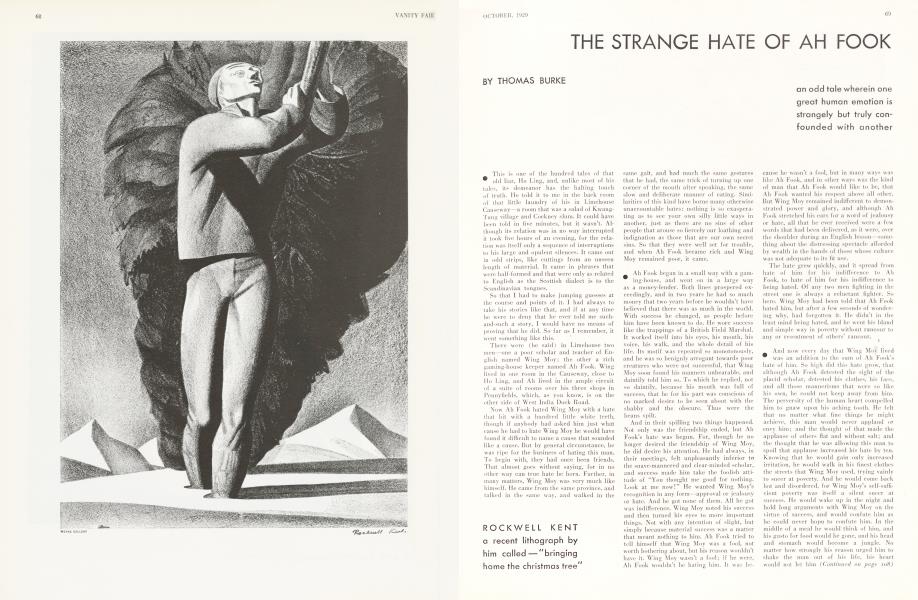
Sign In Not a Subscriber?Join NowTHE STRANGE HATE OF AH FOOK
THOMAS BURKE
an odd tale wherein one great human emotion is strangely but truly confounded with another
This is one of the hundred tales of that old liar, Ho Ling, and, unlike most of his tales, its demeanor has the halting touch of truth. He told it to me in the back room of that little laundry of his in Limehouse Causeway—a room that was a salad of KwangTung village and Cockney slum. It could have been told in five minutes, but it wasn't. Although its relation was in no way interrupted it took five hours of an evening, for the relation was itself only a sequence of interruptions to his large and opulent silences. It came out in odd strips, like cuttings from an unseen length of material. It came in phrases that were half-formed and that were only as related to English as the Scottish dialect is to the Scandinavian tongues.
So that I had to make jumping guesses at the course and points of it. I had always to take his stories like that, and if at any time he were to deny that he ever told me suchand-such a story, I would have no means of proving that he did. So far as I remember, it went something like this.
There were (he said) in Limehouse two men—one a poor scholar and teacher of English named Wing Moy; the other a rich gaming-house keeper named Ah Fook. Wing lived in one room in the Causeway, close to Ho Ling, and Ah lived in the ample circuit of a suite of rooms over his three shops in Pennyfields, which, as you know, is on the other side of West India Dock Road.
Now Ah Fook hated Wing Moy with a hate that bit with a hundred little white teeth, though if anybody had asked him just what cause he had to hate Wing Moy he would have found it difficult to name a cause that sounded like a cause. But by general circumstance, he was ripe for the business of hating this man. To begin with, they had once been friends. That almost goes without saying, for in no other way can true hate be born. Further, in many matters, Wing Moy was very much like himself. He came from the same province, and talked in the same way, and walked in the same gait, and had much the same gestures that he had, the same trick of turning up one corner of the mouth after speaking, the same slow and deliberate manner of eating. Similarities of this kind have borne many otherwise unaccountable hates: nothing is so exasperating as to see your own silly little ways in another, just as there are no sins of other people that arouse so fiercely our loathing and indignation as those that are our own secret sins. So that they were well set for trouble, and when Ah Fook became rich and Wing Moy remained poor, it came.
Ah Fook began in a small way with a gaming-house, and went on in a large way as a money-lender. Both lines prospered exceedingly, and in two years he had so much money that two years before he wouldn't have believed that there was as much in the world. With success he changed, as people before him have been known to do. He wore success like the trappings of a British Field Marshal. It worked itself into his eyes, his mouth, his voice, his walk, and the whole detail of his life. Its motif was repeated so monotonously, and he was so benignly arrogant towards poor creatures who were not successful, that Wing Moy soon found his manners unbearable, and daintily told him so. To which he replied, not so daintily, because his mouth was full of success, that he for his part was conscious of no marked desire to be seen about with the shabby and the obscure. Thus were the beans spilt.
And in their spilling two things happened. Not only was the friendship ended, but Ah Fook's hate was begun. For, though he no longer desired the friendship of Wing Moy, he did desire his attention. He had always, in their meetings, felt unpleasantly inferior to the suave-mannered and clear-minded scholar, and success made him take the foolish attitude of "You thought me good for nothing. Look at me now!" He wanted Wing Moy's recognition in any form—approval or jealousy or hate. And he got none of them. All he got was indifference. Wing Moy noted his success and then turned his eyes to more important things. Not with any intention of slight, but simply because material success was a matter that meant nothing to him. Ah Fook tried to tell himself that Wing Moy was a fool, not worth bothering about, but his reason wouldn't have it. Wing Moy wasn't a fool; if he w'ere, Ah Fook wouldn't be hating him. It was because he wasn't a fool, but in many ways was like Ah Fook, and in other ways was the kind of man that Ah Fook would like to be, that Ah Fook wanted his respect above all other. But Wing Moy remained indifferent to demonstrated power and glory, and although Ah Fook stretched his ears for a word of jealousy or hate, all that he ever received were a few words that had been delivered, as it were, over the shoulder during an English lesson—something about the distressing spectacle afforded by wealth in the hands of those whose culture was not adequate to its fit use.
The hate grew quickly, and it spread from hate of him for his indifference to Ah Fook, to hate of him for his indifference to being hated. Of any two men fighting in the street one is always a reluctant fighter. So here. Wing Moy had been told that Ah Fook hated him, but after a few seconds of wondering why, had forgotten it. He didn't in the least mind being hated, and he went his bland and simple way in poverty without rancour to any or resentment of others' rancour. ⅜
And now every day that Wing Moy lived w was an addition to the sum of Ah Fook's hate of him. So high did this hate grow, that although Ah Fook detested the sight of the placid scholar, detested his clothes, his face, and all those mannerisms that were so like his own, he could not keep away from him. The perversity of the human heart compelled him to gnaw upon his aching tooth. He felt that no matter what fine things he might achieve, this man would never applaud or envy him; and the thought of that made the applause of others flat and without salt; and the thought that he was allowing this man to spoil that applause increased his hate by ten. Knowing that he would gain only increased irritation, he would walk in his finest clothes the streets that Wing Moy used, trying vainly to sneer at poverty. And he would come back hot and disordered, for Wing Moy's self-sufficient poverty was itself a silent sneer at success. He would wake up in the night and hold long arguments with Wing Moy on the virtue of success, and would confute him as he could never hope to confute him. In the middle of a meal he would think of him, and his gusto for food would be gone, and his head and stomach would become a jungle. No matter how strongly his reason urged him to shake the man out of his life, his heart would not let him do it: he was bound to him by the firmest of all ties—the tie of antagonism.
Continued on page 108
Continued, from page 69
His hate grew to be a necessary part of his daily life. Every morning, however his affairs might stand, however empty his interest in other things, there was always his interest in this. However dull the streets might be, they were certain to afford one bitter and burning thrill. He thought each morning of a thousand delicately excoriating insults, until his knowledge of Wing Moy showed him their emptiness. He tried to think of ways of humbling him, until he saw the impossibility of humbling the humble. He rehearsed the scene of the creature begging bread of him, of making the kao-tao, and of himself having him thrown to the gutter. He tried to perceive ways of ruining him, but there was no way by which a wealthy man could use his power upon a teacher of English who was already nine-tenths ruined. He thought of all manner of foolish ways of ridding the streets of him. The creature was a blot upon the agreeable landscape garden he had laid around himself, and he would know no full joy of his wealth until it was removed. But all he could do was to wish and to burn prayer-papers to his fathers for the swift obliteration of the blot; and to go on hating him.
This he did; and then, when he had given up all hope, and had come to see the hated thing as a lasting punishment that some unnoted misdeed had earned, his wishes were granted.
Upon a morning of summer, when the blue-misty furlongs of West India Dock Road had become a channel of dreaming gold, Wing Moy crept out of the mouth of Limehouse Causeway and, with the downcast head of studious abstraction, started to cross the road. At the same moment a motor-bus from the Isle of Dogs curved into the street and made a headlong acceleration, and the next moment saw Wing Moy and the motor-bus in an unhappy and unequal marriage. The motor-bus skidded for a few yards and pulled up on the pavement with its bonnet in a shop-window; Wing Moy lay on the spot where it had divorced him. The swiftest helpers saw at once that he was dead.
In this little quarter news has means of spreading that make Ariel and beam-radio look like an express delivery messenger. Almost in the moment that Wing Moy knew that he was dead Ah Fook knew it; and at the news the sun shone out from golden mist to yellow blaze, and the white clouds rose higher in the sky.
Such a feeling of freedom the news gave that he felt he must celebrate it, and he left his accounts and went out to the streets. He walked with airy feet and his face glowed upon all he met. Certain of these he invited to five o'clock dinner, naming a good stroke of business as the occasion; and the rest of the morning he spent in lordly discussion with his cook. It would be the Dinner of Limehouse; it should go into history.
At five o'clock twenty guests were assembled. Sharp on his call dinner was served, and twenty golden suns made homage around the supreme sun.
But how is this? Ah Fook could see no radiance in those suns; his mouth could perceive no bliss in those transcendent dishes; his mind could borrow no joy from the splendid profusion about him. Something —he could not tell what—was wrong.
Not before midnight could he rid himself of his guests. By that time his depression was so acute that he shrank from taking it to bed with him, and took it into the dark streets and tried to lose it there. But it wouldn't be lost. Life seemed all at once as empty of purpose as the streets. He had a queer sense of being alone in the world, and as he came to different corners where he was used to meet Wing Moy, and either freeze or burn, he was aware of a nakedness in their appearance, or a dryness, as though their essential virtue had gone out of them. The world of flesh had become a skeleton. The thing that had shadowed his happiness in life was haunting him in death.
It was haunting him so intimately that a little later he found himself, without intent, drifting towards Limehouse Causeway, and then he found himself in the Causeway, and then he found himself, still without intent, standing outside Wing Moy's lodging. And then he knocked at the door. He did this with intent— perhaps the actual sight of the hated one for ever silent and still would restore his morning mood.
The old man who kept the house bowed to his request, and admired the beautiful act of the rich man paying his respects to his old poor friend. He took him upstairs, and there showed him the body of Wing Moy, and Ah Fook bent over it and looked down at the face of indifference. He looked down for some seconds with an elegant and superior smile. Then the old man, with a swift movement, set down the lamp he was carrying and went towards him. It appeared that Ah Fook was going to be ill, for, though he was still smiling, the smile had changed its key, and his hands had gone to his breast, and he was standing rigid. It was not illness, though: it was only that his whole being in that moment was thrilled with a rush of feeling. And it wasn't triumph or satisfaction or relief; it was a feeling he had never known before: new, it was, and strangely sweet and sad, like a town-child's first sight of the sea. For, as he bent over that face, he learned something. He learned that the bond that had held him bound in hate to his indifferent friend had been the only bond that can bind people together, and he knew that his hate of Wing Moy had been, like all human hate, nothing but earth-corrupted love.
Subscribers have complete access to the archive.
Sign In Not a Subscriber?Join Now
