Sign In to Your Account
Subscribers have complete access to the archive.
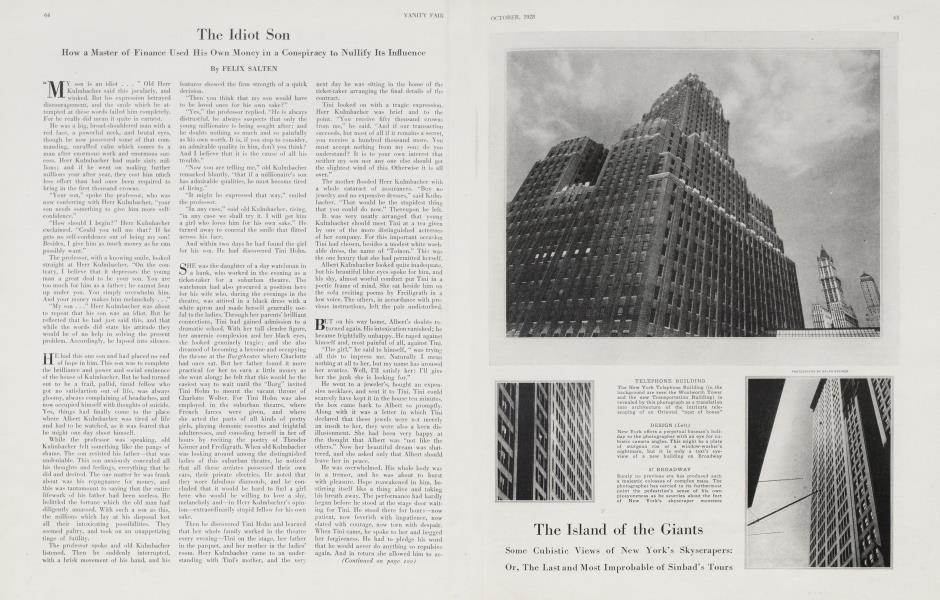
Sign In Not a Subscriber?Join NowThe Idiot Son
How a Master of Finance Used His Own Money in a Conspiracy to Nullify Its Influence
FELIX SALTEN
MY son is an idiot ..." Old Herr Kulmbacher said this jocularly, and winked. But his expression betrayed discouragement, and the smile which he attempted at these words failed him completely. For he really did mean it quite in earnest.
He was a big, broad-shouldered man with a red face, a powerful neck, and brutal eyes, though he now possessed some of that commanding, unruffled calm which comes to a man after enormous work and enormous success. Herr Kulmbacher had made sixty millions; and if he went on making further millions year after year, they cost him miich less effort than had once been required to bring in the first thousand crowns.
"Your son," spoke the professor, who was now conferring with Herr Kulmbacher, "your son needs something to give him more selfconfidence."
"How should I begin?" Herr Kulmbacher exclaimed. "Could you tell me that? If he gets no self-confidence out of being my son! Besides, I give him as much money as he can possibly want."
The professor, with a knowing smile, looked straight at Herr Kulmbacher. "On the contrary, I believe that it depresses the young man a great deal to be your son. You are too much for him as a father; he cannot bear up under you. You simply overwhelm him. And your money makes him melancholy . . ."
"My son . . ." Herr Kulmbacher was about to repeat that his son was an idiot. But he reflected that he had just said this, and that while the words did state his attitude they would be of no help in solving the present problem. Accordingly, he lapsed into silence.
HE had this one son and had placed no end of hope in him. This son was to complete the brilliance and power and social eminence of the house of Kulmbacher. But he had turned out to be a frail, pallid, timid fellow who got no satisfaction out of life, was always gloomy, always complaining of headaches, and now occupied himself with thoughts of suicide. Yes, things had finally come to the place where Albert Kulmbacher was tired of life and had to be watched, as it was feared that he might one day shoot himself.
While the professor was speaking, old Kulmbacher felt something like the pangs of shame. The son resisted his father—that was undeniable. This son anxiously concealed all his thoughts and feelings, everything that he did and desired. The one matter he was frank about was his repugnance for money, and this was tantamount to saying that the entire lifework of his father had been useless. He belittled the fortune which the old man had diligently amassed. With such a son as this, the millions which lay at his disposal lost all their intoxicating possibilities. They seemed paltry, and took on an unappetizing tinge of futility.
The professor spoke and old Kulmbacher listened. Then he suddenly interrupted, with a brisk movement of his hand, and his features showed the firm strength of a quick decision.
"Then you think that my son would have to be loved once for his own sake?"
"Yes," the professor replied. "He is always distrustful, he always suspects that only the young millionaire is being sought after; and he doubts nothing so much and so painfully as his own worth. It is, if you stop to consider, an admirable quality in him, don't you think? And I believe that it is the cause of all his trouble."
"Now you are telling me," old Kulmbacher remarked bluntly, "that if a millionaire's son has admirable qualities, he must become tired of living."
"It might be expressed that way," smiled the professor.
"In any case," said old Kulmbacher, rising, "in any case we shall try it. I will get him a girl who loves him for his own sake." He turned away to conceal the smile that flitted across his face.
And within two days he had found the girl for his son. He had discovered Tini Holm.
SHE was the daughter of a day watchman in a bank, who worked in the evening as a ticket-taker for a suburban theatre. The watchman had also procured a position here for his wife who, during the evenings in the theatre, was attired in a black dress with a white apron and made herself generally useful to the ladies. Through her parents' brilliant connections, Tini had gained admission to a dramatic school. With her tall slender figure, her anaemic complexion and her black eyes, she looked genuinely tragic; and she also dreamed of becoming a heroine and occupying the throne at the Burgtheater where Charlotte had once sat. But her father found it more practical for her to earn a little money as she went along; he felt that this would be the easiest way to wait until the "Burg" invited Tini Holm to mount the vacant throne of Charlotte Wolter. For Tini Holm was also employed in the suburban theatre, where French farces were given, and where she acted the parts of all kinds of pretty girls, playing demonic cocottes and frightful adulteresses, and consoling herself in her off hours by reciting the poetry of Theodor Körner and Freiligrath. When old Kulmbacher was looking around among the distinguished ladies of this suburban theatre, he noticed that all these artistes possessed their own cars, their private electrics. He noted that they wore fabulous diamonds, and he concluded that it would be hard to find a girl here who would be willing to love a shy, melancholy and—in Herr Kulmbacher's opinion—extraordinarily stupid fellow for his own sake.
Then he discovered Tini Holm and learned that her whole family worked in the theatre every evening—Tini on the stage, her father in the parquet, and her mother in the ladies' room. Herr Kulmbacher came to an understanding with Tini's mother, and the very next day he was sitting in the home of the ticket-taker arranging the final details of the contract.
Tini looked on with a tragic expression. Herr Kulmbacher was brief and to the point. "You receive fifty thousand crowns from me," he said. "And if our transaction succeeds, but most of all if it remains a secret, you receive a hundred thousand more. You must accept nothing from my son; do you understand? It is to your own interest that neither my son nor any one else should get the slightest wind of this. Otherwise it is all over."
The mother flooded Herr Kulmbacher with a whole cataract of assurances. "Buy no jewelry and no expensive dresses," said Kulmbacher. "That would be the stupidest thing that you could do now." Thereupon he left.
It was very neatly arranged that young Kulmbacher should meet Tini at a tea given by one of the more distinguished actresses of her company. For this important occasion Tini had chosen, besides a modest white washable dress, the name of "Toinon." This was the one luxury that she had permitted herself.
Albert Kulmbacher looked quite inadequate, but his beautiful blue eyes spoke for him, and his shy, almost woeful conduct put Tini in a poetic frame of mind. She sat beside him on the sofa reciting poems by Freiligrath in a low voice. The others, in accordance with previous instructions, left the pair undisturbed.
BUT on his way home, Albert's doubts returned again. His intoxication vanished; he became frightfully unhappy. He raged against himself and, most painful of all, against Tini.
"The girl," he said to himself, "was trying all this to impress me. Naturally I mean nothing at all to her, but my name has aroused her avarice. Well, I'll satisfy her: I'll give her the junk she is looking for."
He went to a jeweler's, bought an expensive necklace, and sent it to Tini. Tini could scarcely have kept it in the house ten minutes, the box came back to Albert so promptly. Along with it was a letter in which Tini declared that these jewels were not merelv an insult to her, they were also a keen disillusionment. She had been very happy at the thought that Albert was "not like the others." Now her beautiful dream was shattered, and she asked only that Albert should leave her in peace.
He was overwhelmed. His whole body was in a tremor, and he was about to burst with pleasure. Hope reawakened in him, bestirring itself like a thing alive and taking his breath away. The performance had hardly begun before he stood at the stage door waiting for Tini. He stood there for hours—now patient, now feverish with impatience, now elated with courage, now torn with despair. When Tini came, he spoke to her and begged her forgiveness. He had to pledge his word that he would never do anything so repulsive again. And in return she allowed him to accompany her home. Then as they passed along the dark streets, she recited poems by Theodor Körner and Freiligrath; and the mood of the evening and the verses filled Albert with vital courage and delight. But he had just one question to ask her. How she had come to be at that tea? For after all, the hostess was not . . . Tini explained quite simply: "I beg of you, she acts in the same company as I. No one should cause bad feelings." He understood, and agreed with her, and felt sorry for her, and his doubts were at rest.
Continued on page 122
Continued from page 64
From this day on, in the Kulmbacher home there was no more mention of Albert's weariness with living. Albert even began playing the piano again; he conversed with his father at the table. He was, of course, as reserved and shy as ever. But yet he frequently smiled, and his blue eyes beamed.
Gradually he brought his whole life to Tini and spread it out before her. His childhood reminiscences, his weltschmerz, his repugnance for money, his piano playing. Through him Tini became acquainted with Beethoven and Chopin. She went with him to concerts, she listened when he came to visit her in the home of her parents and played on the wretched little piano which she herself had paid for. Then he in turn listened while she recited. She declaimed Maria Stuart, The Maid of Orleans, and Iphigenia. He was intoxicated with happiness to think that a great artist loved him. For he considered Tini the greatest artist that ever lived.
This childlike, distinguished, and good-hearted man affected Tini. He gave fresh stimulus to her penchant for poetry, and one day she became aware that she was madly in love with Albert. The clearer this grew to her, and the stronger her devotion became, the more she was pained at the thought of her contract with Albert's father. Now for the first time she saw that she had done something opprobrious. She believed she was lost, and decided upon a desperate course of action.
Old Kulmbacher laughed irritably when she offered to return him his money. "And a devil of a chance you have," he said gruffly, "of making me believe that you now really love my son. You are a speculator! But don't expect me to quarrel with you!"
Immediately after Tini had left, he sent for the professor. "The whole thing looks suspicious to me," he said on ending the story. "There is nothing else to do now but to tell my son the
straight of it. Besides, he is in good spirits again now."
The professor became grave: "If you do that now, or at any other time, I won't be responsible! Your son would be beyond rescue, and would permanently lose his faith in the world. Of course I cannot say whether he would again succumb to his weariness with living. It is probable that he would. But one thing I do know: Your son would be through with you. He would no longer look upon you as a father if he heard what sort of comedy you have been playing on him!"
Old Kulmbacher felt that he was caught. He realized that little Tini held him in the hollow of her hand. But he made one last attempt. He acted as though he had just discovered his son's love-affair for the first time. He sent for him, and pounced upon him with rage and fury, since he knew that Albert had always been spineless when his father was aroused. He insisted that Albert should go on a trip immediately. It didn't matter where. To Japan, to Australia. And he himself, his father, would settle with the girl.
Albert listened to his father calmly —calmly, and with a gentle, happy smile. But at the mention of "settling" with the girl, he suddenly became flushed, arose abruptly, fought down his shyness, and finally said softly but resolutely: "I must ask you not to insult my fiancee."
And then, calmly and with a firm step he left the room. Old Kulmbacher sat there as though he had been struck by lightning. Yet at the same time he felt a certain satisfaction at the manliness of Albert's free and energetic attitude.
Now came the time when old Kulmbacher finally saw his son reaching: out eagerly for all the stored-up millions. He reached for them happily and gratefully, almost greedily, in order that he might lay all the splendid things imaginable at the feet of little Tini. Then one day as they were leaving the church, and Tini sat beside Albert in the magnificent carriage of the Kulmbachers, with her slender elegance, her beautiful pale face, and: her black eyes looking like a Spanish princess, the old man standing on the church steps recalled with emotion that she was only the daughter of a. bank attendant, only a little suburban actress; and he remembered the occupation of Tini's mother.
"My son is an idiot ..." he said to himself.
Subscribers have complete access to the archive.
Sign In Not a Subscriber?Join Now
