Sign In to Your Account
Subscribers have complete access to the archive.
Sign In Not a Subscriber?Join NowTwo Meetings
A Young American Discovers for Himself Something of the Charm of Old Europe
CLAUDE ANET
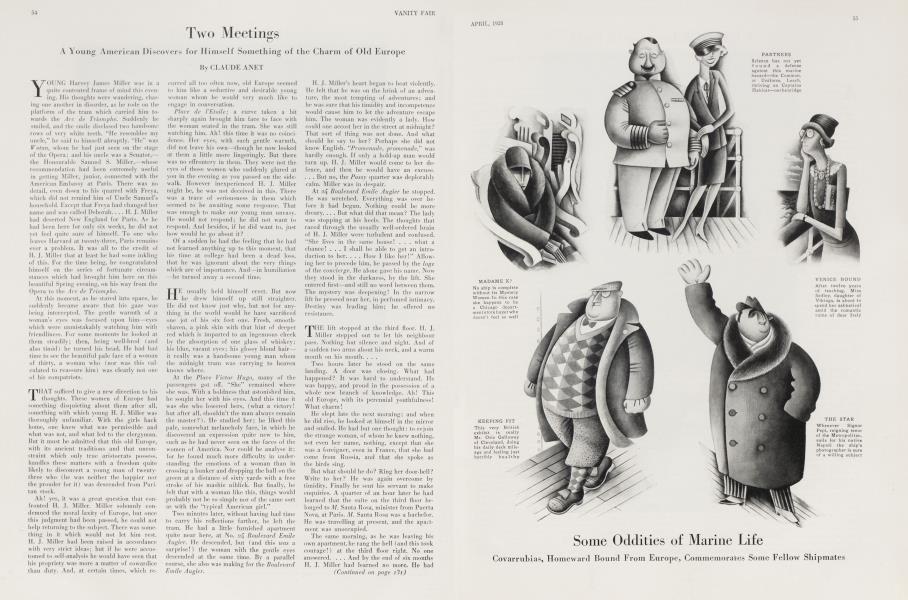
YOUNG Harvey James Miller was in a quite contented frame of mind this evening. His thoughts were wandering, chasing one another in disorder, as he rode on the platform of the tram which carried him towards the Arc de Triomphe. Suddenly he smiled, and the smile disclosed two handsome rows of very white teeth. "He resembles my uncle," he said to himself abruptly. "He" was Wotan, whom he had just seen on the stage of the Opera; and his uncle was a Senator,— the Honourable Samuel S. Miller,—whose recommendation had been extremely useful in getting Miller, junior, connected with the American Embassy at Paris. There was no detail, even down to his quarrel with Freya, which did not remind him of Uncle Samuel's household. Except that Freya had changed her name and was called Deborah.... H. J. Miller had deserted New England for Paris. As he had been here for only six weeks, he did not yet feel quite sure of himself. To one who leaves Harvard at twenty-three, Paris remains ever a problem. It was all to the credit of H. J. Miller that at least he had some inkling of this. For the time being, he congratulated himself on the series of fortunate circumstances which had brought him here on this beautiful Spring evening, on his way from the Opera to the Arc de Triomphe.
At this moment, as he stared into space, he suddenly became aware that his gaze was being intercepted. The gentle warmth of a woman's eyes was focused upon him—eyes which were unmistakably watching him with friendliness. For some moments he looked at them steadily; then, being well-bred (and also timid) he turned his head. He had had time to see the beautiful pale face of a woman of thirty, a woman who (nor was this calculated to reassure him) was clearly not one of his compatriots.
THAT sufficed to give a new direction to his thoughts. These women of Europe had something disquieting about them after all, something with which young H. J. Miller was thoroughly unfamiliar. With the girls back home, one knew what was permissible and what was not, and what led to the clergyman. But it must be admitted that this old Europe, with its ancient traditions and that unconstraint which only true aristocrats possess, handles these matters with a freedom quite likely to disconcert a young man of twentythree who (he was neither the happier nor the prouder for it) was descended from Puritan stock.
Ah! yes, it was a great question that confronted H. J. Miller. Miller solemnly condemned the moral laxity of Europe, but once this judgment had been passed, he could not help returning to the subject. There was something in it which would not let him rest. H. J. Miller had been raised in accordance with very strict ideas; but if he were accustomed to self-analysis he would have seen that his propriety was more a matter of cowardice than duty. And, at certain times, which recurred all too often now, old Europe seemed to him like a seductive and desirable young woman whom he would very much like to engage in conversation.
Place de TEtoile; a curve taken a bit sharply again brought him face to face with the woman seated in the tram. She was still watching him. Ah! this time it was no coincidence. Her eyes, with such gentle warmth, did not leave his own—though he now looked at them a little more lingeringly. But there was no effrontery in them. They were not the eyes of those women who suddenly glared at you in the evening as you passed on the sidewalk. However inexperienced H. J. Miller might be, he was not deceived in this. There was a trace of seriousness in them which seemed to' be awaiting some response. That was enough to make our young man uneasy. He would not respond; he did not want to respond. And besides, if he did want to, just how would he go about it?
Of a sudden he had the feeling that he had not learned anything up to this moment, that his time at college had been a dead loss, that he was ignorant about the very things which are of importance. And—in humiliation —he turned away a second time.
HE usually held himself erect. But now he drew himself up still straighter. He did not know just why, but not for anything in the world would he have sacrificed one jot of his six feet one. Fresh, smoothshaven, a pink skin with that hint of deeper red which is imparted to an ingenuous cheek by the absorption of one glass of whiskey; his blue, vacant eyes; his glossy blond hair— it really was a handsome young man whom the midnight tram was carrying to heaven knows where.
At the Place Victor Hugo, many of the passengers got off. "She" remained where she was. With a boldness that astonished him, he sought her with his eyes. And this time it was she who lowered hers, (what a victory! but after all, shouldn't the man always remain the master?). He studied her; he liked this pale, somewhat melancholy face, in which he discovered an expression quite new to him, such as he had never seen on the faces of the women of America. Nor could he analyse it; for he found much more difficulty in understanding the emotions of a woman than in crossing a bunker and dropping the ball on the green at a distance of sixty yards with a free stroke of his mashie niblick. But finally, he felt that with a woman like this, things would probably not be so simple nor of the same sort as with the "typical American girl."
Two minutes later, without having had time to carry his reflections farther, he left the tram. He had a little furnished apartment quite near here, at No. 24 Boulevard Emile Augier. He descended, but (and this was a surprise!) the woman with the gentle eyes descended at the same time. By a parallel course, she also was making for the Boulevard Emile Augier.
H. J. Miller's heart began to beat violently. He felt that he was on the brink of an adventure, the most tempting of adventures; and he was sure that his timidity and incompetence would cause him to let the adventure escape him. The woman was evidently a lady. How could one accost her in the street at midnight? That sort of thing was not done. And what should he say to her? Perhaps she did not know English. "Promenade, promenade," was hardly enough. If only a hold-up man would turn up. H. J. Miller would come to her defence, and then he would have an excuse. . . . But no, the Passy quarter was deplorably calm. Miller was in despair.
At 24 Boulevard Emile Augier he stopped. He was wretched. Everything was over before it had begun. Nothing could be more dreary. .. . But what did that mean? The lady was stopping at his heels. The thoughts that raced through the usually well-ordered brain of H. J. Miller were turbulent and confused. "She lives in the same house! . . . what a chance! ... I shall be able to get an introduction to her. . . . How I like her!" Allowing her to precede him, he passed by the loge of the concierge. He alone gave his name. Now they stood in the darkness, by the lift. She entered first—and still no word between them. The mystery was deepening! In the narrow lift he pressed near her, in perfumed intimacy. Destiny was leading him; he offered no resistance.
THE lift stopped at the third floor. H. J. Miller stepped out to let his neighbour pass. Nothing but silence and night. And of a sudden two arms about his neck, and a warm mouth on his mouth. . . .
Two hours later he stood on the same landing. A door was closing. What had happened? It was hard to understand. He was happy, and proud in the possession of a whole new branch of knowledge. Ah! This old Europe, with its perennial youthfulness! What charm!
He slept late the next morning; and when he did rise, he looked at himself in the mirror and smiled. He had but one thought: to rejoin the strange woman, of whom he knew nothing, not even her name, nothing, except that she was a foreigner, even in France, that she had come from Russia, and that she spoke as the birds sing.
But what should he do? Ring her door-bell? Write to her? He was again overcome by timidity. Finally he sent his servant to make enquiries. A quarter of an hour later he had learned that the suite on the third floor belonged to M. Santa Rosa, minister from Puerta Nova, at Paris. M. Santa Rosa was a bachelor. He was travelling at present, and the apartment was unoccupied.
The same morning, as he was leaving his own apartment, he rang the bell (and this took courage!) at the third floor right. No one answered. . . . And by the end of six months H. J. Miller had learned no more. He had been noaxeu; someone nau piayeu a trick on him; he was enraged. How could this woman appear and vanish so suddenly? What would he not give to find her again? In the end he might even have doubted whether it has really happened, if he did not possess in the depths of his mind a certainty which nothing could destroy, a certainty which permitted him to look at women with a little more assurance now, and had even netted him some quite flattering successes in the course of the summer. But all the same, no woman could compare with this first unknown one. . . .
Continued on page 131
Continued from page 54
He wras away for one month during the summer. When he returned, he learned that the tenant on (lie third floor had moved. Thus, nothing remained of this disquieting adventure; nothing but the bare walls.
In the autumn, a dinner at a South American legation. A card handed him by a valet read: "M. H. J. Miller will please take Mme. Santa Rosa into dinner." Was M. Santa Rosa married now! But there was more than one Santa Rosa in Paris! Nevertheless, this name was eoough to unnerve our young man. He asked to be presented to the lady who was to be his companion at table.
"A charming woman," said the host. "We have been too kind to you, my dear fellow. Married scarcely two months. My colleague is a happy man. His wife is a Russian."
H. J. Miller did not have time to utter an "Oh!" He found himself confronting the woman. ... It was she! He blushed to the roots of his hair.
While he stood there nonplussed and speechless, nothing could surpass the ease with which Mme. Santa Rosa held out her hand to him and said in IOUS voice wnicn ne naa not yet forgotten: "I have metM. Miller."
At table she was perfectly natural, he very embarrassed. He hardly dared look at her. But she talked and smiled. Clearly she seemed to remember nothing, and he everything. After several glasses of champagne, he finally mustered the courage to ask:
"You no longer live on the Boulevard Emile Augier?"
"No," she said, "that was the bachelor apartment of my husband."
And she added carelessly:
"Whenever he was travelling he would leave me the key."
By now he was on fire. But under the weight of his embarrassment, H. J. Miller could think of nothing less banal to say than "Is that so?"
She looked at him. After all he was quite likeable—this tall boy who was so young and clumsy. In his eyes she read a question which he would never in his life have dared to speak aloud. She felt sorry for him. "It is a hard thing to understand, mon cher, and I myself find it a little difficult. You were not entirely a stranger to me. I saw you once or twice when coming to visit Santa Rosa. And you are so tall! How could I fail to notice you?
. . . Then one day,—the day we met, in fact,—I had to avenge myself. He had left for a trip, and I had learned that he was not alone. I was resolved to retaliate, I saw you in the tram, I realized that you were the very person.
. . . Since then I have laughed, mon cher, at the thought of it. A revenge for me, an education for you. ..."
H. J. Miller had the good sense not to object. He smiled; and as he had such splendid teeth, this smile better served his cause than the most wellthought out reply could possibly have done.
Subscribers have complete access to the archive.
Sign In Not a Subscriber?Join Now
