Sign In to Your Account
Subscribers have complete access to the archive.
Sign In Not a Subscriber?Join NowVariation in a Minor Key
Wherein an Exciting New Experience Is Vouchsafed to a Parisian Composer at the Seaside
CLAUDE ANET
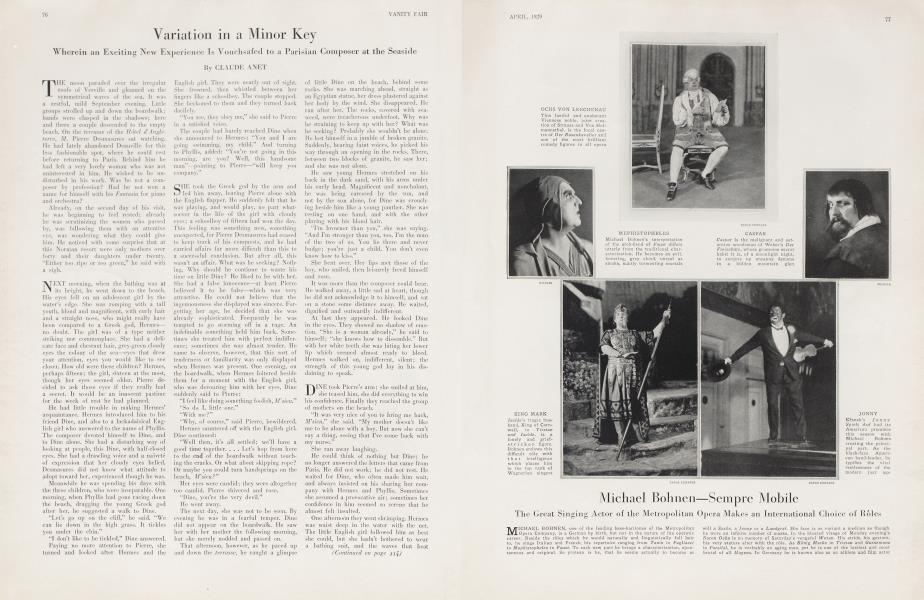
THE moon paraded over the irregular roofs of Verville and gleamed on the symmetrical waves of the sea. It was a restful, mild September evening. Little groups strolled up and down the boardwalk; hands were clasped in the shadows; here and there a couple descended to the empty beach. On the terrasse of the Hotel d'Angleterre, M. Pierre Desmasures sat watching. He had lately abandoned Deauville for this less fashionable spot, where he could rest before returning to Paris. Behind him he had left a very lovely woman who was not uninterested in him. lie wished to be undisturbed in his work. Was he not a composer by profession? Dad he not won a name for himself with his Fantasia for piano and orchestra?
Already, on the second day of his visit, he was beginning to feel rested; already he was scrutinizing the women who passed by, was following them with an attentive eye, was wondering what they could give him. He noticed with some surprise that at this Norman resort were only mothers over forty and their daughters under twenty. "Either too ripe or too green," he said with a sigh.
NEXT morning, when the bathing was at its height, he went down to the beach. His eyes fell on an adolescent girl by the water's edge. She was romping with a tall youth, blond and magnificent, with curly hair and a straight nose, who might really have been compared to a Greek god, Hermes— no doubt. The girl was of a type neither striking nor commonplace. She had a delicate face and chestnut hair, grey-green cloudy eyes the colour of the sea—eyes that drew your attention, eyes you would like to see closer. How old were these children? Hermes, perhaps fifteen; the girl, sixteen at the most, though her eyes seemed older. Pierre decided to ask those eyes if they really had a secret. It would be an innocent pastime for the week of rest he had planned.
He had little trouble in making Hermes' acquaintance. Hermes introduced him to his friend Dine, and also to a lackadaisical English girl who answered to the name of Phyllis. The composer devoted himself to Dine, and to Dine alone. She had a disturbing way of looking at people, this Dine, with half-closed eyes. She had a drawling voice and a naivete of expression that her cloudy eyes belied. Desmasures did not know what attitude to adopt toward her, experienced though he was.
Meanwhile he was spending his days with the three children, who were inseparable. One morning, when Phyllis had gone racing down the beach, dragging the young Greek god after her, he suggested a walk to Dine.
"Let's go up on the cliff," he said. "We can lie down in the high grass. It tickles you under the chin."
"I don't like to be tickled," Dine answered.
Paying no more attention to Pierre, she turned and looked after Hermes and the English girl. They were nearly out of sight. She frowned, then whistled between her fingers like a schoolboy. The couple stopped. She beckoned to them and they turned back docilely.
"You see, they obey me," she said to Pierre in a satisfied voice.
The couple had barely reached Dine when she announced to Hermes; "You and I are going swimming, my child." And turning to Phyllis, added: "You're not going in this morning, are you? Well, this handsome man"—pointing to Pierre—"will keep you company."
SHE took the Greek god by the arm and led him away, leaving Pierre alone with the English flapper. He suddenly felt that he was playing, and would play, no part whatsoever in the life of the girl with cloudy eyes; a schoolboy of fifteen had won the day. This feeling was something new, something unexpected, for Pierre Desmasures had ceased to keep track of his Conquests, and he had carried affairs far more difficult than this to a successful conclusion. But after all, this wasn't an affair. What was he seeking? Nothing. Why should he continue to waste his time on little Dine? lie liked to lie with her. She had a false innocence—at least Pierre believed it to be false—which was very attractive. He could not believe that the ingenuousness she displayed was sincere. Forgetting her age, he decided that she was already sophisticated. Frequently he was tempted to go storming off in a rage. An indefinable something held him back. Sometimes she treated him with perfect indifference; sometimes she was almost tender. He came to observe, however, that this sort of tenderness or familiarity was only displayed when Hermes was present. One evening, on the boardwalk, when Hermes loitered beside them for a moment with the English girl, who was devouring him with her eyes, Dine suddenly said to Pierre:
"I feel like doing something foolish, M'sieu."
"So do I, little one."
"With me?"
"Why, of course," said Pierre, bewildered.
Hermes sauntered off with the English girl. Dine continued:
"Well then, it's all settled; AVC'11 have a good time together. . . . Let's hop from here to the end of the boardwalk without touching the cracks. Or what about skipping rope? Or maybe you could turn handsprings on the beach, M'sieu?"
Her eyes were candid; they were altogether too candid. Pierre shivered and rose.
"Dine, you're the very devil."
He went away.
The next day, she was not to be seen. By evening he was in a fearful temper. Dine did not appear on the boardwalk. He saw her Avith her mother the following morning, but she merely nodded and passed on.
That afternoon, however, as he paced up and down the terrasse, he caught a glimpse of little Dine on the beach, behind some rocks. She was marching ahead, straight as an Egyptian statue, her dress plastered against her body by the wind. She disappeared. He ran after her. The rocks, covered with seaweed, were treacherous underfoot. Why was he straining to keep up with her? What was he seeking? Probably she wouldn't be alone. He lost himself in a jumble of broken granite. Suddenly, hearing faint voices, he picked his way through an opening in the rocks. There, between two blocks of granite, he saw her; and she was not alone.
He saw young Hermes stretched on his back in the dark sand, with his arms under his curly head. Magnificent and nonchalant, he was being caressed by the sun, and not by the sun alone, for Dine was crouching beside him like a young panther. She was resting on one hand, and with the other playing with his blond hair.
"I'm browner than you," she was saying. "And I'm stronger than you, too. I'm the man of the two of us. You lie there and never budge; you're just a child. You don't even know how to kiss."
She bent over. Her lips met those of the boy, who smiled, then leisurely freed himself and rose.
It was more than the composer could bear. He walked away, a little sad at heart, though he did not acknoAvledge it to himself, and sat on a stone some distance away. He waited, dignified and outwardly indifferent.
At last they appeared. He looked Dine in the eyes. They showed no shadow of emotion. "She is a woman already," he said to himself; "she knows how to dissemble." But with her white teeth she was biting her lower lip which seemed almost ready to bleed. Hermes walked on, indifferent, silent; the strength of this young god lay in his disdaining to speak.
DINE took Pierre's arm; she smiled at him, she teased him, she did everything to win his confidence. Finally they reached the group of mothers on the beach.
"It was very nice of you to bring me back, M'sieu" she said. "My mother doesn't like me to be alone with a boy. But noAv she can't say a thing, seeing that I've come back with my nurse."
She ran aAvay laughing.
He could think of nothing but Dine; he no longer answered the letters that came from Paris. He did not work; he did not rest. He waited for Dine, who often made him wait, and always insisted on his sharing her company with Hermes and Phyllis. Sometimes she assumed a provocative air; sometimes her confidence in him seemed so serene that he almost felt insulted.
One afternoon they went shrimping. Hermes was waist deep in the water with the net. The little English girl followed him as best she could, but she hadn't bothered to wear a bathing suit, and the waves that beat against her slender legs were soaking her chemise. Pierre was left alone with Dine on the beach. Without difficulty, he led her into a neighbouring hollow among the rocks.
(Continued on page 114)
(Continued from page 76)
"You've been here before, haven't you, child?"
"No, M'sieu," she answered indifferently.
"A lie," thought Pierre. "Ah, you can lie already! But just wait; I'll catch you at it."
She lay in the sand with Pierre at her side. He threw sand on her legs. She closed her eyes and said nothing. A long silence followed. She was pale today; her dark eyelids seemed heavy on her closed eyes. How old was she really? She seemed a woman already, a wife . . . his own wife, perhaps. Pierre, a hardened bachelor, shivered and drew back. . . . Ah, never!'. . . He looked at her again. What a lovely thing she was! Her mouth, with its rather full lips, was half open. She must he sleeping. . . . He bent over, intending to take her in his arms. . . . In a flash, Dine had taken a little sidewise leap. She was on her feet before Pierre even had time to turn. For a moment he hesitated. They were standing face to face. What would she do? Fall into his arms? It seemed unlikely. Would she make a fool of him again? He took a step forward. He was tired of playing a comedy; he would put an end to it here and now. At this moment, Dine chose a course of action. She began to run, so lightly that she seemed to skim over the heavy sand, in which Pierre was sinking to his ankles. She ran, but not toward the beach where Hermes and Phyllis were still catching shrimp, nor toward her mother at Verville. She did not seem to be seriously disturbed; she was not seeking safety in flight. Yet Pierre was behind her, panting from his race through the soft sand; she could hear his heavy breathing. She continued her flight among the rocks; it seemed to amuse her. It was a game, he thought; damnation, it was a game. Finally she stopped. Pierre stopped, too. He was out of breath, red-faced perspiring . . . Dine was cool, smiling and her heartbeats were barely visible on her young breast.
"We had a nice run, hadn't we, M'sieu?"
(Continued on page 120)
(Continued from page 114)
"Dine, you're making fun of me," said Pierre in bewilderment. "I've had enough of it. . . . We can't go on this way."
"But what do you want with me, M'sieu?" she said with an air of supreme innocence, an incredible sort of noli mi tangere air that was too perfect to be entirely convincing; one could never produce such a masterpiece at the first attempt. Pierre was nonplussed. She was so pretty, however, that he soon recovered the lost thread of his desire.
"What do I want. You know very well what I want, little devil."
Dine stood before him like a question mark. She opened her sea-green eyes still wider. She was the picture of innocence. Pierre stopped, hesitated, and finally stammered, pointing to the little hollow among the rocks:
"Here, the other day, with Hermes..."
Dine did not try to feign ignorance.
"Hermes is only a child."
She said this with a happy smile, in which there was something benignant and tender, something truly maternal. She seemed to become a different person, and Pierre was deeply moved. Meanwhile Dine continued:
"You see, he knows nothing at all."
This time, she had gone too far. A picture rose before his eyes: Hermes stretched out on the sand, Dine bending over him. Pierre could not refrain
from saying rather maliciously:
"Not even how to kiss."
As soon as these words escaped him, he was frightened. How would Dine take them? For an instant, her eyes flashed. But Dine surprised him.
"I love him," she said with such a gentle air that Pierre was stirred profoundly. "I love him . . ."
"But I can't even be sure that he likes me a little . . . that he prefers me to that terrible English girl who shows off her legs so shamelessly. Ah! M'sieu, there are times when I am sad, you know."
She came to Pierre, and now she was just an unhappy little girl. He felt only pity; he was all paternal. He consoled her; he reassured her; he put his arms around her protectingly. It was very agreeable after all, this chaste embrace.
To his great surprise, he continued his stay at Verville, with Dine, with Hermes also, and with Phyllis.
In October he returned to Paris. At the station he was met by the lovely woman he had left at Deauville.
"You've been away from me for weeks and weeks," she said. "I'm sure that you've been unfaithful!"
"Oh, no," said Pierre, "I've been trying to write a Variation in a Minor Key.—Not successfully. But there's something about it that pleases me..."
Subscribers have complete access to the archive.
Sign In Not a Subscriber?Join Now

