
Sign In to Your Account
Subscribers have complete access to the archive.
Sign In Not a Subscriber?Join NowThe Conductorless Orchestra
An English Critic Finds Faint Hope in Communism When It Is Applied to Music
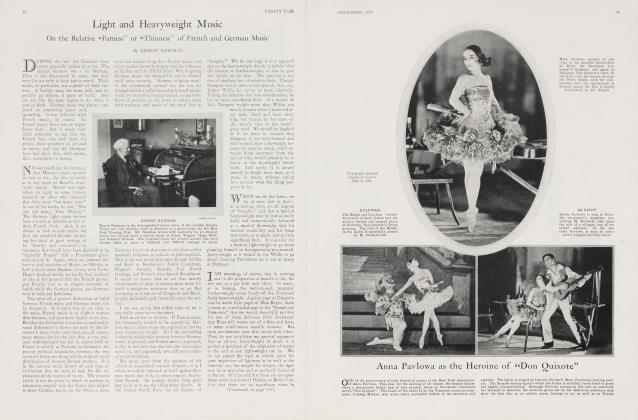
ERNEST NEWMAN
IN London we hear that New York has heard its first conductorless orchestra, following the example of Moscow (or is it Petrograd?) where an orchestra without a conductor is said to have been giving performances for some years now. Reports indicate that the experiment proves itself an interesting one.
I should very much like to know, from having myself heard the American Symphonic Ensemble, how the Russian experiment has really worked. You cannot trust any mere democrat on a point like this; he may have the genuine Bolshevik hatred of the outstanding individual who can do what the ordinary man can't do and will never be able to do, and he may fancy the conductorless orchestra plays better than it actually does. I wonder what my own dispassionate verdict as a seasoned London concert-goer would be.
Theoretically, of course, and up to a point, there is something to be said for an orchestra managing without a conductor. I know orchestras that could easily do that,—for I know the conductors also. In England we have a venerable institution called the three Choirs' Festival: each year the choirs of the three small cathedral towns Worcester, Gloucester and Hereford unite to give a week of music, the venue changing from town to town each year. As these towns have no orchestras of their own, the band is imported from London. It is made up of hard-boiled individuals who have played under most of the leading English and European conductors, from Richter and Nikisch and Mengelberg and Lamoureux down to Beecham, Vi alter and Koussevitzky. They know the ordinary repertory by heart; they know it much better than the local conductor—who is merely the local cathedral organist, put up on a platform with a baton in his hand once every three years and dignified with the title of conductor—does or will ever do. They play under him, for the most part, with amused toleration; they humour him as a cynical chauffeur humours the owner who is learning to drive a car; the chauffeur has no objection to letting the good man cherish the illusion that he is doing it all himself, but at the first sight of danger a more experienced pair of hands takes possession of the steering wheel, or a more decided foot comes down on the brake.
YEARS before the Bolshevists came out X with their experiment I used to listen to these Three Choirs' Festivals and wonder whether the conductor was really necessary, so superfluous did he seem to be in most cases. There were times, indeed, when the whole chance of salvation for the performance resided in the fact that no one paid the slightest attention to him; I remember one performance of a violin concerto, with a world-famous violinist as soloist, in which neither he nor the orchestra paid the least notice to the conductor after they had taken his measure during the first few bars. The conductorless orchestra, then, is hardly the novelty for me that it has been for Americans.
There are two ways of looking at the matter; and I am prepared to argue with equal conviction and equal convincingness, according to the side by which I am briefed, that we can quite well do without conductors altogether or that we want more conductors. It has in the past been thought that without a conductor, though an orchestra "keep together" as the result of good musicianship and long association, it cannot "interpret" a work with any unity, cannot give it out as the imaginative reconstruction of a single mind. But, speaking from the theoretic stand point, why not? A string quartet gets along quite well without a conductor, and manages not merely to keep together but to give a wholly individual reading of a work. If four people can do this, why cannot eight? And if eight, why not eighty? What is the precise number at which the principle would break down? Somehow or other from the rehearsals of the four members of a quartet there is developed a communal artistic consciousness, a communal conception of what the composer meant. Why should not an orchestra that is always rehearsing together develop a consciousness and a conception of the same kind? Orchestral players have come to rely upon a conductor for their conception of the work; but may not that be only because they have been trained to rely on him for it instead of working it out among themselves? The string quartet, having always had to rely on itself, has had to do the working out for itself.
ON the other hand, I have heard quartets that would have been all the better for a conductor, and I have heard orchestras that prompted the thought in me that they needed more than one conductor,—that a conductor for each section, or even for each player, would not have been too much. And the principle of multiplicity might be extended to the singers. Which of us, at the opera, has not felt occasionally that it would be better if the conductor were to leave the orchestra to look after itself—after all, it is composed of musicians!—and go on the stage and beat time in the very face of the singer,—who, as often as not, is no musician? But, per contra, have there not been cases within the experience of all of us when we have wished that some singer who happened to be an artist were allowed to conduct the conductor instead of being conducted by him? I must admit that singers of this sort are rare; but in the course of a lifetime of concert and opera going I have met with one or two of them.
The difficulty about this would be that it would take the logic of a Kant and the eloquence of a Demosthenes to persuade any singer that he was not the exceptional sort of artist I have just mentioned; and if we gave all of them rope, they would hang not merely themselves but the performance. There is a celebrated operatic bass who is credited with offering so much gratuitous advice to conductors not merely at rehearsal but during the performance that it is a wonder he has not been slain long ago. In London, quite recently, he is credited with having made signs to the conductor that lie wanted another tempo. During another performance he walked off the stage for a "lime, to everyone's amazement. The explanation given afterwards was that the lighting was not to his fancy, and he had gone to give instructions for altering it. This gentleman may or may not be the all-comprehending, all-capable genius he apparently imagines himself to be; but even if he is, lie could hardly be allowed the liberty he desires unless we grant the same liberty to his colleagues, each of whom, we may be sure, has the same high opinion of himself.
So that all in all I cannot quite see the permanent disappearance of the conductor, lie may, in some cases, be an evil, but at any rate he is a more or less necessary evil. He may be no more superior to the rank and file than a Prime Minister or a President is superior to his constituents; but since it is obvious that all cannot govern, there is a certain convenience in the authority of government being entrusted to one head, even though there be thousands of better heads among the governed. It is here that my sophistical argument from the four to the eight, and from the eight to the eighty, breaks down in practice. The four members of a quartet manage to think with one mind partly because they have minds to begin with; and they must have been pretty well of the same mind from the commencement or they would not have come together. But the more you multiply the four, the less likely are these ideal conditions to persist. When you come to eighty or a hundred, you are pretty sure to have a fair number who have hardly any minds at all; they may make quite good passengers, fit to lend a hand in a storm, but not fit to help sail the ship. And since an orchestra is no stronger than its weakest member, I fancy we are asking for trouble when we leave a heterogeneous body of that sort to play of itself.
THE proof of the pudding is in the eating. In the standard works of the concert repertory the American Symphonic Ensemble has apparently acquitted itself, according to its critics, about as well without a conductor as it would have with one. But that is probably because a certain unity of conception had already been hammered into them. When a German conductor is asked to come to London to conduct one of our orchestras, the first work he puts down in his suggested programme is sure to be Strauss's Don Juan, and the second, Beethoven's C Minor Symphony.
The Committee has great trouble in pointing out to him, as tactfully as possible, that these works have been given in London before, and they would like something new. The conductor cannot quite see the matter from this point of view; he wants to come to London not for art's sake but for finance's sake and reclame's sake, and his idea is to conduct a few works that the orchestra knows by heart, with which he can hit the audience between the eyes. Recently a German conductor was asked to give at a London concert the first English performance of a new work by Stravinsky. He consented. When the time to fulfill the engagement drew near he asked the Committee to withdraw the Stravinsky and substitute for it one of Beethoven's symphonies,—the C minor, I think. The Committee, pale and weary but still polite, tried to bring it home to him that even in London the C minor was quite well known; it had been done, in fact, by almost every conductor in the universe for something like a hundred years, and the London public was at the moment not greatly interested in bearing it again. "But surely," said the master egoist, "they would be interested to see how I take it?" And once more the Committee had to get to work and explain to him that not even that dazzling prospect would induce them to engage him to conduct the C minor.
(Continued on page 82)
(Continued from page 53)
In the case of works that are as familiar to them as the routine of their own households, any band of intelligent players would be able to give performances almost, if not quite, as good as those we get at present; but that, as I have suggested, would be because the necessary community of conception would already be there in them. But what about the case of new or unfamiliar works? It is on this point that I should like to have the verdict of some competent and unbiased musician who has heard the Russian or American orchestra. It is possible for a quartet to beat out in rehearsal a unified idea of a new work, but how successfully can a large orchestra do so? Even in a quartet, as in a committee, there is generally one mind that matters more than the others and gets its own way, whether the others are aware of it or not; and this apparently was the case with the American Philharmonic Orchestra where Paul Stassevitch, the concert master, and an interpretation committee of five members were the guiding spirits. Further, it took some sixteen rehearsals in preparation of the first concert before a communal conception was agreed upon.
This leads to the question: what difference is there between dominance of the orchestra by someone inside it and dominance by someone outside? If one man's idea is to prevail, why not put a baton in his hand and give him full control at once?
I am still sceptical about the lasting success of control from inside the orchestra. A little while ago we had in London a distinguished musician, who is at once conductor, composer and pianist, both playing the solo part in a piano concerto and conducting the orchestra from the piano, in the 18th century fashion. The event was an interesting oddity, but nothing more. Aesthetically the results were much below what are obtained under the ordinary system; the pianist was too occupied with that one part of his job to be able to give the orchestra all the attention it needed, with the result that, though the entries were correct enough, the general effect was rather lifeless; many a phrase in this instrument or that was delivered more tepidly than it would have been had the player been fixed with the gimlet eye of a conductor who knew what he wanted, and meant to have it.
I cannot, then, see the conductor being permanently displaced just yet. A conductorless orchestra is an interesting novelty for a time; but when the novelty has worn off, if the public one night has the choice of hearing a favourite work played by an orchestra without a conductor and played by an orchestra under Koussevitzky or Toscanini, I fancy I could say with surety where the rush on the box office will be.
Subscribers have complete access to the archive.
Sign In Not a Subscriber?Join Now
