Sign In to Your Account
Subscribers have complete access to the archive.
Sign In Not a Subscriber?Join NowThe Big Noise
An Unfanatical Defense of the Potentialities of Talking Pictures, the Cinema's Unwanted Scion
GEORGE ABBOTT
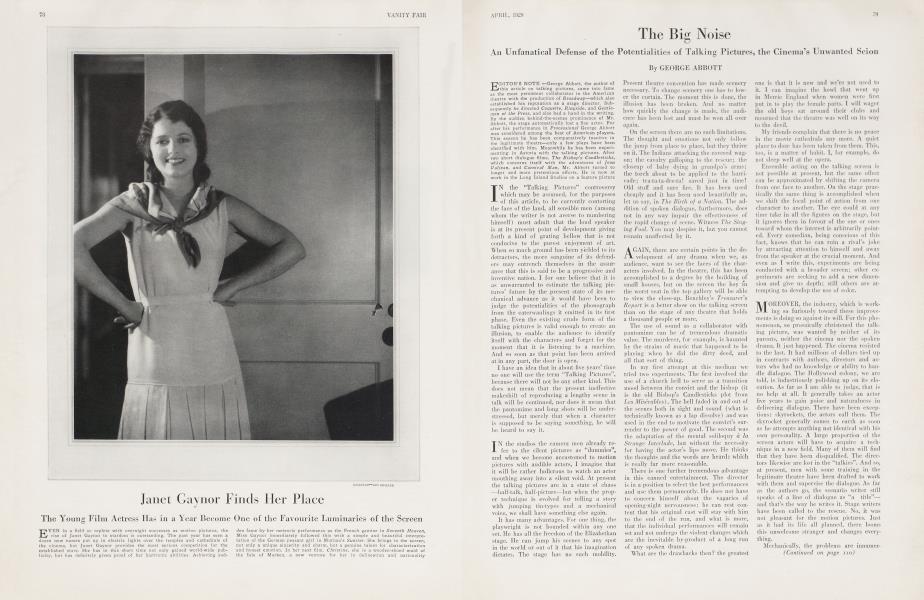
EDITOR'S NOTE —George Abbott, the author of this article on talking pictures, came into fame as the most persistent collaborator in the American theatre with the production of Broadway—which also established his reputation as a stage director. Subsequently he directed Coquette, Ringside, and Gentlemen of the Press, and also had a hand in the writing. By the sudden behind-the-scenes prominence of Mr. Abbott, the stage automatically lost a fine actor. For after his performance in Processional George Abbott was considered among the best of American players. This season he has been comparatively inactive in the legitimate theatre—only a few plays have been identified with him. Meanwhile he has been experimenting in Astoria with the talking pictures. After two short dialogue films. The Bishop's Candlesticks, which concerns itself with the adventures of Jean Valjean, and Carnival Man, Mr. Abbott turned to longer and more pretentious efforts. He is now at work in the Long Island Studios on a feature picture
IN the "Talking Pictures" controversy which may be assumed, for the purposes of this article, to he currently contorting the face of the land, all sensible men (among whom the writer is not averse to numbering himself) must admit that the loud speaker is at its present point of development giving forth a kind of grating bellow that is not conducive to the purest enjoyment of art. When so much ground has been yielded to its detractors, the more sanguine of its defenders may entrench themselves in the assurance that this is said to be a progressive and inventive nation. I for one believe that it is as unwarranted to estimate the talking pictures' future by the present state of its mechanical advance as it would have been to judge the potentialities of the phonograph from the caterwaulings it emitted in its first phase. Even the existing crude form of the talking pictures is valid enough to create an illusion, to enable the audience to identify itself with the characters and forget for the moment that it is listening to a machine. And so soon as that point has been arrived at in any part, the door is open.
I have an idea that in about five years' time no one will use the term "Talking Pictures", because there will not be any other kind. This does not mean that the present ineffective makeshift of reproducing a lengthy scene in talk will be continued, nor does it mean that the pantomime and long shots will be understressed, but merely that when a character is supposed to be saying something, he will be heard to say it.
IN the studios the camera men already refer to the silent pictures as "dummies", and when we become accustomed to motion pictures with audible actors, I imagine that it will be rather ludicrous to watch an actor mouthing away into a silent void. At present the talking pictures are in a state of chaos —half-talk, half-picture—but when the proper technique is evolved for telling a story with jumping tin-types and a mechanical voice, we shall have something else again.
It has many advantages. For one thing, the playwright is not bounded within any one set. He has all the freedom of the Elizabethan stage. He can jump his scenes to any spot in the world or out of it that his imagination dictates. The stage has no such mobility. Present theatre convention has made scenery necessary. To change scenery one has to lower the curtain. The moment this is done, the illusion has been broken. And no matter how quickly the change is made, the audience has been lost and must be won all over again.
On the screen there are no such limitations. The thought and emotions not only follow the jump from place to place, hut they thrive on it. The Indians attacking the covered wagon; the cavalry galloping to the rescue; the closeup of baby dying in grandpa's arms; the torch about to be applied to the barricade; tra-ta-ta-dee-ta! saved just in time! Old stuff and sure fire. It has been used cheaply and it has been used beautifully as, let us say, in The Birth of a Nation. The addition of spoken dialogue, furthermore, does not in any way impair the effectiveness of the rapid change of scene. Witness The Singing Fool. You may despise it, but you cannot remain unaffected by it.
AGAIN, there are certain points in the development of any drama when we, as audience, want to see the faces of the characters involved. In the theatre, this has been accomplished to a degree by the building of small houses, but on the screen the boy in the worst seat in the top gallery will be able to view the close-up. Bencldey's Treasurer s Report is a better show on the talking screen than on the stage of any theatre that holds a thousand people or more.
The use of sound as a collaborator with pantomime can be of tremendous dramatic value. The murderer, for example, is haunted by the strains of music that happened to be playing when he did the dirty deed, and all that sort of thing.
In my first attempt at this medium we tried two experiments. The first involved the use of a church bell to serve as a transition mood between the convict and the bishop (it is the old Bishop's Candlesticks plot from Les Miserables). The bell faded in and out of the scenes both in sight and sound (what is technically known as a lap dissolve) and was used in the end to motivate the convict's surrender to the power of good. The second was the adaptation of the mental soliloquy a la Strange Interlude, but without the necessity for having the actor's lips move. He thinks the thoughts and the words are heard: which is really far more reasonable.
There is one further tremendous advantage in this canned entertainment. The director is in a position to select the best performances and use them permanently. He does not have to concern himself about the vagaries of opening-night nervousness; he can rest content that his original cast will stay with him to the end of the run, and what is more, that the individual performances will remain set and not undergo the violent changes which are the inevitable by-product of a long run of any spoken drama.
What are the drawbacks then? the greatest one is that it is new and we're not used to it. I can imagine the howl that went up in Merrie England when women were first put in to play the female parts. I will wager the old boys sat around their clubs and mourned that the theatre was well on its way to the devil.
My friends complain that there is no peace in the movie cathedrals any more. A quiet place to doze has been taken from them. This, too, is a matter of habit. I, for example, do not sleep well at the opera.
Ensemble acting on the talking screen is not possible at present, but the same effect can be approximated by shifting the camera from one face to another. On the stage practically the same thing is accomplished when we shift the focal point of action from one character to another. The eye could at any time take in all the figures on the stage, but it ignores them in favour of the one or ones toward whom the interest is arbitrarily pointed. Every comedian, being conscious of this fact, knows that lie can ruin a rival's joke by attracting attention to himself and away from the speaker at the crucial moment. And even as I write this, experiments are being conducted with a broader screen; other experiments are seeking to add a new dimension and give us depth; still others are attempting to develop the use of color.
MOREOVER, the industry, which is working so furiously toward these improvements is doing so against its will. For this phenomenon, so prosaically christened the talking picture, was wanted by neither of its parents, neither the cinema nor the spoken drama. It just happened. The cinema resisted to the last. It had millions of dollars tied up in contracts with authors, directors and actors who had no knowledge or ability to handle dialogue. The Hollywood colony, we are told, is industriously polishing up on its elocution. As far as I am able to judge, that is no help at all. It generally takes an actor five years to gain poise and naturalness in delivering dialogue. There have been exceptions: skyrockets, the actors call them. The skyrocket generally comes to earth as soon as he attempts anything not identical with his own personality. A large proportion of the screen actors will have to acquire a technique in a new field. Many of them will find that they have been disqualified. The directors likewise are lost in the "talkies". And so, at present, men with some training in the legitimate theatre have been drafted to work with them and supervise the dialogue. As far as the authors go, the scenario writer still speaks of a line of dialogue as "a title"— and that's the way he writes it. Stage writers have been called to the rescue. No, it was not pleasant for the motion pictures. Just as it had its life all planned, there looms this unwelcome stranger and changes everything.
Mechanically, the problems are innumerable. Tlie microphone which catches the dialogue is in reality a big tin ear. Now our ears are connected with a brain and the brain eliminates for us the sounds we don't want to hear. We are unconscious, by habitual selection, of the passing traffic or whatnot. The tin ear hears everything. The click of the camera would record like a steam riveter. Therefore the camera men must work inside sound-proof booths. The carbon lights are also noisy. Consequently, sound pictures must be photographed by incandescent light. This means new and more sensitive film.
(Continued on page 110)
(Continued from page 79)
The sound motor and the camera must be perfectly synchronized: the adjustment must be made before every shot and causes constant delay; the necessity of new laboratory work: the sound film and the camera film are developed in different "soup"; add also the difficulties in cutting— and you have given plenty of grief to an industry that was already becoming set in its ways. In cutting film with a sound track the greatest ingenuity is required. The sound, you see, is nineteen frames ahead of the vision on the film. If the voice and the vision were released simultaneously, they would seem to be out of step for (you remember your physics, of course) the light travels faster.
Now when you add the further fact that all this trouble is necessary to make pictures that are not saleable except in English-speaking countries, it is not hard to realize that the motion picture industry is not trying to foist this child on anybody, but that he was just so healthy that nothing could stop him.
What are they going to do about their foreign markets? They don't know. They don't know what they're going to do about any of it. It's just here. And here it seems determined to remain.
The spoken drama, naturally, wasn't so distressed by the incident. True, there are those who think that the apathy toward the theatre during the past season was induced by a disturbing interest in the new child; and there are those, too, who see "the road" forever given over to the newcomer. But, after all, the legitimate theatre has been doomed by its critics for centuries and it still shows considerable signs of life. It can teach the baby a great deal and get well paid for it, and that's one compensation. In a case like this, where the relations between father and son are already so strained, where filial piety doesn't enter in at all, it's not a question of the principle of the thing: it's the money. Indeed, parental prosperity might result in a family reconciliation.
Subscribers have complete access to the archive.
Sign In Not a Subscriber?Join Now
