
Sign In to Your Account
Subscribers have complete access to the archive.
Sign In Not a Subscriber?Join NowHollywood—a minority opinion
GEORGE ABBOTT
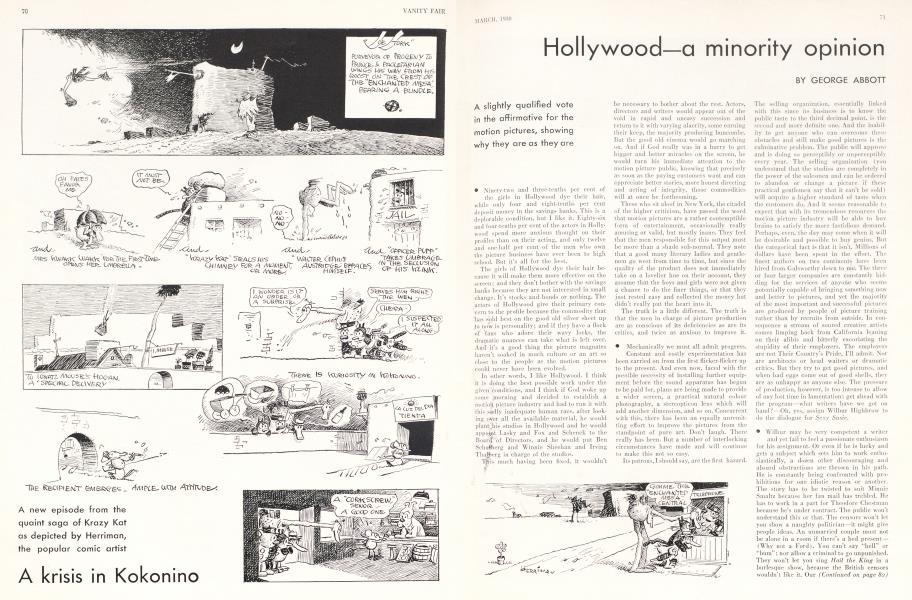
A slightly qualified vote in the affirmative for the motion pictures, showing why they are as they are
• Ninety-two and three-tenths per cent of the girls in Hollywood dye their hair, while only four and eight-tenths per cent deposit money in the savings banks. This is a deplorable condition, but I like it. Eighty-six and four-tenths per cent of the actors in Hollywood spend more anxious thought on their profiles than on their acting, and only twelve and one-half per cent of the men who own the picture business have ever been to high school. But it's all for the best.
The girls of Hollywood dye their hair because it will make them more effective on the screen; and they don't bother with the savings banks because they are not interested in small change. It's stocks and bonds or nothing. The 'actors of Hollywood give their primary concern to the profile because the commodity that 'has sbld best on the good old silver sheet up ;te> now is personality; and if they have a flock of fans who adore their wavy locks, the dramatic nuances can take what is left over. And'it's a good thing the picture magnates haven't soaked in much culture or an art so close to the people as the motion pictures could never have been evolved.
In other words, I like Hollywood. I think it is doing the best possible work under the given Conditions, and I think if God woke up some jnorning and decided to establish a motioft picture industry and had to run it with this s&dly. inadequate human race, after looking otfer all the available material, he would plantTiis studios in Hollywood and he would appoint Lasky and Fox and Schenck to the Boarqrof Directors, and he would put Ben Schierg and Winnie Sheehan and Irving Thalberg in charge of the studios.
This much having been fixed, it wouldn't be necessary to bother about the rest. Actors, directors and writers would appear out of the void in rapid and uneasy succession and return to it with varying alacrity, some earning their keep, the majority producing buncombe. But the good old cinema would go marching on. And if God really was in a hurry to get bigger and better miracles on the screen, he would turn his immediate attention to the motion picture public, knowing that precisely as soon as the paying customers want and can appreciate better stories, more honest directing and acting of integrity, those commodities will at once be forthcoming.
These who sit aloof in New York, the citadel of the higher criticism, have passed the word that motion pictures are a rather contemptible form of entertainment, occasionally really amusing or valid, but mostly inane. They feel that the men responsible for this output must be more than a shade sub-normal. They note that a good many literary ladies and gentlemen go west from time to time, but since the quality of the product does not immediately take on a lovelier hue on their account, they assume that the boys and girls were not given a chance to do the finer things, or that they just rested easy and collected the money but didn't really put the heart into it.
The truth is a little different. The truth is that the men in charge of picture production are as conscious of its deficiencies as are its critics, and twice as anxious to improve it.
• Mechanically we must all admit progress.
Constant and costly experimentation has been carried on from the first flicker-flicker up to the present. And even now, faced with the possible necessity of installing further equipment before the sound apparatus has begun to be paid for, plans are being made to provide a wider screen, a practical natural colour photography, a stereopticon lens which will add another dimension, and so on. Concurrent with this, there has been an equally unremitting effort to improve the pictures from the standpoint of pure art. Don't laugh. There really has been. But a number of interlocking circumstances have made and will continue to make this not so easy.
Its patrons, I should say, are the first hazard. The selling organization, essentially linked with this since its business is to know the public taste to the third decimal point, is the second and more definite one. And the inability to get anyone who can overcome these obstacles and still make good pictures is the culminative problem. The public will approve and is doing so perceptibly or imperceptibly every year. The selling organization (you understand that the studios are completely in the power of the salesmen and can be ordered to abandon or change a picture if these practical gentlemen say that it can't be sold) will acquire a higher standard of taste when the customers do. And it seems reasonable to expect that with its tremendous resources the motion picture industry will be able to buy brains to satisfy the more fastidious demand. Perhaps, even, the day may come when it will be desirable and possible to buy genius. But the categorical fact is that it isn't. Millions of dollars have been spent in the effort. The finest authors on two continents have been hired from Galsworthy down to me. The three or four larger companies are constantly bidding for the services of anyone who seems potentially capable of bringing something new and better to pictures, and yet the majority of the most important and successful pictures are produced by people of picture training rather than by recruits from outside. In consequence a stream of soured creative artists comes limping back from California leaning on their alibis and bitterly excoriating the stupidity of their employers. The employers are not Their Country's Pride, I'll admit. Nor are architects or head waiters or dramatic critics. But they try to get good pictures, and when bad eggs come out of good shells, they are as unhappy as anyone else. The pressure of production, however, is too intense to allow of any lost time in lamentation: get ahead with the program—what writers have we got on hand?—Oh, yes, assign Wilbur Highbrow to do the dialogue for Sexy Susie.
• Wilbur may be very competent a writer and yet fail to feel a passionate enthusiasm for his assignment. Or even if he is lucky and gets a subject which sets him to work enthusiastically, a dozen other discouraging and absurd obstructions are thrown in his path. He is constantly being confronted with prohibitions for one idiotic reason or another. The story has to be twisted to suit Minnie Smaltz because her fan mail has trebled. He has to work in a part for Theodore Chestman because he's under contract. The public won't understand this or that. The censors won't let you show a naughty politician—it might give people ideas. An unmarried couple must not be alone in a room if there's a bed present— (Why not a Ford). You can't say "hell" or "bum"; nor allow a criminal to go unpunished. They won't let you sing Hail the King in a burlesque show, because the British censors wouldn't like it. Our relations with South America make it impossible to have a Mexican villain, et cetera ad nauseam.
Continued on page 82
(Continued from page 71)
And so the picture which Wilbur Highbrow set out to do in such a high fever of idealism gradually crumbles away from under him. He loses his grip. The thing appears to be headed for the rocks. Then the panic sets in. Conferences are held. The powers decide that he must have help, and a corps of pinch hitters is rushed to the •front. A release date has already been made. The picture has been sold the year before. Now it must be produced. The hacks lay on. They know motion pictures from custard pie to dying mother. They ridicule their own product. Their personal taste is high enough, but habit is strong with them, and when faced with the emergency, out comes the stereotyped, the mawkish and the obvious. Then someone adds a scene that he saw in a play in New York last year. The director starts shooting before the script is half done, and the result is just another one of those things.
It looks so absurdly easy to make a picture. You go to the theatre and see some appalling melange and think to yourself that your cousin's aunt could do better on one day's notice. But, like newspaper reporting or pants-pressing, it takes practice. It is a highly technical affair, requiring experience and skill in all its branches and capable of being foozled by bad work in any one of a dozen departments. And when it is further complicated by the necessity of conforming to the arbitrary demands of business expediency, the wonder is not that so many bad pictures are made, but that there are so many good ones.
That Hollywood's point of view will be more fully appreciated in the coming years seems to me to be a foregone certainty. Hundreds of us have gone out there, or are going, and our motive is not only to grab off some easy dough, but to learn a new and perhaps important way of telling a story. To me it seems very important. It seems, indeed, that it is likely to crowd the stage more and more into a certain limited type of production, the plays chiefly concerned with ideas rather than with action, and of course musical comedy. And if that should prove to be so, Hollywood will get what it wants. Thousands will pass through and make a lot of money and lose it in bear markets and poker games. The skies out there are slate instead of blue, the flowers have no scent, it's too cold at night and the lettuce hasn't any taste, but they'll like it.
Subscribers have complete access to the archive.
Sign In Not a Subscriber?Join Now
