Sign In to Your Account
Subscribers have complete access to the archive.
Sign In Not a Subscriber?Join NowThe New Salvation
If We Discover How to Create Our Own Destinies, Will We Know Then How to Be Saved?
ALDOUS HUXLEY
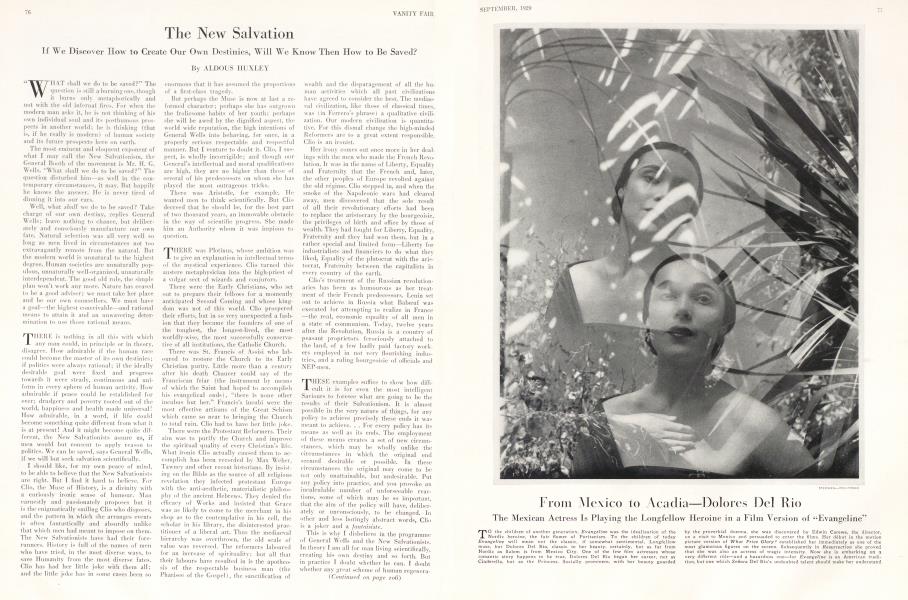
THAT shall we do to be saved?" The question is still a burning one, though it burns only metaphorically and not with the old infernal fires. For when the modern man asks it, he is not thinking of his own individual soul and its posthumous prospects in another world; he is thinking (that is, if he really is modern ) of human society and its future prospects here on earth.
The most eminent and eloquent exponent of what I may call the New Salvationism, the General Booth of the movement is Mr. H. G. Wells. "What shall we do to be saved?" The question disturbed him—as well in the contemporary circumstances, it may. But happily he knows the answer. He is never tired of dinning it into our ears.
Well, what shall we do to be saved? Take charge of our own destiny, replies General Wells; leave nothing to chance, but deliberately and consciously manufacture our own fate. Natural selection was all very well so long as men lived in circumstances not too extravagantly remote from the natural. But the modern world is unnatural to the highest degree. Human societies are unnaturally populous, unnaturally well-organized, unnaturally interdependent. The good old rule, the simple plan won't work any more. Nature has ceased to be a good adviser; we must take her place and be our own counsellors. We must have a goal—the highest conceivable—and rational means to attain it and an unwavering determination to use those rational means.
THERE is nothing in all this with which any man could, in principle or in theory, disagree. How admirable if the human race could become the master of its own destinies; if politics were always rational; if the ideally desirable goal were fixed and progress towards it were steady, continuous and uniform in every sphere of human activity. How admirable if peace could be established for ever; drudgery and poverty rooted out of the world, happiness and health made universal! How admirable, in a word, if life could become something quite different from what it is at present! And it might become quite different, the New Salvationists assure us, if men would but consent to apply reason to politics. We can be saved, says General Wells, if we will but seek salvation scientifically.
I should like, for my own peace of mind, to be able to believe that the New Salvationists are right. But I find it hard to believe. For Clio, the Muse of History, is a divinity with a curiously ironic sense of humour. Man earnestly and passionately proposes but it is the enigmatically smiling Clio who disposes, and the pattern in which she arranges events is often fantastically and absurdly unlike that which men had meant to impose on them. The New Salvationists have had their forerunners. History is full of the names of men who have tried, in the most diverse ways, to save Humanity from the most diverse fates. Clio has had her little joke with them all; and the little joke has in some cases been so enormous that it has assumed the proportions of a first-class tragedy.
But perhaps the Muse is now at last a reformed character; perhaps she has outgrown the frolicsome habits of her youth; perhaps she will be awed by the dignified aspect, the world wide reputation, the high intentions of General Wells into behaving, for once, in a properly serious respectable and respectful manner. But I venture to doubt it. Clio, I suspect, is wholly incorrigible; and though our General's intellectual and moral qualifications are high, they are no higher than those of several of his predecessors on whom she has played the most outrageous tricks.
There was Aristotle, for example. He wanted men to think scientifically. But Clio decreed that he should be, for the best part of two thousand years, an immovable obstacle in the way of scientific progress. She made him an Authority whom it was impious to question.
THERE was Plotinus, whose ambition was to give an explanation in intellectual terms of the mystical experience. Clio turned this austere metaphysician into the bigh-priest of a vulgar sect of wizards and conjurors.
There were the Early Christians, who set out to prepare their fellows for a momently anticipated Second Coming and whose kingdom was not of this world. Clio prospered their efforts, but in so very unexpected a fashion that they became the founders of one of the toughest, the longest-lived, the most worldly-wise, the most successfully conservative of all institutions, the Catholic Church.
There was St. Francis of Assisi who laboured to restore the Church to its Early Christian purity. Little more than a century after his death Chaucer could say of the Franciscan friar (the instrument by means of which the Saint had hoped to accomplish his evangelical ends), "there is none other incubus but her." Francis's incubi were the most effective artisans of the Great Schism which came so near to bringing the Church to total ruin. Clio had to have her little joke.
There were the Protestant Reformers. Their aim was to purify the Church and improve the spiritual quality of every Christian's life. What ironic Clio actually caused them to accomplish has been recorded by Max Weber, Tawney and other recent historians. By insisting on the Bible as the source of all religious revelation they infected protestant Europe with the anti-aesthetic, materialistic philosophy of the ancient Hebrews. They denied the efficacy of Works and insisted that Grace was as likely to come to the merchant in his shop as to the contemplative in his cell, the scholar in his library, the disinterested practitioner of a liberal art. Thus the mediaeval hierarchy was overthrown, the old scale of value was reversed. The reformers laboured for an increase of spirituality; but all that their labours have resulted in is the apotheosis of the respectable business man (the Pharisee of the Gospel), the sanctification of wealth and the disparagement of all the human activities which all past civilizations have agreed to consider the best. The mediaeval civilization, like those of classical times, was (in Ferrero's phrase) a qualitative civilization. Our modern civilization is quantitative. For this dismal change the high-minded Reformers are to a great extent responsible. Clio is an ironist.
Her irony comes out once more in her dealings with the men who made the French Revolution. It was in the name of Liberty, Equality and Fraternity that the French and, later, the other peoples of Europe revolted against the old regime. Clio stepped in, and when the smoke of the Napoleonic wars had cleared away, men discovered that the sole result of all their revolutionary efforts had been to replace the aristocracy by the bourgeoisie, the privileges of birth and office by those of wealth. They had fought for Liberty, Equality, Fraternity and they had won them, but in a rather special and limited form—Liberty for industrialists and financiers to do what they liked, Equality of the plutocrat with the aristocrat, Fraternity between the capitalists in every country of the earth.
Clio's treatment of the Russian revolutionaries has been as humourous as her treatment of their French predecessors. Lenin set out to achieve in Russia what Babœuf was executed for attempting to realize in France —the real, economic equality of all men in a state of communism. Today, twelve years after the Revolution, Russia is a country of peasant proprietors ferociously attached to the land, of a few badly paid factory workers employed in not very flourishing industries, and a ruling bourgeoisie of officials and NEP-men.
THESE examples suffice to show how difficult it is for even the most intelligent Saviours to foresee what are going to be the results of their Salvationism. It is almost possible in the very nature of things, for any policy to achieve precisely these ends it was meant to achieve. . . For every policy has its means as well as its ends. The employment of these, means creates a set of new circumstances, which may be wholly unlike the circumstances in which the original end seemed desirable or possible. In these circumstances the original may come to be not only unattainable, but undesirable. Put any policy into practice, and you provoke an incalculable number of unforseeable reactions, some of which may be so important, that the aim of the policy will have, deliberately or unconsciously, to be changed. In other and less boringly abstract words, Clio is a joker and a fantaisiste.
This is why I disbelieve in the programme of General Wells and the New Salvationists. In theory I am all for man living scientifically, creating his own destiny and so forth. But in practice I doubt whether he can. I doubt whether any great scheme of human regeneration, of large-scale social Salvationism, can be carried through. No human being can possibly foresee all the consequences of an act, much less of a whole series of acts. Every great Salvationist's programme requires the performance of innumerable acts. The reaction of these acts is bound to create new circumstances in which the end and means of the original programme must be modified.
Continued on page 106
(Continued from page 76)
Let us consider a few specific cases. The invention and development of machinery, for example. The benefits which the machine would bestow were foreseen from an early date. They are known to everyone now. The machine increases production and, therefore, prosperity; and it saves labour. Yes; but it also, we have now discovered, saves creation, both in the hours of work and in those of leisure; and, in consequence of this creation-saving, it increases boredom and discontent to such a pitch that we are on the verge of mass-imbecility and violent mass-insanity. The machine makes men richer and more comfortable; but it also makes them less than men. It is one of the means, according to the New Salvationists, by which we are to realize supermanhood; but in the employment of the means, we are becoming sub-men.
The New Salvationists have a positively religious faith in the efficacy of education. In this they resemble those Eighteenth-Century humanitarians to whom we owe the preposterous theory of democracy. According to Helvitius, you can educate any shepherd-boy into a Newton, an Alexander, a Raphael—what you will. We have had universal education for about fifty years, the supply of Newtons, however, has not perceptibly increased. Everybody, it is true, can now read—with the result that newspapers of an unbelievable stupidity and baseness have circulations of millions. Everybody can read—so it pays rich men to print lies wholesale. Everybody can read— so men make fortunes by inventing specious reasons why people should buy things they don't really want. Everybody can read—so the old traditions have died, the local peculiarities which gave a savour to life are being ironed out, and every peasant is as shallow, as half-baked, as vulgar as the journalists who stir together the hog-wash in his daily paper.
One could go on with this list. But it is long enough to show that you can't get anything for nothing. All things have their price and it must be paid. There is no action without re. actions; each step towards a goal is followed by incalculable reverberations—reverberations sometimes so considerable that they actually displace the goal. But the employment of the means, as we have seen, is creating new circumstances, in the light of which the ends originally proposed seem unattainable and the means themselves mischievous. There is not, it seems to me, the slightest prospect of any of the New Salvationists' programmes being realized. But this fact does not increase the real value which these programmes and the ideal, of which they are the expression, possess. For they are really, and only, valuable as instruments of change. In the attempt to realize these ideals, to carry out these programmes, new realities are created. These new realities demand new ideals to correct them, and the new ideals must be given a new set of means for their fulfilment in practice. The employment of the new means creates yet another set of new circumstances, and the cycle is recommenced—again, and again, until either the divine spectator gets bored with the performance, or the human player manages so stupidly and ineptly that he meets with some fatal accident. We seem at the moment to be not so very far removed from the second of these two alternatives.
Subscribers have complete access to the archive.
Sign In Not a Subscriber?Join Now
