Sign In to Your Account
Subscribers have complete access to the archive.
Sign In Not a Subscriber?Join NowArt and the obvious
ALDOUS HUXLEY
A reproach to our modern artists for refusing to give the public what it wants in matters of aesthetics
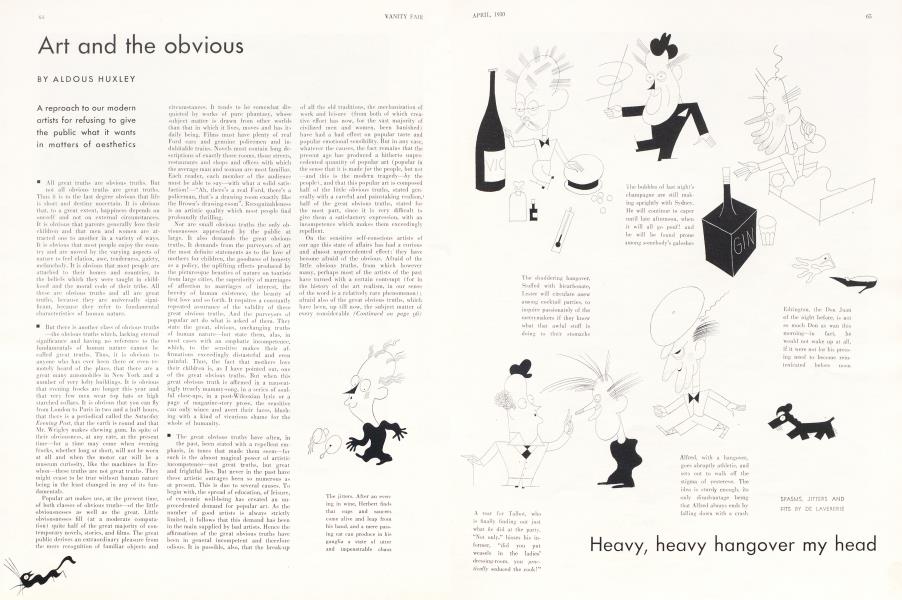
■ All great truths are obvious truths. But not all obvious truths are great truths. Thus it is to the last degree obvious that life is short and destiny uncertain. It is obvious that, to a great extent, happiness depends on oneself and not on external circumstances. It is obvious that parents generally love their children and that men and women are attracted one to another in a variety of ways. It is obvious that most people enjoy the country and are moved by the varying aspects of nature to feel elation, awe, tenderness, gaiety, melancholy. It is obvious that most people are attached to their homes and countries, to the beliefs which they were taught in childhood and the moral code of their tribe. All these are obvious truths and all are great truths, because. they are universally significant, because they refer to fundamental characteristics of human nature.
■ But there is another class of obvious truths
—the obvious truths which, lacking eternal significance and having no reference to the fundamentals of human nature cannot be called great truths. Thus, it is obvious to anyone who has ever been there or even remotely heard of the place, that there are a great many automobiles in New York and a number of very lofty buildings. It is obvious that evening frocks are longer this year and that very few men wear top hats or high starched collars. It is obvious that you can fly from London to Paris in two and a half hours, that there is a periodical called the Saturday Evening Post, that the earth is round and that Mr. Wrigley makes chewing gum. In spite of their obviousness, at any rate, at the present time—for a time may come when evening frocks, whether long or short, will not be worn at all and when the motor car will be a museum curiosity, like the machines in Erewhon—these truths are not great truths. They might cease to be true without human nature being in the least changed in any of its fundamentals.
Popular art makes use, at the present time, of both classes of obvious truths—of the little obviousnesses as well as the great. Little obviousnesses fill (at a moderate computation) quite half of the great majority of contemporary novels, stories, and films. The great public derives an extraordinary pleasure from the mere recognition of familiar objects and circumstances. It tends to be somewhat disquieted by works of pure phantasy, whose subject matter is drawn from other worlds than that in which it lives, moves and has its daily being. Films must have plenty of real Ford cars and genuine policemen and indubitable trains. Novels must contain long descriptions of exactly those rooms, those streets, restaurants and shops and offices with which the average man and woman are most familiar. Each reader, each member of the audience must be able to say—with what a solid satisfaction!—"Ah, there's a real Ford, there's a policeman, that's a drawing room exactly like the Brown's drawing-room". Recognizableness is an artistic quality which most people find profoundly thrilling.
Nor are small obvious truths the only obviousnesses appreciated by the public at large. It also demands the great obvious truths. It demands from the purveyors of art the most definite statements as to the love of mothers for children, the goodness of honesty as a policy, the uplifting effects produced by the picturesque beauties of nature on tourists from large cities, the superiority of marriages of affection to marriages of interest, the brevity of human existence, the beauty of first love and so forth. It requires a constantly repeated assurance of the validity of these great obvious truths. And the purveyors of popular art do what is asked of them. They state the great, obvious, unchanging truths of human nature—but state them, alas, in most cases with an emphatic incompetence, which, to the sensitive makes their affirmations exceedingly distasteful and even painful. Thus, the fact that mothers love their children is, as I have pointed out, one of the great obvious truths. But when this great obvious truth is affirmed in a nauseatingly treacly mammy-song, in a series of soulful close-ups, in a post-Wilcoxian lyric or a page of magazine-story prose, the sensitive can only wince and avert their faces, blushing with a kind of vicarious shame for the whole of humanity.
■ The great obvious truths have often, in the past, been stated with a repellent emphasis, in tones that made them seem—for such is the almost magical power of artistic incompetence—not great truths, but great and frightful lies. But never in the past have these artistic outrages been so numerous as at present. This is due to several causes. To begin with, the spread of education, of leisure, of economic well-being has created an unprecedented demand for popular art. As the number of good artists is always strictly limited, it follows that this demand has been in the main supplied by bad artists. Hence the affirmations of the great obvious truths have been in general incompetent and therefore odious. It is possible, also, that the break-up
of all the old traditions, the mechanization of work and leisure (from both of which creative effort has now, for the vast majority of civilized men and women, been banished) have had a bad effect on popular taste and popular emotional sensibility. But in any case, whatever the causes, the fact remains that the present age has produced a hitherto unprecedented quantity of popular art (popular in the sense that it is made for the people, but not —and this is the modern tragedy—by the people), and that this popular art is composed half of the little obvious truths, stated generally with a careful and painstaking realism, half of the great obvious truths, stated for the most part, since it is very difficult to give them a satisfactory expression, with an incompetence which makes them exceedingly repellent.
On the sensitive self-conscious artists of our age this state of affairs has had a curious and almost unprecedented effect: they have become afraid of the obvious. Afraid of the little obvious truths, from which however many, perhaps most of the artists of the past have turned with a certain contempt (for in the history of the art realism, in our sense of the word is a relatively rare phenomenon); afraid also of the great obvious truths, which have been, up till now, the subject matter of every considerable work of art. We are faced now with an unprecedented situation: the greater number of the more sensitive and accomplished artists of our time have rejected not merely external realism (for which we may be rather thankful), but even what I may call internal realism. They simply refuse to take artistic cognizance of most of the eternal facts of human nature. Disgusted by the excesses of popular art, they are haunted by a terror of the obvious, even of the obvious sublimities and beauties and marvels. Now, about nine tenths of life are made up precisely of the obvious. Which means that the majority of sensitive modern artists are compelled, by their disgust and fear, to confine themselves to the exploitation of only a tiny fraction of existence.
(Continued on page 96)
(Continued from page 64)
The most self-conscious of contemporary artistic centres is Paris and it is, as we should expect, in Paris that this strange new fear of the obvious has borne the most striking fruits. But what is true of Paris is also true of the other artistic capitals of the world. But advanced art in other countries is less deliberate and less thorough-going. In every country, but in France a little more clearly than elsewhere, we see the same fear of the obvious producing the same effects. We see the plastic arts stripped of all their 'literary' cpialities, pictures and statues reduced to their strictly formal elements. We listen to a music from which almost every expression of a tragical, a mournful, a tender sentiment has been excluded—a music that has deliberately confined itself to the expression of physical energy, of motion. Both music and the visual arts are impregnated to a greater or less extent with that now topsy-turvy romanticism which exalts the machine, the crowd, the merely muscular body and despises the soul and solitude and nature. Advanced literature is full of the same romanticism. Its subject matter is arbitrarily simplified by the exclusion of all those great obviousnesses of everlasting human nature which were held in highest esteem by the men of earlier generations. This process is justified theoretically by a kind of philosophy of history which affirms—quite gratuitously and, I am convinced, quite falsely—that human nature has radically changed in the last few years and that the modern man or woman is, or at least ought to be, radically different from his ancestors. Nor is it only in regard to subjectmatter that the writer's fear of the obvious manifests itself. He has a terror of the obvious in his artistic medium—a terror which leads him to make laborious efforts to destroy the gradually perfected instrument of language. Those who are completely and ruthlessly logical parade a total nihilism and would like to see the abolition of all art, all science and all organized society whatsoever. It is extraordinary to what lengths the fear of the obvious can drive its victims.
Almost all that is most daring in contemporary art, is thus seen to be the fruit of terror—the terror, in an age of unprecedented vulgarity, of the obvious. The spectacle of so much fearinspired boldness is one which I find rather depressing. If young artists really desire to offer proof of their courage they should attack the monster of obviousness and try to conquer it, try to reduce it to a state of artistic domestication, not timorously run away from it. For the great obvious truths are there— facts. Those who deny their existence, those who proclaim that human nature has changed since August 4th, 1914, are merely rationalizing their terrors and disgusts. Popular art gives a deplorably beastly expression to the obvious; sensitive men and women hate this beastly expression; therefore, by a natural .but highly unscientific process, they affirm that the things so hatefully expressed do not exist. But they do exist, as any dispassionate survey of the facts makes clear. And since they exist, they should be faced, fought with and reduced to artistic order. By pretending that certain things are not there, which are there, much of the most accomplished modern art is condemning itself to inconydeteness, sterility, premature decrepitude and death.
Subscribers have complete access to the archive.
Sign In Not a Subscriber?Join Now
