Sign In to Your Account
Subscribers have complete access to the archive.
Sign In Not a Subscriber?Join NowA day in the life of "our Dear President"
JEFFERSON CHASE
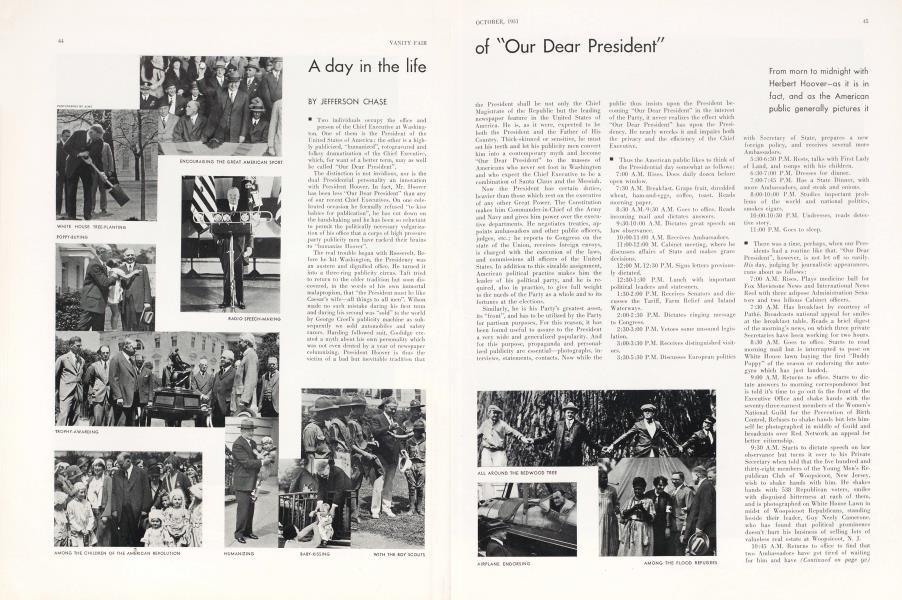
Two individuals occupy the office and person of the Chief Executive at Washington. One of them is the President of the United States of America; the other is a highly publicized, "humanized", rotogravured and folksy dramatization of the Chief Executive, which, for want of a better term, may as well be called "Our Dear President".
The distinction is not invidious, nor is the dual Presidential personality an innovation with President Hoover. In fact, Mr. Hoover has been less "Our Dear President" than any of our recent Chief Executives. On one celebrated occasion he formally refused "to kiss babies for publication", he has cut down on the handshaking and he has been so reluctant to permit the politically necessary vulgarization of his office that a corps of high pressure party publicity men have racked their brains to "humanize Hoover".
The real trouble began with Roosevelt. Before he hit Washington, the Presidency was an austere and dignified office. He turned it into a three-ring publicity circus. Taft tried to return to the older tradition but soon discovered, in the words of his own immortal malapropism, that "the President must be like Caesar's wife—all things to all men". Wilson made no such mistake during his first term and during his second was "sold" to the world by George Creel's publicity machine as subsequently we sold automobiles and safety razors. Harding followed suit. Coolidge created a myth about his own personality which was not even dented by a year of newspaper columnizing. President Hoover is thus the victim of a bad but inevitable tradition that the President shall be not only the Chief Magistrate of the Republic but the leading newspaper feature in the United States of America. He is, as it were, expected to be both the President and the Father of His Country. Thick-skinned or sensitive, be must set his teeth and let his publicity men convert him into a contemporary myth and become "Our Dear President" to the masses of Americans who never set foot in Washington and who expect the Chief Executive to be a combination of Santa Claus and the Messiah.
From morn to midnight with Herbert Hoover—as it is in fact, and as the American public generally pictures it
Now the President has certain duties, heavier than those which rest on the executive of any other Great Power. The Constitution makes him Commander-in-Chief of the Army and Navy and gives him power over the executive departments. He negotiates treaties, appoints ambassadors and other public officers, judges, etc.; he reports to Congress on the state of the Union, receives foreign envoys, is charged with the execution of the laws, and commissions all officers of the United States. In addition to this sizeable assignment, American political practice makes him the leader of his political party, and he is required, also in practice, to give full weight to the needs of the Party as a whole and to its fortunes at the elections.
Similarly, he is his Party's greatest asset, its "front", and has to be utilized by the Party for partisan purposes. For this reason, it has been found useful to assure to the President a very wide and generalized popularity. And for this purpose, propaganda and personalized publicity are essential—photographs, interviews, statements, contacts. Now while the public thus insists upon the President becoming "Our Dear President" in the interest of the Party, it never realizes the effect which "Our Dear President" has upon the Presidency. He nearly wrecks it and impairs both the privacy and the efficiency of the Chief Executive.
■ Thus the American public likes to think of the Presidential day somewhat as follows:
7:00 A.M. Rises. Does daily dozen before open window.
7:30 A.M. Breakfast. Grape fruit, shredded wheat, ham-and-eggs, coffee, toast. Reads morning paper.
8:30 A.M.-9:30 A.M. Goes to office. Reads incoming mail and dictates answers.
9:30-10:00 A.M. Dictates great speech on law observance.
10:00-11:00 A.M. Receives Ambassadors.
11:00-12:00 M. Cabinet meeting, where he discusses affairs of State and makes grave decisions.
12:00 M.-12:30 P.M. Signs letters previously dictated.
12:30-1:30 P.M. Lunch with important political leaders and statesmen.
1:30-2:00 P.M. Receives Senators and discusses the Tariff, Farm Relief and Inland Waterways.
2:00-2:30 P.M. Dictates ringing message to Congress.
2:30-3:00 P.M. Vetoes some unsound legislation.
3:00-3:30 P.M. Receives distinguished visitors.
3:30-5:30 P.M. Discusses European politics with Secretary of State, prepares a new foreign policy, and receives several more Ambassadors.
5:30-6:30 P.M. Rests, talks with First Lady of Land, and romps with his children.
6:30-7:00 P.M. Dresses for dinner.
7:00-7:45 P.M. Has a State Dinner, with more Ambassadors, and steak and onions.
8:00-10:00 P.M. Studies important problems of the world and national politics, smokes cigars.
10:00-10:30 P.M. Undresses, reads detective story.
11:00 P.M. Goes to sleep.
■ There was a time, perhaps, when our Presidents had a routine like that. "Our Dear President", however, is not let off so easily. His day, judging by journalistic appearances, runs about as follows:
7:00 A.M. Rises. Plays medicine ball for Fox Movietone News and International News Reel with three adipose Administration Senators and two bilious Cabinet officers.
7:30 A.M. Has breakfast by courtesy of Pathe. Broadcasts national appeal for smiles at the breakfast table. Reads a brief digest of the morning's news, on which three private Secretaries have been working for two hours.
8:30 A.M. Goes to office. Starts to read morning mail but is interrupted to pose on White House lawn buying the first "Buddy Poppy" of the season or endorsing the autogyro which has just landed.
9:00 A.M. Returns to office. Starts to dictate answers to morning correspondence but is told it's time to go out to the front of the Executive Office and shake hands with the seventy-three earnest members of the Women's National Guild for the Prevention of Birth Control. Refuses to shake hands but lets himself be photographed in middle of Guild and broadcasts over Red Network an appeal for better citizenship.
9:30 A.M. Starts to dictate speech on law observance but turns it over to his Private Secretary when told that the five hundred and thirty-eight members of the Young Men's Republican Club of Woopsicoot, New Jersey, wish to shake hands with him. He shakes hands with 538 Republican voters, smiles with disguised bitterness at each of them, and is photographed on White House Lawn in midst of Woopsicoot Republicans, standing beside their leader, Guy Neely Camerone, who has found that political prominence doesn't hurt his business of selling lots of valueless real estate at Woopsicoot, N. J.
10:45 A.M. Returns to office to find that two Ambassadors have got tired of waiting for him and have gone to see the Secretary of State instead. Is thanking God for all small mercies, when he is suddenly cornered by the Ambassador Extraordinary and Minister Plenipotentiary of Patagonia, who has been instructed to protest bitterly against the new tariff on Patagonian gadgets and who also wants to ask the President's advice on whether General Motors is a good investment. Talks helplessly until 10:57 A.M., when he is rescued by bis Private Secretary in time for
(Continued on page 92)
(Continued from page 45)
11:00 A.M. Cabinet Meeting. Bitter argument between Secretary of War and Secretary of Navy as to which should economize. Secretary of Treasury suggests both should do so. Discussion of whether this summer is as hot as last summer. Instructions issued to investigate and report on water-power projects in time to issue authoritative statement of policy before next Monday morning's papers. Secretary of Interior sneezes and says he has hay fever. Postmaster General wants higher postage rates. Attorney General wants to give Prohibition enforcement back to Treasury. Secretary of Treasury says he has trouble enough as it is. Cabinet meeting breaks up without anybody knowing what, if anything, has been decided.
12:00 M.-12:30 P.M. Starts to sign letters written by Private Secretaries. Is interrupted by Senator Sounder of the rock-bound Republican State of Winnemac who wants to get his nephew George Sounder an appointment in the Internal Revenue Department and who feels apprehensive that the Third Assistant Postmastership at Willow Falls may be decided without his knowledge. President agrees to appoint George Sounder Third Assistant Postmaster at Willow Falls if Senator Sounder will vote to report the Unnatural Gas Utilization Bill out of Committee.
12:30-1:00 P.M. Starts for lunch but is caught by eight busloads of Methodist Sunday School Teachers from Virginia, West Virginia and Maryland, who are holding their Annual Convention and Clambake at the Majestic Hotel, because the hotel's press agent offered them low rates and a chance to meet the President.
1:00-2:00 P.M. Interrupts what is left of luncheon to broadcast greeting to Elks Convention at Pittsburgh. Reads by mistake message prepared for Minneapolis Convention of Advertising Men. No one notices the difference.
2:00 P.M. Returns to office to catch up with morning's work. Is caught up by Chairman of Republican National Committee who is very depressed over the intra-party row in Iowa, the defection of the Bulgarian vote in Rochester, N. Y., and the unrest of the black-and-tan vote in the Border States. Chairman succeeds in depressing the President and thereupon leaves considerably cheered.
2:30 P.M. Starts to sign the commissions of eighteen hundred new Prohibition agents when he is reminded that he promised to present Gold Medal to winner of North American Pie Eating contest.
3:00 P.M. Returns to office and is immediately rushed into a talk with the Secretary of State, who wishes his authorization on three commercial treaties and a new Latin American policy. Starts to agree but is interrupted by three thousand Boy Scouts who have formed a human flag in front of the Washington Monument.
4:00-5:00 P.M. Sits in office and lets himself be talked at for two minutes at a time by seven Congressmen, two American Ambassadors, five Senators, three old friends of the family who would be willing to serve the Government at a suitable salary, and eleven congenital busybodies.
5:00 P.M. Is photographed congratulating aviator who plans trip to North Pole in a glider. Says aviation is a good thing.
5:15 P.M. Answers telephone call from First Lady of the Land, and says, no, that he will not be able to get away as early as he planned and to go ahead without him. Signs twenty letters without reading them.
5:30 P.M. Reads draft of speech on disarmament prepared by State Department. Tells Private Secretary to rewrite it so that ordinary people will understand what it means.
5:45 P.M. Calls up Secretary of Treasury and asks him to hurry up with the next three vetoes. Telephones a couple of Senators and says that a vote to sustain the vetoes will be worth exactly two judgeships, three postmasterships and a couple of commissionerships.
6:00 P.M. Returns to White House and talks with official guests, including three magazine editors, two popular comedians, a couple of aviators, a hoy hero and a political expert. Says it is unusually hot for this time of year. Smokes a cigar.
7:00 P.M. Broadcasts radio greetings to Annual Chicago Convention of Investment Bankers. Says banks are a good thing.
7:15 P.M. Is dressed for dinner.
7:30 P.M. Has dinner with two Ambassadors, five Senators, and a couple of Cabinet members. Puts over new treaty between coffee and cigars. Forgets to tell Secretary of State about it.
9:00 P.M. Yawns and is about to sneak to office when he is reminded that the Inter-City Glee Club is going to serenade the White House at 9:30 and will expect speech. Says something short and ugly about people who sing on lawns after dinner.
9:30 P.M. Listens with patience to Swanee River, Home Sweet Home, The Star Spangled Banner and America. Makes speech in which he says singing is a good thing.
10:00 P.M. Goes to bed and starts new detective story. Has just reached the point where the coroner establishes the fact that the corpse in Lady Alice's boudoir is that of Sir Ronald Lingletree, a notorious man about town, and that Sir Ronald had been stabbed with a hat pin, when the Secretary of State calls him on the telephone and says that there has been another revolution in South America. Throws book out the window, says revolutions are a good thing, and goes to sleep.
Such is a day in the life of "Our Dear President." It helped kill President Harding. President Coolidge got off with only a couple of dislocated wrists. President Hoover grins and bears it.
Subscribers have complete access to the archive.
Sign In Not a Subscriber?Join Now

